

CFD Margin Call: How It Happens, With a Worked Example, and How to Avoid One
Want the daily routine? Get the free 15-Minute Swing Trader’s Checklist. Get it free →
Last updated: 23 September 2026 · By Spencer Li, CFTe
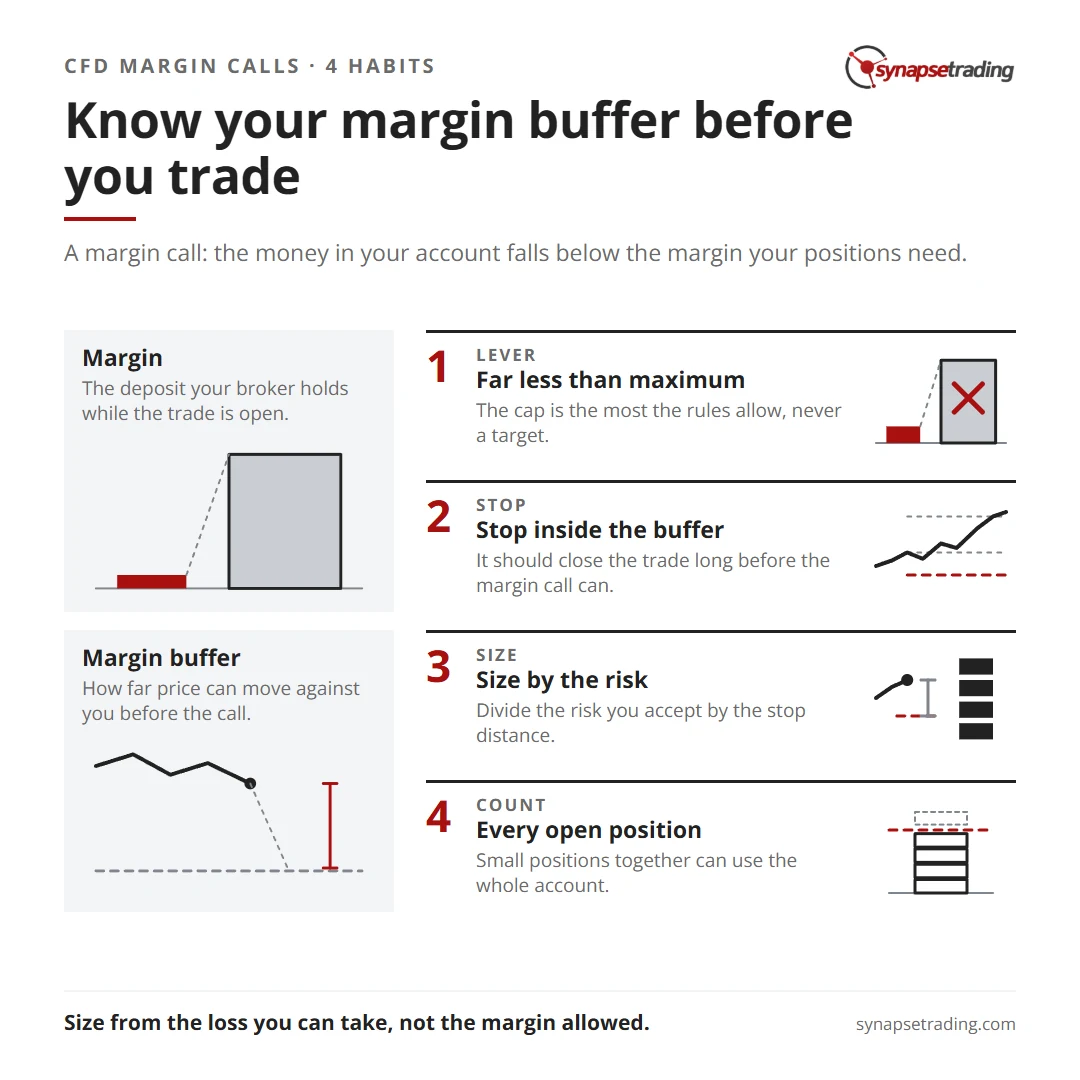
A CFD margin call happens when the money in your account falls below the margin your open positions need. Your broker then asks you to add cash or cut the positions. If you do neither, it starts closing them for you.
The way to avoid one is to know your margin buffer before you place the trade. That is how far the price can move against you before the call comes. With most of your account sitting idle as cash, the buffer is wide. With your account fully used at the maximum leverage, there is no buffer at all, and the first tick against you triggers the call.
What is margin on a CFD?
It is the deposit your broker holds while the trade is open. A CFD lets you trade the price move of a share, index or currency without owning it, and you only put up a fraction of the position’s value, which is called the margin rate.
In Singapore, MAS sets minimum margin rates for CFDs traded by retail investors. The table below is from the Securities and Futures (Financial and Margin Requirements) Regulations, Fourth Schedule, Table 18.
| CFD on | Minimum margin, retail | Maximum leverage that implies |
| Stocks in an index | 10% | 10 to 1 |
| Stocks not in an index | 20% | 5 to 1 |
| A stock index | 5% | 20 to 1 |
| A currency pair | 5% | 20 to 1 |
| Anything else | 20% | 5 to 1 |
For currencies, MAS explained its reasoning when it set the 5% floor: “While capping the leverage does not necessarily prevent losses, it mitigates the risk of retail investors taking on excessive positions and provides a buffer for unexpected losses.” It added that the cap was “in line with practices in other jurisdictions in the region such as Hong Kong (5%) and Japan (4%).”
These rates are for CFDs with no stop-loss attached. The same table lets a broker ask for less on a position that carries one, based on how much you could lose before the stop closes it. Either way, they are floors. Your broker can ask for more, and often does on volatile stocks.
When does a margin call happen?
When your equity falls below the margin your positions require. Equity is your cash plus or minus the open profit or loss on every position, and each day, often each minute, the broker compares that number with the margin it needs.
MAS’s 2014 response on retail derivatives spells out the timing. Dealers “should make margin calls within the day or as soon as practicable” once the account falls short. Then “the additional margins have to be met within two business days from the time the margin call is issued to the customer.” If you cannot pay, the dealer is expected to protect itself, “for example, by accepting only transactions which reduce the customer’s exposure to market risk.”
In practice, brokers also set their own close-out levels in their terms, and they can close positions before the 2 days are up. Read that part of your agreement before you trade, because it decides what happens on a fast day.
What does a margin call look like with real numbers?
Here is a worked example, all hypothetical. You have SGD 10,000 in your account. You open a CFD on a stock that sits in a major index, so the minimum margin is 10%. Here is what happens at 4 different position sizes.
| Position size | Margin held at 10% | Effective leverage | Fall that triggers a margin call | Loss on a 10% fall, % of account |
| SGD 20,000 | SGD 2,000 | 2 to 1 | about 44% | 20% |
| SGD 50,000 | SGD 5,000 | 5 to 1 | about 11% | 50% |
| SGD 80,000 | SGD 8,000 | 8 to 1 | about 2.8% | 80% |
| SGD 100,000 | SGD 10,000 | 10 to 1 | any fall at all | 100% |
The margin rate is the same in every row. The only thing that changes is how much of the account you use, and that alone moves the margin call from a 44% fall to the next tick.
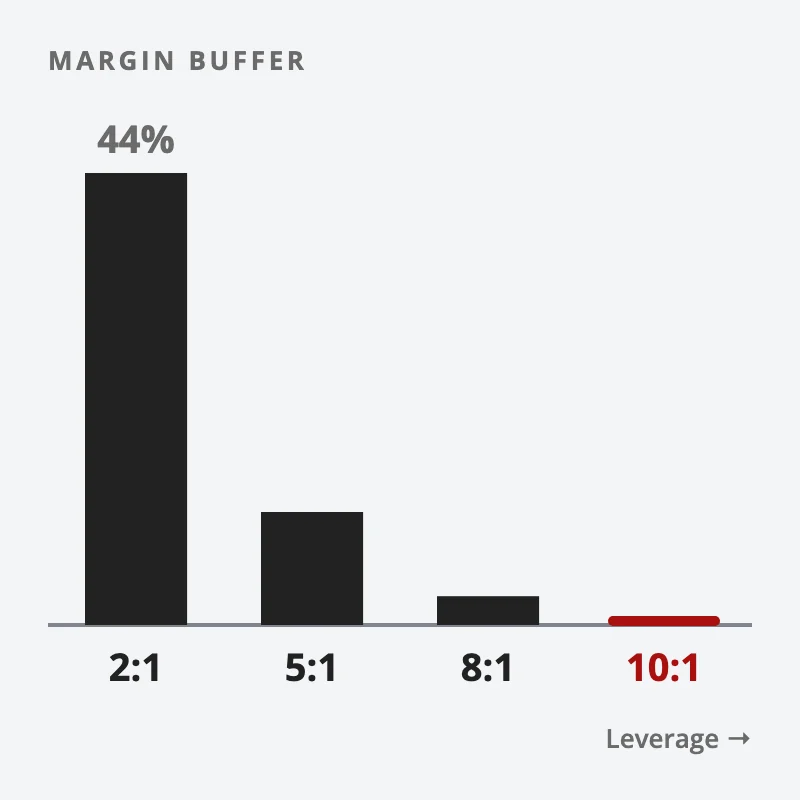
The bottom row is the one to fear. At the maximum leverage MAS allows on an index stock with no stop-loss, a 10% fall wipes out the whole account. A single stock can gap 10% on a results day, and a stop-loss cannot fill until the market trades.
If you want a daily routine that sizes every trade before you place it, the free 15-Minute Swing Trader’s Checklist is at the end of this post.
What is the margin buffer?
It is the distance between your equity and your required margin, measured as a price move. I call it the margin buffer. In the table above, it is the column that says what fall triggers the call.
You can estimate it before every trade. Take the cash you would have left over after the margin, and divide it by the full position size. In the SGD 50,000 row, SGD 5,000 spare on a SGD 50,000 position gives a buffer of about 10%, close to the exact 11%. If that number is smaller than the move the stock makes on a bad day, you are one bad day from a call.
How do you avoid a margin call?
4 habits keep you well clear of one.
- Use far less than the maximum leverage. The cap is the most the rules allow, never a target. Keep your total exposure small enough that the buffer is wider than a normal bad week. How much leverage you should use goes deeper on choosing the number.
- Put the stop well inside the buffer. Your stop-loss should close the trade long before the margin call can. If the stop is 5% away and the buffer is 11%, the stop does the work. Where to place it is in where to put your stop-loss and take-profit.
- Size by the risk you accept. Decide how much of the account you are willing to lose if the stop is hit, say 1%. Divide that by the stop distance to get the position size. The margin the broker asks for is a separate check, and it should never be what sets your size.
- Count every open position. The buffer is shared. 3 positions that each look small can use the whole account together, and a market-wide drop hits them all at once.
What happens if you short a CFD?
The same rules, with one difference. A short CFD loses when the price rises, and a price can rise without limit. So the margin buffer on a short shrinks as the stock rallies, and a sharp squeeze can trigger a call fast. How shorting works, and its extra costs, is in short selling explained.
What really prevents a margin call?
The buffer you leave on purpose. A margin call is never a surprise when you have done the sum first. It only feels like one when the position was sized from the margin the broker allowed in place of the loss you could take. If you can say, before you click, how far the price can move before the call comes, you already know whether the trade is too big.
How CFDs compare with owning the shares outright is in what CFDs are and how they work and the ultimate guide to stocks and CFDs trading.
FAQ
What is a CFD margin call?
A request from your broker to add money or reduce positions, because your account equity has fallen below the margin your open CFDs require. If you do neither, the broker can close positions.
How long do you have to meet a margin call in Singapore?
MAS said in 2014 that additional margin must be met within 2 business days of the call. Brokers can still close positions sooner under their own terms, so check your agreement.
What is the maximum CFD leverage in Singapore?
For retail investors, the minimum margins are 10% on index stocks, 20% on other stocks, and 5% on stock indices and currency pairs. That works out to 10 to 1, 5 to 1 and 20 to 1.
Can you lose more than your deposit on a CFD?
A gap can move the price past your stop before it fills, so a loss can exceed what you planned. How your broker handles a negative balance is set in its own terms.
How do I avoid a margin call on CFDs?
Use much less than the maximum leverage, place your stop well inside the margin buffer, size each trade from the risk you accept, and count all open positions together.
Go deeper
The free 15-Minute Swing Trader’s Checklist has the daily routine, the questions to ask before every trade, and the five rules that keep you in the game.
About the author. Spencer Li is The 15-Minute Trader and the founder of Synapse Trading. He is a Certified Financial Technician (CFTe) with 15+ years of trading, run from 70+ countries. He holds a B.Acc and B.BM from SMU. Every trade he takes is public, dated, losses left in. He teaches rules-based swing trading in 15 minutes a day, one system for any market.
Educational content only, not personalised financial advice. Trading carries risk, including loss of capital. Past performance is not indicative of future results. Synapse Trading is not licensed or regulated by MAS.
Want the daily routine? Enter your email for the free 15-Minute Swing Trader's Checklist.
Free 5-page PDF, then occasional trading emails. Education only, not financial advice. Unsubscribe anytime. Kit stores your email in the US: see our privacy policy.
Want to learn the full method? The Trading Mastery Program teaches the 4 strategies I have traded since 2011. It suits beginners and experienced traders.
Rather follow the trades as they happen? Daily Trading Signals is our Telegram channel: my trade ideas with entry, stop and exit, and every trade is public.
Questions about this post? Ask in the free Telegram channel →
Educational content only, not personalised financial advice. Trading carries risk, including loss of capital. Past performance is not indicative of future results. Synapse Trading is not licensed or regulated by MAS.

