

What Is the Real Risk of Selling Covered Calls?
Want the daily routine? Get the free 15-Minute Swing Trader’s Checklist. Get it free →
On shares you want to keep, the premium hides two risks
Published: 16 October 2026 · Last updated: 16 October 2026 · By Spencer Li, CFTe
“Beginner covered-call writing: I don’t see what’s so risky here.” That was the title of a question on Reddit’s options forum, and it is a fair one. You own 100 shares, you sell someone the right to buy them from you at a higher price, and you collect a premium for it. If the shares never get there, you keep the cash and the shares. So where is the risk?
Here is the short answer. A covered call keeps almost all of the downside of the shares and caps the upside at the strike price. The premium is small next to either. In a crash, you still take the fall, cushioned by a percent or two. And on shares you want to keep for years, you have sold away the sharp rally that would have made your year, for roughly what one month of waiting pays.
Both risks are easy to miss, because a covered call wins in most ordinary months.
Why does a covered call look so safe?
Let me give it its due first.
Compared with owning the shares on their own, a covered call is a little less risky. The premium arrives on day one, and it is yours whatever the stock does next. If the stock drifts sideways for the month, the covered call simply wins. You collected something for holding shares that went nowhere.
That is why it feels like free money. A run of small, steady gains is easy to show, month after month, and the rare bad month is easy to scroll past. Each month looks like a success on its own.
But a strategy that wins most months can still lose you the year. To see how, it helps to put real numbers on one trade.
What happens to a covered call when the stock moves a lot?
Here is a hypothetical example with round numbers. You own 100 shares of a stock at USD 50. You sell one call with a strike of 55, expiring in a month, for USD 0.80 a share. One contract covers 100 shares, so you collect 1.6% of the shares’ value, today.
Now picture three different months.
| Stock price at expiry | Shares alone | Shares plus covered call | What happened |
| USD 52, a quiet month | +4.0% | +5.6% | You keep the shares and the premium |
| USD 65, good news lands | +30.0% | +11.6% | Your shares are called away at 55 |
| USD 40, a bad month | −20.0% | −18.4% | The premium cushions 1.6 points of the fall |
Read the table from the bottom up.
In the bad month, you lose almost as much as someone who did nothing. The premium paid for 1.6 points of a 20-point drop, and that is the whole of the protection.
In the good month, the stock ran to 65 and your shares left at 55. You gave up USD 9.20 a share of gain (65 minus 55, less the 0.80 you were paid) to collect USD 0.80. At 0.80 a month, that is about 11 months of premium, handed over in a single month.
One good month can cost you nearly a year of premiums.
This is what the guide to options trading means when it says a covered call keeps every loss and gives away every big win. Neither half shows up in a calm month, which is exactly when most people try it for the first time.
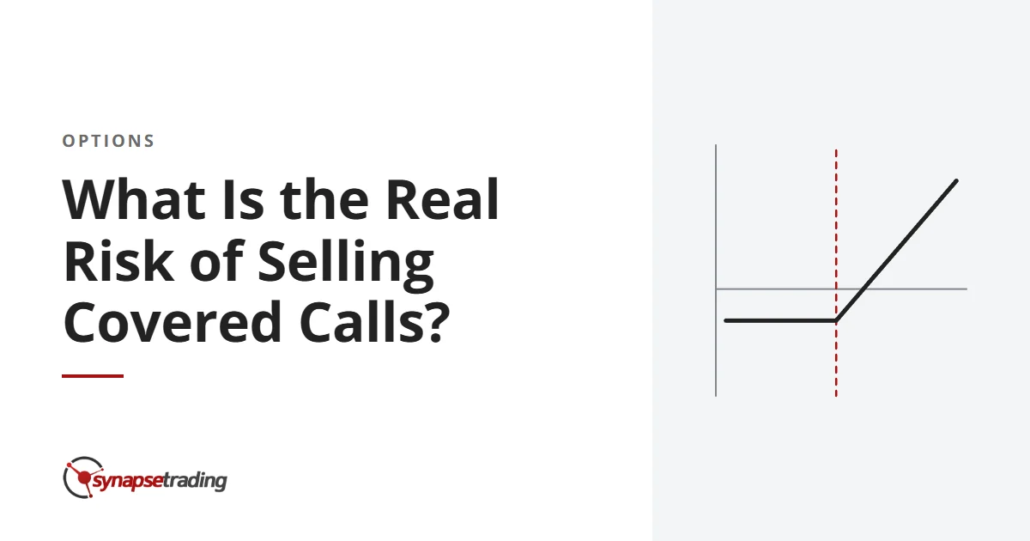
[INFOGRAPHIC: payoff at expiry of 100 shares alone versus shares plus a covered call, with the capped side above 55 shaded and the 1.6-point cushion marked below 50]
What if I want to keep the shares when the call goes in the money?
This is where most of the regret shows up.
Say the stock is at 65 a few days before expiry, and these are shares you planned to hold for a decade. You have two ways to keep them. Both cost money.
The first is to buy back the call. With the stock at 65, the right to buy at 55 is worth at least USD 10 a share, so you pay 10 to close a trade that paid you 0.80. Your shares are still yours, now worth 65. Add it up and you are up 5.80 a share, the same as if they had been called away. The cap does not go anywhere. You just pay it in cash instead of in shares.
The second is to “roll” the call. You buy back the old one and sell a new one further out in time, at a higher strike, usually for a small credit. A roll is two trades: a loss you lock in today, and a fresh promise to sell tomorrow. If the stock keeps climbing, you can roll several times and stack up real losses on the calls while the shares rise on paper, which is how a trade meant to pay a little ends up costing a lot.
People do this because selling a winner they love feels worse than a loss they can hide inside a roll. The fear of missing the next leg up is doing the trading.
Can a covered call be assigned before expiry?
Yes. The usual trigger is a dividend.
US-listed stock options can be exercised on any business day, not only at expiry. The Options Industry Council puts it plainly: “All standardized equity options use American-style exercise.” When someone exercises, the clearing house assigns the notice at random to a broker with sellers on its books, and the broker then picks among its own customers, so you cannot know in advance whether it will be you.
The dividend is what makes early exercise worth it to the buyer. In the Council’s words, “A call holder is entitled to the dividend if the holder exercises the call prior to the ex-dividend date.” So when your call is deep in the money, with little time value left, and an ex-dividend date is close, the buyer has a reason to exercise the day before, and you find out when the shares are gone. They leave at the strike, and the dividend you were counting on leaves with them. What to do when that happens is in what happens when an option is assigned.
The Keep, Cap, Collect test
Before selling a call on shares you hold, write down three numbers.
- Keep. How far could the shares fall in a bad month? That is the risk you keep in full.
- Cap. How far could they rise in a great month? Everything above the strike is what you sell.
- Collect. The premium, as a percentage of the shares.
In the example, Keep was the full 20% fall, Cap began at the strike, 10% above the price, and Collect was 1.6%. When Collect is tiny next to both Keep and Cap, the trade is paying you very little to carry two risks at once.
Then ask one more question. Would you be happy to sell these shares at the strike this month? If yes, the covered call does what it says, and you are being paid to place a sell order you wanted anyway. If no, the Cap is the risk that will hurt, because it lands on exactly the shares you care about most.
Personally, I think that is the honest way to frame a covered call. It is a decision to sell your shares at a set price, and a small payment for making the promise.
If you would rather start with the part we do teach, our free 15-Minute Swing Trader’s Checklist has the daily routine and the questions to ask before any trade. Get the free checklist →
Is a covered call worse than simply owning the shares?
It depends on the month. Nobody gets to pick the month.
Sideways and slowly rising markets favour the covered call. Strong rallies punish it, because that is where the cap bites. Crashes treat both about the same, since a percent or two of premium does little against a 20% fall.
So the covered call does not lower your risk in any way that matters in a bad year. It changes the shape of your returns: more small wins, smaller big wins, and the same big losses. Your position size is still 100 shares, with the full risk of 100 shares. The sizing rules in our money and risk management guide apply in full, premium or no premium.
Covered calls are also one half of the wheel strategy, which runs them in a loop with cash-secured puts, so the same two risks travel with it.
Which shares in your account would you be glad to sell at a higher price this month? And which would you regret selling? A covered call belongs only on the first list.
FAQ
Is selling covered calls risky?
Yes, in a way the premium hides. You keep nearly the full downside of the shares and give up everything above the strike, while the premium is usually a percent or two. In a crash you still take the fall, and in a big rally your shares are sold at the strike.
What is the maximum loss on a covered call?
The maximum loss is the price you paid for the shares minus the premium, if the stock goes to zero. In the example above, that is USD 50 minus 0.80, or USD 49.20 a share.
What happens when a covered call is assigned?
You sell 100 shares per contract at the strike price and keep the premium. If you wanted to keep the shares, you have to buy them back at the market price.
Can I lose the dividend on a covered call?
Yes. If the buyer exercises the call before the ex-dividend date, your shares are gone before the dividend is paid, and the buyer collects it instead of you.
Does Synapse Trading teach covered calls?
No, we do not teach options at the moment. We teach end-of-day swing trading in shares, forex and ETFs, and the chart-reading and sizing carry over to whatever product you use.
Go deeper
This post covers one corner of options. If you would rather start with what we do teach, the free 15-Minute Swing Trader’s Checklist has the daily routine, the questions to ask before every trade, and the five rules that keep you in the game. Enter your email and we’ll send it over:
We use your email address to send you the checklist, then emails about trading and our courses. Unsubscribe in one click, any time. Privacy policy.
About the author. Spencer Li is the founder of Synapse Trading and a Certified Financial Technician (CFTe) with 15 years of trading across stocks, forex, crypto, commodities, and bonds. His trade log is public: every trade since April 2024, dated, losses left in. He teaches low-risk swing trading in 15 minutes a day, one system for any market.
Educational content only, not personalised financial advice. Trading carries risk, including loss of capital. Past performance is not indicative of future results. Synapse Trading is not licensed or regulated by MAS.
Want the daily routine? Enter your email for the free 15-Minute Swing Trader's Checklist.
Free 5-page PDF, then occasional trading emails. Education only, not financial advice. Unsubscribe anytime. Kit stores your email in the US: see our privacy policy.
Want to learn the full method? The Trading Mastery Program teaches the 4 strategies I have traded since 2011. It suits beginners and experienced traders.
Rather follow the trades as they happen? Daily Trading Signals is our Telegram channel: my trade ideas with entry, stop and exit, and every trade is public.
Educational content only, not personalised financial advice. Trading carries risk, including loss of capital. Past performance is not indicative of future results. Synapse Trading is not licensed or regulated by MAS.


Leave a Reply
Want to join the discussion?Feel free to contribute!