

The Wheel Strategy and Cash-Secured Puts: How It Works and Where It Breaks
Want the daily routine? Get the free 15-Minute Swing Trader’s Checklist. Get it free →
Last updated: 16 October 2026 · By Spencer Li, CFTe
The wheel strategy is a loop of 2 option sales on the same stock. First you sell a cash-secured put, which means you set aside enough cash to buy 100 shares at the strike price and collect a premium for promising to do so. If the stock stays above the strike, you keep the premium and sell another put. If the stock falls below it and you are assigned, you buy the 100 shares at the strike. Then you sell covered calls against those shares until they are called away, and the loop starts again.
In a calm or rising market, the wheel collects a steady trickle of small premiums. In a falling market, it holds the full downside of the shares, bought at the old price, and the calls you can sell above your cost pay very little. Call that second state a stuck wheel.
So the honest summary has 3 stages, Put, Own, Call, and one way it breaks, the stuck wheel. Here is each in turn, with the arithmetic shown.
How does a cash-secured put work?
A cash-secured put is the first stage, the Put. Let’s use one hypothetical example with round numbers, and the premiums are made up for illustration only.
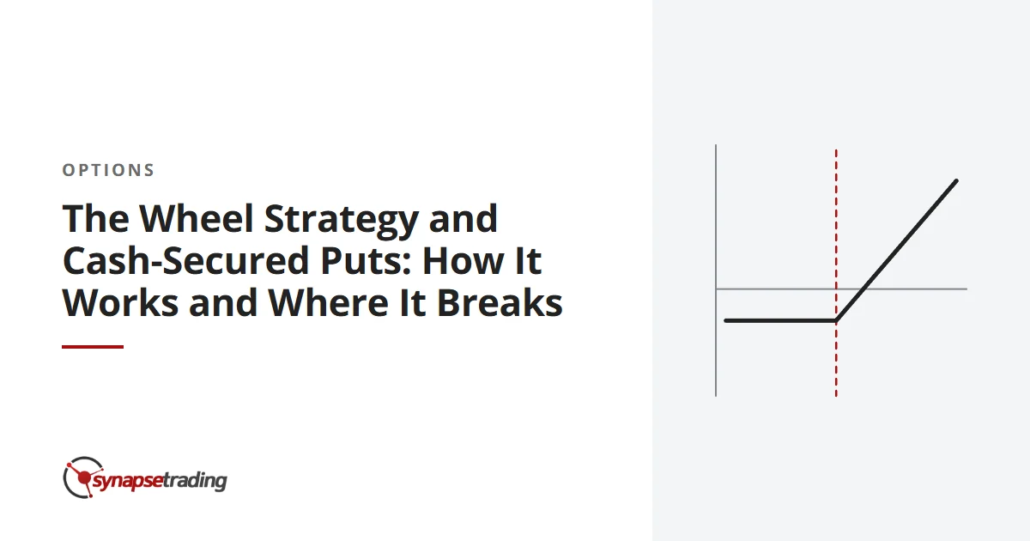
A stock trades at USD 50. You sell the 45 put expiring in a month and collect USD 0.60 a share. Since one contract covers 100 shares, the broker holds 45 times 100 in cash, USD 4,500, so that you can pay for the shares if you have to. The premium is 0.60 on 45, which is about 1.3% of the cash set aside.
Here is how that one month can end:
| Stock price at expiry | What happens | Your result on the cash set aside |
| 52 | the put expires, you keep the premium | +1.3% |
| 46 | the put expires, you keep the premium | +1.3% |
| 44.40 | you are assigned at 45, and the premium brings your cost to 44.40 | about 0% |
| 40 | you are assigned at 45, and the shares are worth 40 | about −9.8% |
| 30 | you are assigned at 45, and the shares are worth 30 | about −32% |
Look at the shape of that table. The top 2 rows can only ever pay 1.3%. The bottom 2 rows have no such limit, and the last one is a stock falling 40% in a month. A single stock can fall sharply on one bad set of results.
That is what the ultimate guide to options trading means when it says you are paid a little to promise to buy a lot.
What happens when you get assigned?
Assignment means the buyer of your put used their right to sell you the shares at the strike. So now you own 100 shares at 45, which is the second stage, the Own.
Do note that it can happen before expiry. US stock options can be exercised early, so a put that is deep in the money can be assigned any day, and the 100 shares appear in the account whether you were ready or not. On the screen it looks a lot calmer than it feels. You promised to buy a stock at 45, the stock is now at 40, and the cash you set aside has become shares that are down on day 1.
Most wheel tutorials say the same thing at this point: only sell puts on stocks you would be happy to own. It sounds sensible. But a post on r/options in August 2026 was titled, in quotes, “‘Stocks I wouldn’t mind getting assigned’ is a myth”, and the reason is easy to feel. A stock that has just fallen 20% is no longer the stock you wanted. It is the same ticker with worse news, and fear has a way of rewriting how much you wanted it.
How do the covered calls work in the third stage?
The third stage is the Call. You own the shares, so you sell a call against them, and the call is “covered” because you can deliver the shares if it is exercised.
If the stock stays near your cost, this part is easy. You sell a call a little above 44.40, collect the premium, and if the stock rises through the strike, your shares are called away at a small gain and you go back to selling puts.
Now take the 40 row from the table. Your cost is 44.40 and the stock is at 40. That leaves you with 2 choices, and neither is pleasant.
- Sell a call above your cost, say the 45 call. It is far above the current price, so it pays very little, perhaps 0.20 in this made-up example, about 0.5% a month. You are waiting for an 11% recovery while collecting a fraction of what you collected before.
- Sell a call near the current price, say the 40 call, for a bigger premium. If the stock rises and the shares are called away at 40, you lock in the loss: 40 plus the call premium is still below 44.40.
This is the stuck wheel. Nothing has gone “wrong” in the mechanics. The strategy did exactly what it promised, which was to buy the stock if it fell, and now the income from it has mostly dried up while the loss on the shares sits there.
If you would rather learn the trades we do teach, the free 15-Minute Swing Trader’s Checklist is at the end of this post.
Why do so many people like the wheel anyway?
Because most months look like the top 2 rows of the table. You sell a put, it expires, you keep the premium, and you do it again. The win rate is high, and every win brings a little relief.
A retail backtest posted on r/options in September 2026 shows how that looks over many trades. Across 3 big US index ETFs from 2020 to 2025, selling cash-secured puts and holding each for 10 trading days won 74.1% of the time, and the worst single trade lost about 20% of the ETF’s value. That is one person’s self-reported test, unchecked, but the shape matches the table above. Frequent small gains, and a rare loss that is many times bigger than any one of them.
Whether that adds up to a steady income over a full cycle, including a bear market, is a separate question. It gets its own post: can selling options pay a steady monthly income?
What does the wheel actually need from you?
Here are the 3 stages side by side, with what each one asks of you.
| Stage | What you do | What you collect | What you carry |
| Put | sell a cash-secured put, holding 100 times the strike in cash | a small premium | the obligation to buy 100 shares at the strike, however far the stock falls |
| Own | take delivery of 100 shares if assigned | nothing | the full downside of the shares |
| Call | sell covered calls against the shares | a premium that shrinks as the stock falls below your cost | the shares, plus a cap on the upside |
Three things follow from that table.
- Capital per contract is large. On a USD 50 stock with a 45 strike, one contract ties up USD 4,500. A small account can only wheel 1 or 2 stocks, which means the whole account rides on 1 or 2 companies.
- The position size is the 100 shares. It is tempting to size the trade by the premium collected, because that is the number you see. The risk is the 100 shares, so they need to fit inside your position sizing the way any stock purchase does. The 2% money management rule for position sizing is a good place to start.
- You need a plan for the stuck wheel before it happens. Either a price at which you sell the shares and take the loss, or a clear acceptance that you will hold them as an investment for years. Deciding that while the stock is falling is much harder.
And if the mechanics of puts and calls are still new, how call and put options make or lose money is the place to start, with a worked example of each.
Personally, I think the wheel is best understood as what it is, which is a slow, patient way of buying a stock at a lower price, with a small fee paid to you for the wait. Framed that way, the stuck wheel stops being a surprise. It is the strategy doing its job on a stock that kept falling after you bought it.
FAQ
What is the wheel strategy in options?
The wheel is a loop of selling cash-secured puts until you are assigned 100 shares, then selling covered calls on those shares until they are called away, then starting again. It collects premiums in calm markets and carries the full downside of the shares in a falling one.
What is a cash-secured put?
A cash-secured put is a sold put where you hold enough cash to buy 100 shares at the strike price. You collect a premium, and if the stock falls below the strike you may have to buy the shares at that price.
What happens if my cash-secured put is assigned?
You buy 100 shares per contract at the strike price, using the cash you set aside. US stock options can be assigned before expiry, so it can happen on any day the put is in the money.
What is a stuck wheel?
A stuck wheel is when you own the shares at a cost well above the current price, so any call above your cost pays very little. Your choice is between waiting for a recovery and locking in a loss.
How much money do I need for the wheel strategy?
For each contract, 100 times the strike price in cash, so a 45 strike needs USD 4,500. That size usually limits a small account to 1 or 2 stocks.
Does Synapse Trading teach the wheel strategy?
No, we do not teach options at the moment. We teach end-of-day swing trading in shares, forex and ETFs, and this post exists because the wheel is one of the most asked-about strategies we see.
Go deeper
The wheel is, underneath, a way of buying a stock and managing it once you own it, which is the swing trader’s job too. The free 15-Minute Swing Trader’s Checklist has the daily routine, the questions to ask before every trade, and the five rules that keep you in the game. Enter your email and we’ll send it over:
We use your email address to send you the checklist, then emails about trading and our courses. Unsubscribe in one click, any time. Privacy policy.
About the author. Spencer Li is the founder of Synapse Trading and a Certified Financial Technician (CFTe) with 15 years of trading across stocks, forex, crypto, commodities, and bonds. His trade log is public: every trade since April 2024, dated, losses left in. He teaches low-risk swing trading in 15 minutes a day, one system for any market.
Educational content only, not personalised financial advice. Trading carries risk, including loss of capital, and isn’t suitable for everyone. Past performance is not indicative of future results. Synapse Trading is not licensed or regulated by MAS.
Want the daily routine? Enter your email for the free 15-Minute Swing Trader's Checklist.
Free 5-page PDF, then occasional trading emails. Education only, not financial advice. Unsubscribe anytime. Kit stores your email in the US: see our privacy policy.
Want to learn the full method? The Trading Mastery Program teaches the 4 strategies I have traded since 2011. It suits beginners and experienced traders.
Rather follow the trades as they happen? Daily Trading Signals is our Telegram channel: my trade ideas with entry, stop and exit, and every trade is public.
Educational content only, not personalised financial advice. Trading carries risk, including loss of capital. Past performance is not indicative of future results. Synapse Trading is not licensed or regulated by MAS.


Leave a Reply
Want to join the discussion?Feel free to contribute!