

AI Won’t Make You a Profitable Trader: The Five Edges It Can’t Trade for You
Want the daily routine? Get the free 15-Minute Swing Trader’s Checklist. Get it free →
Why AI makes traders faster, and the five edges it cannot trade for you
Published: 24 November 2026 · By Spencer Li, CFTe
AI will not make you a profitable trader. It will make you a faster one. Those are two different things, and the gap between them is where a lot of accounts are about to die.
Everyone has the story backwards right now. The pitch is that AI levels the playing field. It reads the charts, spots the setups, and even places the trades. So the human who used to charge you for analysis is finished, and you can do this yourself for US$20 (about S$26) a month.
The analysis part is true, but the conclusion people are drawing from it is exactly wrong.
Here’s why. Information was the easy part.
I spent more than 15 years and 1,500 books building an edge in information. Today a chatbot has read more than I ever will, and it answers in 4 seconds. If information were the thing that made traders money, every retail trader with ChatGPT would be rich by now. They aren’t. What the early studies do show is that generic AI, used alone, makes retail traders more confident and makes them trade more. Nobody has shown it makes them any richer.
The bottleneck was never the chart. It was the gap between the chart and your own behaviour. AI just made that gap more dangerous, because it removed the one thing that used to slow you down, which was the dull and slightly painful effort of doing the analysis yourself before you clicked buy.
You already know this, even if you haven’t said it out loud. You have the tools. Maybe you even let the AI pick a few trades. If you still lost, you assumed the problem was your analysis. It wasn’t.
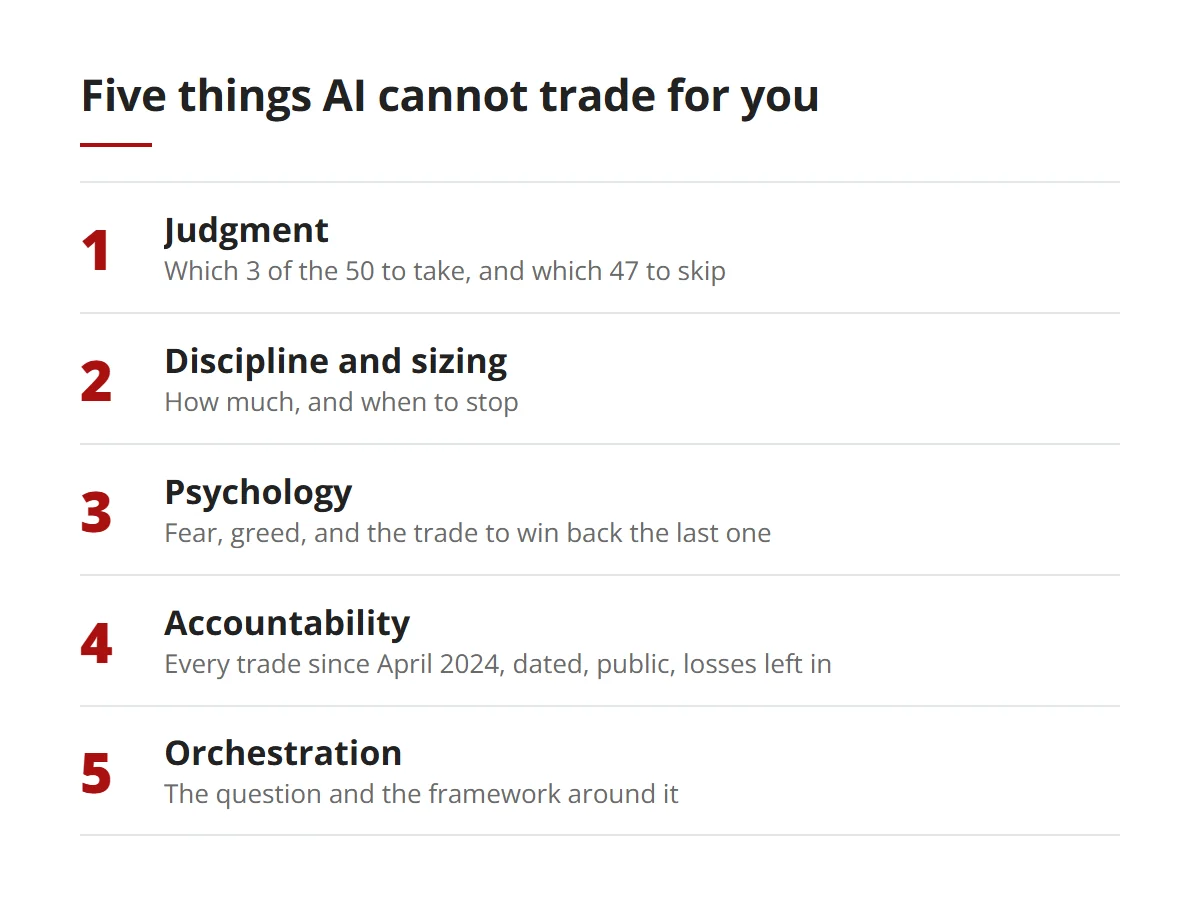
There are five things AI cannot trade for you. I call them the Five Edges, and together they decide whether you keep your account.
One. Judgment
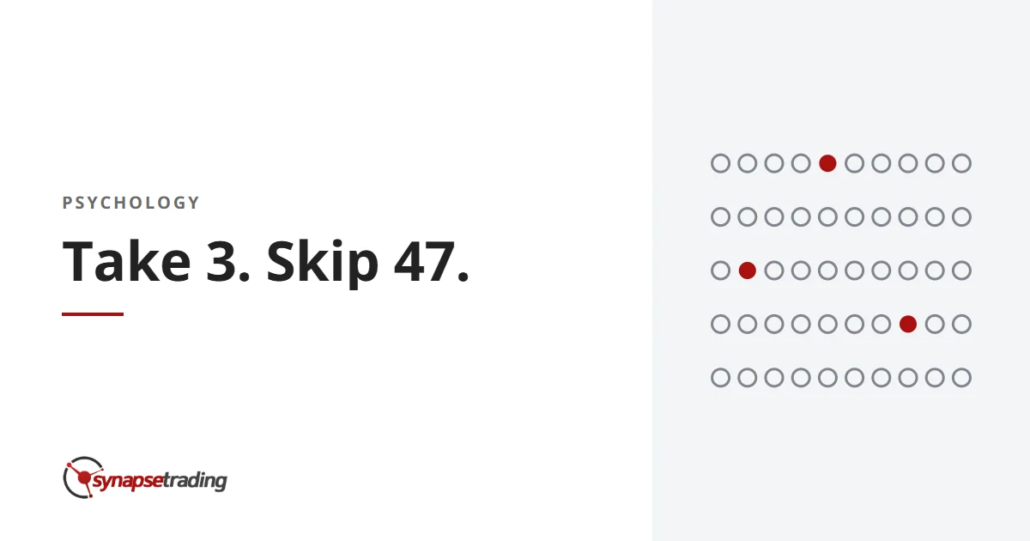
AI gives you 50 setups a day. Some are good. Some are confidently wrong, which is worse than being unsure. The skill was never finding setups. It is knowing which 3 of the 50 to take, and which 47 to skip. I checked 40 setups last week. I took 2. The other 38 were the lesson. AI multiplies your options. It does not supply the judgment to choose between them.
Two. Discipline and sizing
The AI will happily tell you what to buy. How much, and when to stop? No chatbot you can buy in Singapore is allowed to tell you that, and the ones that try were not built for you. Nor will it pull you off the cliff at 2am when you are about to revenge-trade your rent money. Position sizing is boring. It is also the entire difference between a drawdown and a blown account.
Three. Psychology
Most retail traders don’t lose from bad analysis. They lose from no stop, oversizing, fear, greed, and the trade they took to win back the last one. Generic AI, used alone, adds three things to that list: more confidence, more trades and more lottery-ticket bets, every one of them an accelerant on a fire that was already burning. Now, in fairness, a tool built for the job can help. One study found a robo-adviser made its users less likely to sell winners too soon, ride losers or chase trends (D’Acunto, Prabhala and Rossi, 2019). That tool was designed to hold people back, and the chatbot on your phone was designed to answer them.
And before you hear “psychology” as a character lecture, stress under drawdown is measurable biology. It shows up in your heart-rate variability, and it can be trained. The traders who last treat it the way athletes treat recovery. AI cannot sit in your nervous system.
Four. Accountability
I have published every trade since April 2024, dated, public, losses left in. I lean on that record because it is the one thing on this page nobody can copy: not a competitor, not a model. You cannot backdate a track record. And the record is only half of it. The other half is being forced to change, to update how you trade the moment the market proves you wrong, or pay for it in real money. No model does that, and no influencer with nothing on the line ever has to. The market grades you, and you either revise or you go broke.
Now run the same test on the AI. Who do you call when the AI-driven position is down 30 percent? No skin in the game. No money on the line. Nothing published. It will be just as confident tomorrow, and it will not remember today.
Five. Orchestration
AI output is only as good as the question and the framework around it. Most people lack the operating system. They have the tool and no idea what to ask it.
Why this lasts
And if that sounds like opinion, here’s the mechanism. Every retail system that gets published dies the same way: enough people trade it, bigger players learn to trade against it, and the edge stops existing. The system didn’t fail because it was wrong. It failed because it was shared. Economists have a name for the general case. Andrew Lo, a finance professor at MIT, calls it the Adaptive Markets Hypothesis: markets are evolutionary, so every edge decays as the crowd adapts to it. No conspiracy required. Just competition.
AI is a superb research tool, the best one a retail trader has ever had. I use it most days for scanning and backtesting, at a speed no human matches. Use it for all of that. But the research was never what blew up your account. The problem is still what you do with its output.
Where I have landed
So here is where I have landed, and it is a change.
I used to sell a system. I can’t really sell that anymore, and I am not going to pretend otherwise. The analysis is half-commoditised. Your AI can draft a system. What I actually do now, the thing worth paying for, is the human layer around your AI. Judgment. Sizing. Psychology. Accountability. Orchestration. The trusted human in your AI-assisted trading.
Let me undercut myself before you do. This isn’t me defending my job from the robots. If a model could hand people discipline, I would shut the courses down and go play chess and tennis full time, happily. It can’t. Discipline was never an information problem, and information is the only thing AI solved. The hard part is exactly as hard as it was 20 years ago. It just feels easier now, and that feeling is what empties accounts.
The traders who make it through the next few years will not be the ones with the best AI. Everyone will have the same good-enough AI. They will be the ones who can sit still when the model is wrong, cut a position when it is losing, and size it so one bad call does not end them.
Because no matter how good the models get, AI automates anything that holds still, a fixed problem, with fixed rules, that does not fight back. That is exactly why it will drive your car and read your X-rays. Markets don’t hold still. The moment an edge is known, the crowd arbitrages it away and the game rewrites itself to beat you. The not-holding-still is the entire job, and it’s the one thing you can’t download.
AI can find a good trade. The harder thing is adapting when the game changes. That is still you, or it is nobody.
Every elite team already has the same analytics. They still pay a coach, because no model reads the opponent, makes the call at 2-1 down, or stands in the room when it’s slipping away. Your AI is the analytics. The only question left is who’s coaching you.
About the author. Spencer Li is The 15-Minute Trader and the founder of Synapse Trading. He is a Certified Financial Technician (CFTe) with 15+ years of trading, run from 70+ countries. He holds a B.Acc and B.BM from SMU. Every trade he takes is public, dated, losses left in. He teaches rules-based swing trading in 15 minutes a day, one system for any market.
Educational content only, not personalised financial advice. Trading carries risk, including loss of capital. Past performance is not indicative of future results. Synapse Trading is not licensed or regulated by MAS.
Want the daily routine? Enter your email for the free 15-Minute Swing Trader's Checklist.
Free 5-page PDF, then occasional trading emails. Education only, not financial advice. Unsubscribe anytime. Kit stores your email in the US: see our privacy policy.
Want to learn the full method? The Trading Mastery Program teaches the 4 strategies I have traded since 2011. It suits beginners and experienced traders.
Rather follow the trades as they happen? Daily Trading Signals is our Telegram channel: my trade ideas with entry, stop and exit, and every trade is public.
Questions about this post? Ask in the free Telegram channel →
Educational content only, not personalised financial advice. Trading carries risk, including loss of capital. Past performance is not indicative of future results. Synapse Trading is not licensed or regulated by MAS.
