

Trading for a Living by Alexander Elder: A Summary, and the Lessons I Still Trade With
Want the daily routine? Get the free 15-Minute Swing Trader’s Checklist. Get it free →
By Spencer Li, CFTe · Last updated: 1 October 2026
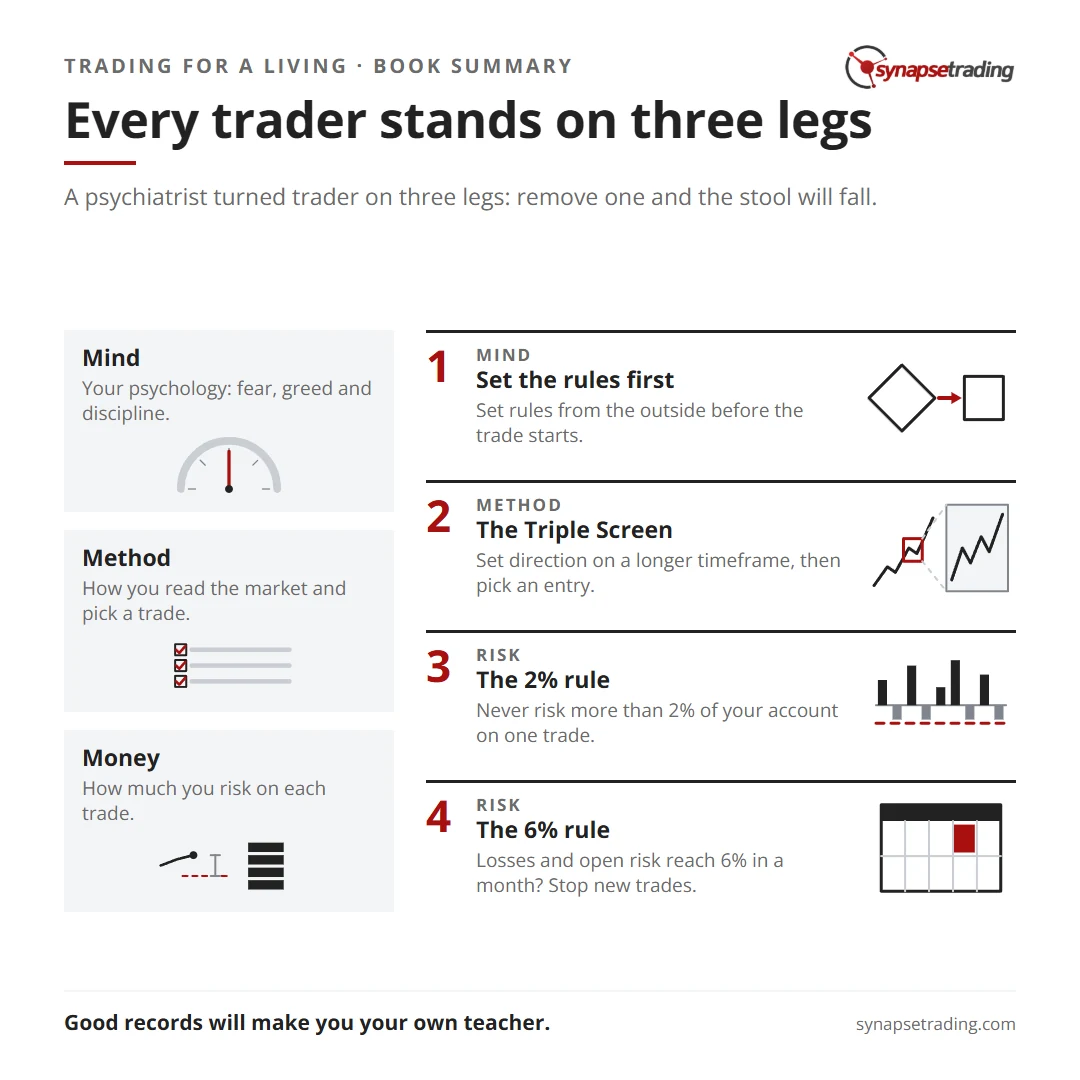
Trading for a Living is a 1993 trading book by Dr. Alexander Elder, a psychiatrist who became a full-time trader, and its main argument is that every trader stands on three legs: Mind, Method and Money. Mind is your psychology, Method is how you read the market and pick a trade, and Money is how much you risk on each one. Elder puts it plainly: “remove one and the stool will fall.”
The book is also where many traders first meet the Triple Screen trading system, which checks three timeframes before any trade, and the 2% and 6% risk rules. In 2014 Elder rewrote the whole thing as The New Trading for a Living. He kept the psychology almost untouched, rewrote the money chapters, and added record-keeping as a fourth factor that ties the other three together.
I first read it as a student at SMU, around 2008, while working through the classic trading books. Two of its rules still sit in my own trading plan today, which is a fair compliment for a book that is now over 30 years old.

Who is Dr. Alexander Elder?
At 23, Alexander Elder was working as a doctor on a Soviet ship. In Africa, he jumped ship, and he later received political asylum in the United States.
That is quite an unusual start for a trading author. According to the author note from his publisher, Wiley, he was born in Leningrad and grew up in Estonia, where he entered medical school at 16. In America he worked as a psychiatrist in New York City and taught at Columbia University. He founded his trading school, now elder.com, in 1988, and Trading for a Living came out 5 years later and became an international bestseller.
So why should a trader care about any of this? Because the background explains the book. Plenty of trading authors are chart people who come to psychology late, after a few painful years. Elder was a psychiatrist first, so he came to the market already knowing how people behave under stress, and one line from the book sums up his view quite well: “Most failures in life are due to self-sabotage.”
What is Trading for a Living about?
Early on, Elder lays out an uncomfortable fact. Trading is a minus-sum game, because commissions and slippage drain money out of the pool on every single trade, so the average trader does worse than break-even before skill even enters the picture.
From there the book follows his three legs, starting with the psychology of the trader and the crowd, moving on to the indicators and trading systems, and ending with money management. The quotes below come from the 2014 edition, where Elder says the psychology barely changed.
Personally, I think the structure is the real value. A lot of trading books are a pile of tactics with no skeleton, and you finish them knowing 40 indicators and no idea which one to use. This one gives you the skeleton first, so even the chapters that have aged badly still have a place to go.
What are the 3 M’s of trading?
Imagine a stool with three legs. It works fine on three, it wobbles on two, and on one it is basically firewood.
That is Elder’s picture of a trader, and the 3 M’s are the three legs.
| The M | What it covers | What goes wrong without it |
|---|---|---|
| Mind | Your psychology: fear, greed, discipline and how you handle a losing streak | You break your own rules the moment a trade turns against you |
| Method | How you read the market and decide on an entry, a target and a stop | Every trade is a fresh guess, so there is nothing to review or improve |
| Money | How much of your account you risk on each trade, and in total | One oversized loss wipes out months of good trades |
The three depend on each other. A trader with a brilliant method and no risk control will eventually blow up the account. A trader with perfect risk control and no method will simply bleed slowly, which is a gentler way of reaching the same place.
Elder admits his own breakthrough came late, when he “realized that the key to winning was inside my head and not inside a computer.” Coming from a man who invented several indicators, that is quite a confession.
I teach the same three ideas at Synapse under slightly different names, Method, Money management and Mindset, and my own trading plan is built around them. If you trade around a full-time job, the free 15-minute swing trader checklist is the daily routine I use myself.
Why does a psychiatrist think most traders lose?
Elder’s most memorable idea comes from his medical work. He compares a losing trader to an alcoholic, and he means it quite literally: “loss is to a loser what alcohol is to an alcoholic.”
Both problems feed on themselves. A trader feels the sting of a loss, takes a bigger trade to win it back, loses again, and the fear and regret keep piling up until the next decision is made by the feelings rather than the plan. Elder’s cure borrows from Alcoholics Anonymous. You admit that you cannot trust yourself in the heat of the moment, you set the rules from the outside before the trade starts, and you take it one day at a time.
He also treats the market as a crowd, with price as the leader of that crowd at any given moment. On the hard right edge of the chart, where the next bar has not printed yet, nobody knows what comes next, and “trying to be right is an unaffordable luxury.”
That line hit me harder than I expected. When I wrote down my own weaknesses as a trader, one of them was a perfectionist desire to be right, which in practice meant tweaking my systems endlessly instead of trading them. Elder’s answer is that a good trader’s goal is to trade well, and the money is a by-product. It sounds like a fortune cookie, right up until you notice how much of your stress comes from wanting each trade to prove you right.
How does the Triple Screen trading system work?
Why does a setup that looks perfect on the daily chart so often fail? Elder’s answer, first published in Futures magazine in April 1986, is that you looked at the wrong chart first. So the Triple Screen puts every trade through three tests, in a fixed order.
- The first screen is the market tide. Start on a timeframe about 5 times longer than the one you trade, so a daily trader starts on the weekly chart, and decide from that chart alone whether you are a bull or a bear.
- The second screen is the market wave. Go back to the daily chart and use an oscillator to find moves against the tide. In a weekly uptrend, a daily dip is a chance to buy, and the oscillator’s sell signals are ignored.
- The third screen is the entry. Pick a precise way to get in, then place the stop off the daily chart and the target off the weekly.
Elder later added the Impulse system, which colours each bar green, red or blue. He first traded it as a buy-and-sell system, it got chopped up in sideways markets, and he concluded that it “told me what not to do.” The long-term screen does the same job. It forbids a buy when the tide is falling and a short when it is rising, and it never tells you to trade.
Personally, I use it the same way. My trading plan keeps Elder’s long-term screen purely as a censor, and the entries come from my own setups.
What are Elder’s 2% and 6% rules?
Elder names his two risk rules after two kinds of fish. The 2% rule protects you from the shark, the single bite that takes off a leg. The 6% rule protects you from piranhas, the many small bites that strip you to the bone before you notice.
The 2% rule says you never risk more than 2% of your trading account on one trade. It caps the risk. The size of the position follows from where your stop sits. Say your stop is 5% below your entry.
2% risk ÷ 5% stop distance = a position worth 40% of your account
Move the stop to 10% away and the same rule allows only 20%. The position shrinks as the stop widens, and the most you can lose stays at 2% either way.
The strictness comes from simple arithmetic, since losses do not recover evenly. Lose 25% on one trade and you need a gain of about 33% just to get back to where you started. Elder adds that a trader who survives a bite that size often loses the nerve to pull the trigger.
The 6% rule works across a whole month. Once your closed losses plus the open risk on your current trades add up to 6% of the account you started the month with, you stop opening new trades until the month is over. It changes the question from “do I have enough money for this trade?” to “do I have enough risk left?”
My own plan keeps the 6% monthly rule as Elder wrote it. On the 2% rule I am more cautious, and most of my trades risk well under Elder’s ceiling. The free 15-minute swing trader checklist is the daily routine I run alongside it.
Is Trading for a Living good for beginners?
In March 2024, a trader on Reddit’s r/Daytrading listed four books, Elder’s rewrite among them, and asked a fair question. “I am an absolute beginner and wondering which of these I should read first.”
My honest answer is yes, with one warning. The psychology and risk chapters cover exactly the ground most beginners skip. The indicator chapters are another story, and a beginner can easily come away thinking that trading means stacking MACD, RSI and Stochastic until they all agree.
Elder seems to agree, at least partly. When he rewrote the book in 2014, he cut the number of technical chapters and moved some of them into a download, on the view that less is often more.
So personally, I would read it out of order. Start with the psychology, then go straight to the 2% and 6% rules, and read the indicator chapters last, with a pencil, picking 1 or 2 tools at most. Then start keeping records, which is the fourth pillar of the 2014 edition. Elder says good records “will make you your own teacher,” and of everything in the book, that is the habit I would least want to give up.
FAQ
What are the 3 M’s of trading?
Mind, Method and Money: your psychology, how you pick trades, and how much you risk. Alexander Elder’s point is that a weakness in any one can sink the other two.
When was Trading for a Living published?
The original came out in 1993. Elder rewrote it in 2014 as The New Trading for a Living, which adds record-keeping as a fourth factor.
What is the Triple Screen trading system?
It puts each trade through three tests. You set your direction on a longer timeframe, look for a move against it on your trading timeframe, then pick a precise entry.
What is the 2% rule in trading?
You never risk more than 2% of your trading account on one trade. The position size follows from the stop distance, so a stop 5% away allows a position worth 40% of the account.
What is Elder’s 6% rule?
Once your closed losses for the month plus the open risk on current trades reach 6% of the account you started the month with, you stop opening new trades until the next month.
Is Trading for a Living still worth reading?
Yes, mainly for the psychology and the risk rules, which have aged well. The indicator chapters are dense for a beginner, and Elder himself trimmed them in the 2014 rewrite.
Have you read Trading for a Living, and which of the three legs is the one that wobbles for you? Let me know in the comments.
My full reading list is in Best Investing and Trading Books of All Time, and more of Elder’s lines are in Best Trading Tips and Quotes from Alexander Elder. For the Mind leg, read my Complete Guide to Trading Psychology. For the Method leg, start with my guide to building a trading plan, and the rest is in my free trading guides.

If you would like to find more book summaries and recommendations, also check out: “Best Investing & Trading Books of All Time”
And if you want a trading routine that fits into 15 minutes a day, grab the free 15-minute swing trader checklist.
About the author. Spencer Li is The 15-Minute Trader and the founder of Synapse Trading. He is a Certified Financial Technician (CFTe) with 15+ years of trading, run from 70+ countries. He holds a B.Acc and B.BM from SMU. Every trade he takes is public, dated, losses left in. He teaches rules-based swing trading in 15 minutes a day, one system for any market.
Education, not financial advice. Synapse Trading is not licensed by MAS to advise on investment products. Trading carries risk of loss, and past performance is not indicative of future results.
Want the daily routine? Enter your email for the free 15-Minute Swing Trader's Checklist.
Free 5-page PDF, then occasional trading emails. Education only, not financial advice. Unsubscribe anytime. Kit stores your email in the US: see our privacy policy.
Want to learn the full method? The Trading Mastery Program teaches the 4 strategies I have traded since 2011. It suits beginners and experienced traders.
Rather follow the trades as they happen? Daily Trading Signals is our Telegram channel: my trade ideas with entry, stop and exit, and every trade is public.
Questions about this post? Ask in the free Telegram channel →
Educational content only, not personalised financial advice. Trading carries risk, including loss of capital. Past performance is not indicative of future results. Synapse Trading is not licensed or regulated by MAS.

