

How to Create a Trading Journal That Shows Why You Keep Repeating Mistakes
Want the daily routine? Get the free 15-Minute Swing Trader’s Checklist. Get it free →
By Spencer Li, CFTe · Last updated: 26 October 2026
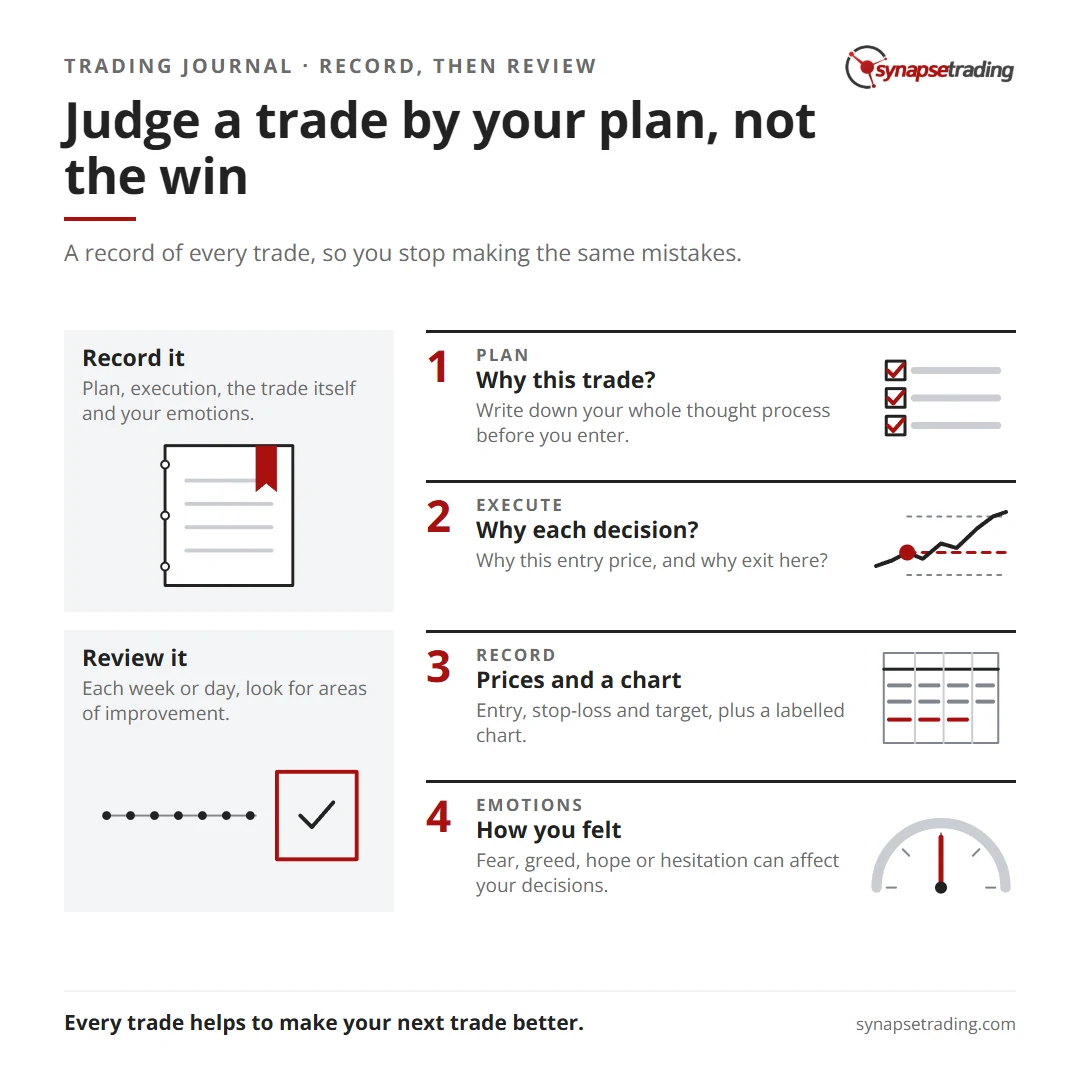
A trading journal is a record of every trade you take, written so you can look back at your decisions and spot the patterns you cannot see while you are in the trade. To start one, record four things for each trade: your plan before you enter, your reasons at each decision point, the trade itself with a labelled chart, and what you were feeling. Then review it on a fixed schedule, weekly if you swing trade and daily if you day trade, and begin every review with one question. Did I follow my plan?
I first wrote this post in March 2021, and I called the journal “a window into your own trading psyche”. I still think that is the best reason to keep one. What I understand better now is why the window has to be built before the trade, because the version of you who writes it afterwards already knows how the trade ended.
Why keep a trading journal at all?
Before President Nixon flew to China and Russia in 1972, two psychologists, Baruch Fischhoff and Ruth Beyth, asked people to put odds on fifteen things that might happen on the trip. Would Mao agree to meet him? Would the US recognise China? After Nixon came home, they asked the same people to recall the odds they had given.
The answers had quietly moved. If an event had happened, people remembered giving it higher odds than they really did. If it had not, they remembered having always thought it unlikely. Psychologists call this hindsight bias, and nobody in the study was lying. Their memory had simply rewritten what they used to believe, and they could not tell.
The same thing happens in trading every week. A trade that worked starts to feel obvious, and a trade that failed starts to feel like a mistake you somehow saw coming. Without a written record, every lesson you take from your own trading passes through a memory that edits as it goes. That is why so many traders keep making the same mistakes over and over again, and never quite connect them.
Professionals know this. When I traded professionally for a few years early in my career, keeping a trading journal was standard practice on the desk. So when you reviewed your book with your manager, there was a record of your style and your decisions, instead of whatever story you remembered that afternoon. Trading on your own, the logic is the same, except that you are now the manager as well.
What should you record in a trading journal?
Most people record the numbers and stop there. The numbers are only one of four parts, and the part people skip tends to explain the rest.
| Part | What to record | What it tells you later |
|---|---|---|
| 1. Plan | Why this trade, the strategy behind it, the factors for and against, before you click | Why you took the trade, or passed |
| 2. Execution | Your reason at each decision point, from entry to exit | Why you acted at each moment |
| 3. The trade | Style, product, timeframe, entry, stoploss, target, plus a labelled chart | Exactly what the trade was |
| 4. Emotions | Fear, greed, hope, hesitation, the fear of missing out | What was driving you underneath the analysis |
Part 1: plan the new trade
You should already have a trading plan before you take your first trade. Then, before each trade, write that trade down: why you are taking it, the strategy behind it, and the factors in its favour and against it. Record the trades you pass on as well, because a month later they show you whether your caution was saving you money or costing you the best setups.
Part 2: record the execution
Next, write down your reasoning at each decision point while the trade is open. That means why you entered at this price instead of waiting a little longer, why you took profit here instead of letting it run, and why you moved the stop.
Each of these feels obvious in the moment. Three weeks later you will have no idea, and this record is what separates a sound decision that lost from a sloppy one that happened to win.
Part 3: record the trade itself
These are the hard numbers. Note the trading style, the product and the timeframe, then the three prices every trade needs: the entry price, the stoploss, which you write down even if it never got hit, and the target price. If you scale out or trail your stop, record that too, and a few months later it will tell you whether your position management is helping or just costing you returns.
Then attach a chart of the entry and exit. Label as much as you can fit on it, including where you moved the stop, where you scaled in or out, and even your thinking, written straight onto the chart.
A spreadsheet is easy to run statistics on, and a folder of labelled charts is easy to remember, so do both if you can and keep at least one labelled chart per trade.
Part 4: record your emotions
This is the part most traders neglect. They want hard data, so they leave out how they felt, which is a pity, because as I wrote in 2021, trading is an emotional activity. Fear, greed and regret still make plenty of decisions underneath the analysis, whether you notice them or not.
So write it down, whether it was the fear of missing out, hesitation because the last trade burned you, or a little greed after three winners in a row. You cannot manage an emotion you never noticed, and writing it down is how you start to notice.
Do note that timing matters here more than anywhere else. A feeling recorded after the result is known gets rewritten by the result, exactly like the odds in the Nixon study, so the honest version is the one you write before you enter.
If you trade around a full-time job, a journal like this takes minutes rather than hours. My free 15-minute swing trader checklist is the daily routine I use myself.
Is a journal filled in after the trade worth anything?
On 1 April 2026, a trader on Reddit’s r/Daytrading put it bluntly: “Trading journals don’t fix discipline.” They had journaled faithfully for a while. Then they went back and marked each trade against their own written rules before looking at the profit and loss, and about half the trades did not pass.
They are right about the journal most people keep. A diary filled in after the trade is mostly a record of excuses, written by someone who already knows the ending. And the fix they found is the right one, which is to judge each trade against rules written down before the trade, never against the result.
I should also concede a limit of my own. Every trade I take since April 2024 sits on a public sheet, and as at 28 September 2026 that public trade log held 475 closed trades, each with its date, entry, stop and result. It has no column for why I took a trade, or for how I felt about it. So it shows anyone exactly what I did, and a record like that can never tell you why. That half of the job belongs to the journal.
How do you review your trading journal?
The first four parts build the journal. The review is what makes it worth keeping. Swing traders can do it at the end of each week, and day traders at the end of each day, and the main job is to find the one or two things worth improving.
Start with your trading plan laid next to the journal. How closely do they match? Then, wherever you strayed from the plan, write down why, whether it was fear, an impulse, or a trade you took to win back the last one.
This is the fork that matters. Either the plan needs improving, or you need to get better at following it, and the review is where you decide honestly which one it is. Most weeks the answer is less flattering than you would like, which usually means the review is working.
Does a winning trade mean it was a good trade?
Poker players have a word for judging a decision by how it turned out. They call it “resulting”, and Annie Duke, a former professional poker player, built a whole book around it. Her favourite example is Pete Carroll, the Seattle Seahawks coach who called a pass at the very end of Super Bowl XLIX in 2015. It was intercepted, Seattle lost, and the headlines called it the worst call in Super Bowl history. Had the pass been caught, the same call would have been called brilliant.
A single trade works the same way. You can break every rule you have, trade horribly, and still win, and that win tells you nothing about your ability. If anything, it teaches you to repeat the behaviour, which is how a lucky streak slowly turns into a blown account.
The reverse is just as true. Suppose, as a made-up example, that your system wins 60% of the time over a few hundred trades. Then out of every 10 trades you take perfectly, by the book, about 4 will still lose. Those 4 are the cost of running the system, the same way a casino pays out to some lucky players every night and still stays in business.
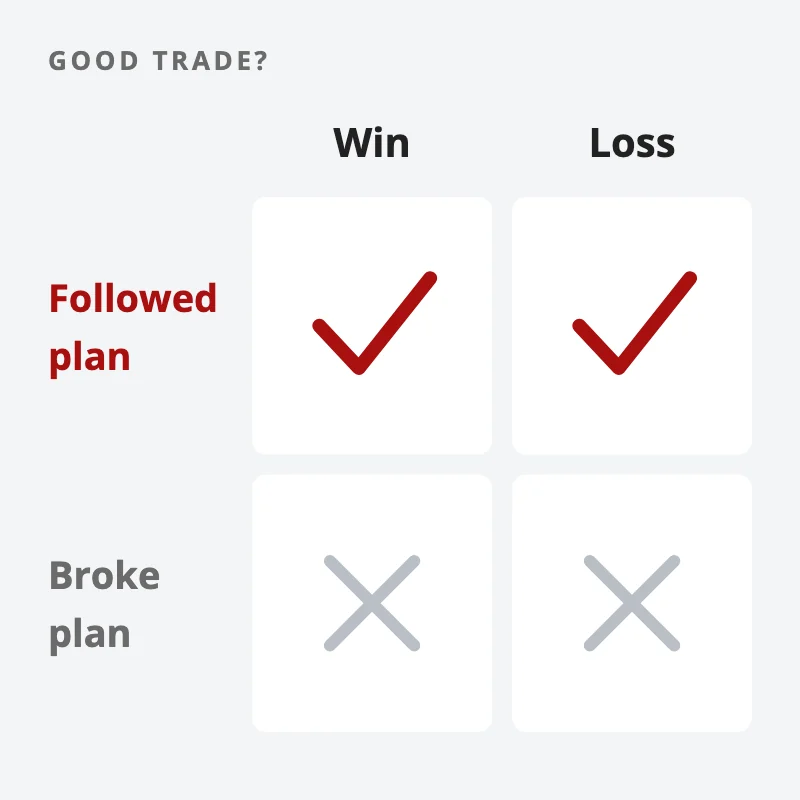
So for each loss, ask whether it came from poor execution or from market conditions doing what they sometimes do. Only one of those is a problem you can fix. Hence the real score in a trading journal is how closely you followed your plan, and the result comes second.
Reviewing every week is a habit, and habits are easier to keep with a routine. The free 15-minute swing trader checklist is the one I run every day.
A simple trading journal template to start with
You do not need special software to begin. A spreadsheet with these columns, plus a folder of labelled charts, covers the basics.
| Field | Example |
|---|---|
| Date, product and timeframe | 14 October, a stock, daily chart |
| Plan, written before entry | Breakout from a range, longer trend up |
| Entry, stop, target | The three prices |
| Emotion, written before entry | Hesitant, the last trade lost |
| Followed the plan? | Yes or no |
| Result and why | Win or loss, and the process reason |
| Chart | Link to the labelled screenshot |
Fill in the plan and the emotion before the trade, the execution notes during it, and the result after it, then review it on your schedule. If you would rather not build the sheet yourself, my free trading journal template sits at the bottom of my monthly market regime read, and you can make your own copy from there.
FAQ
What is a trading journal?
A record of every trade you take, including your plan, your reasons at each decision, the entry, stoploss and target, and your emotions. You keep it so you can review your decisions later and improve them.
Should I use a spreadsheet or a chart-based trading journal?
A spreadsheet is easier to analyse, and labelled charts are easier to remember. Use both if you can, with at least one labelled chart per trade.
How often should I review my trading journal?
Swing traders can review at the end of each week, and day traders at the end of each day. Start every review by checking whether you followed your plan.
Does a winning trade mean it was a good trade?
No. A trade can win on luck even when you broke your rules, and a trade done perfectly can still lose, because no system wins every time. Judge the process, and let the results speak over many trades.
Why do I keep repeating the same trading mistakes?
Usually because memory rewrites each trade once the result is known, so the pattern never gets connected. A journal written before and during the trade holds the record still long enough for you to see it.
For the new traders out there, do you keep a trading journal yet? And for the seasoned ones, which column in yours would you never give up? Let me know in the comments.
If you want the rest of the foundations, my Beginner’s Guide to Trading and Technical Analysis puts them in order, and the emotions behind most journal entries are in my guide to trading psychology. The rest is in my free trading guides.
And if you want a routine that leaves you time to write the journal, grab the free 15-minute swing trader checklist.
About the author. Spencer Li is The 15-Minute Trader and the founder of Synapse Trading. He is a Certified Financial Technician (CFTe) with 15+ years of trading, run from 70+ countries. He holds a B.Acc and B.BM from SMU. Every trade he takes is public, dated, losses left in. He teaches rules-based swing trading in 15 minutes a day, one system for any market.
Education, not financial advice. Synapse Trading is not licensed by MAS to advise on investment products. Trading carries risk of loss, and past performance is not indicative of future results.
Want the daily routine? Enter your email for the free 15-Minute Swing Trader's Checklist.
Free 5-page PDF, then occasional trading emails. Education only, not financial advice. Unsubscribe anytime. Kit stores your email in the US: see our privacy policy.
Want to learn the full method? The Trading Mastery Program teaches the 4 strategies I have traded since 2011. It suits beginners and experienced traders.
Rather follow the trades as they happen? Daily Trading Signals is our Telegram channel: my trade ideas with entry, stop and exit, and every trade is public.
Questions about this post? Ask in the free Telegram channel →
Educational content only, not personalised financial advice. Trading carries risk, including loss of capital. Past performance is not indicative of future results. Synapse Trading is not licensed or regulated by MAS.

