

Tower Top and Tower Bottom: How to Spot These Candlestick Reversals and Know When to Trust Them
Want the daily routine? Get the free 15-Minute Swing Trader’s Checklist. Get it free →
By Spencer Li, CFTe · Last updated: 26 October 2026
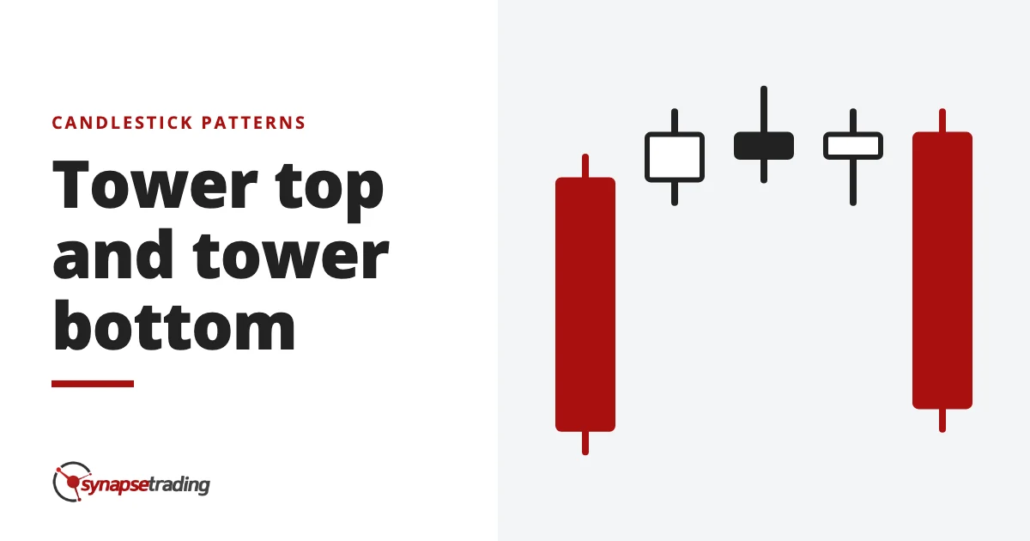
A tower top is a long rising candle, then a cluster of small candles that go nowhere, then a long falling candle that ends the rise. A tower bottom is the mirror image, with a long falling candle, a stall, and a long rising candle. The two long candles stand on either side of the stall like a pair of towers, which is where the name comes from. The pattern only counts once that final long candle has closed. Until then, all you have is a market taking a breather, and a breather can end in either direction.
What are tower tops and tower bottoms?
Gregory Morris, who catalogued these patterns in Candlestick Charting Explained, describes them in one line. “Tower Tops and Tower Bottoms are made of many long days which slowly change color and indicate a possible reversal.”
Notice the word “possible”. Steve Nison, who brought candlestick charts to the West, makes the same point about reversal patterns in general. A reversal signal tells you the old trend is likely to change, which is not the same as a promise that it will turn around and run the other way.
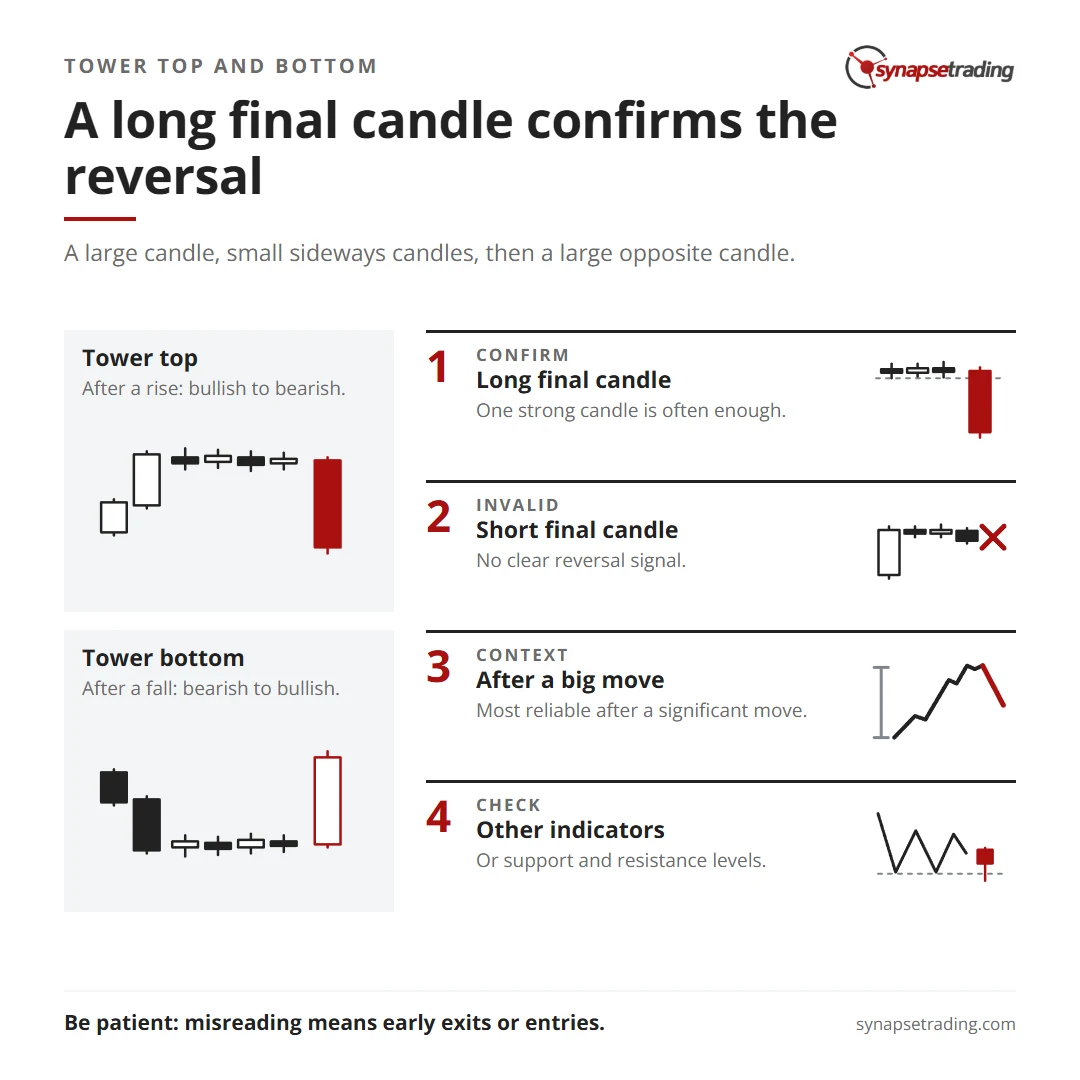
The summary card above shows the whole idea. One long candle carries the trend, a few small candles show it running out of steam, and one long candle in the other direction shows the other side taking over. The small candles in the middle can be any colour, and there is no set number of them.
What does a tower top look like?
The tower top forms after a rise. A long green candle shows buyers still firmly in charge. Then the market stalls for a few sessions, with small bodies that drift sideways, often in mixed colours. Finally a long red candle drops through the stall and wipes out the gains of the first candle.
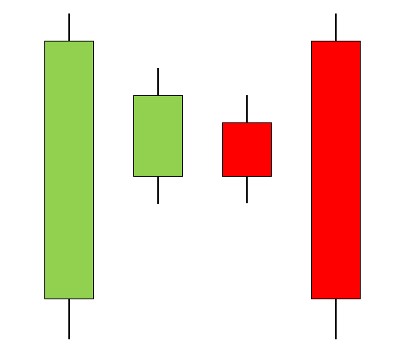
In the chart, the last red candle runs as tall as the first green one. That is the textbook shape, where the sellers’ candle undoes the buyers’ candle almost exactly.
Read the three parts in order and the bearish story is easy to follow. The first candle says buyers were confident. The stall says they ran out of new buyers, while sellers had not yet shown up in force. The final candle says sellers arrived, and they did not stop at the edge of the stall.
So the tower top is most useful after a big run up. If the market has only risen for two days, there is no trend for the pattern to reverse.
What does a tower bottom look like?
Flip the whole thing over. After a fall, a long red candle shows sellers in control. Then a few small candles go sideways, and a long green candle rises out of the stall.
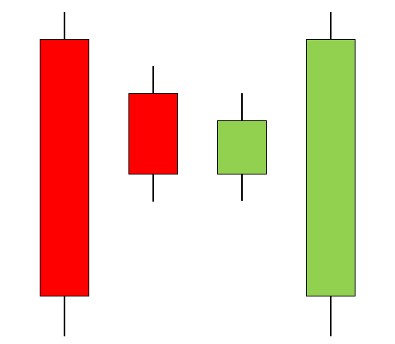
In this chart, the green candle again runs as tall as the red one before the stall, so buyers took back everything the sellers took in that first candle.
There is a small bonus hidden in the first two candles. The small red body sits entirely inside the long red body before it, which is the shape of a harami. Nison describes the harami as a brake, after which the market “will often come to a lull”. So a tower bottom can open with a harami, and the stall that follows is that lull, stretched out over a few sessions. The harami is the first hint that sellers are tiring, and the tower bottom is the market confirming it.
If you want a routine that checks this kind of picture in a few minutes a day, my free 15-minute swing trader checklist is the one I run myself.
Why does the final candle have to be long?
Here is an odd fact from physics class. When you throw a ball straight up, there is a moment at the very top where it stops moving. For that instant its speed is zero, yet gravity never stopped pulling. The pause tells you nothing about which way the ball goes next, but the next moment tells you everything.
The stall in the middle of a tower is that moment at the top. Small candles mean the push in one direction has faded, but they do not tell you whether it will come back. The long final candle is the ball actually falling. You wait for it.
You can see this clearly if you blend the candles into one, using the first open, the highest high, the lowest low and the last close. Take a tower bottom where the red candle opens at 110 and closes at 100. The small candles that follow trade between 99 and 101, with one dip to 98.50. Then the green candle opens at 100 and closes at 109.50, with a high of 111 somewhere in the group.
| Long final candle | Short final candle | |
|---|---|---|
| Final green candle closes | 109.50 | 104.00 |
| Blended open and close | 110 and 109.50 | 110 and 104 |
| Blended body | 0.50 | 6.00 |
| Blended lower shadow, down to 98.50 | 11.00 | 5.50 |
| What the blend looks like | A hammer, close to a dragonfly doji | A plain red candle |
With a long final candle, the whole group blends into a candle with a tiny body and a very long lower shadow. That is the classic shape of sellers being rejected. With a short final candle, the blend is still a red candle whose lower shadow is shorter than its body. In other words, the market has bounced a little, and sellers are still ahead for the period.
That is why the length of the last candle matters so much. A short final candle does not give you a weaker tower bottom, because without a long last candle the pattern never formed.
The tower top works the same way upside down. A long final red candle blends the group into something close to a shooting star, while a short one blends into a green candle that has merely paused.
How do tower patterns differ from fry pan bottoms and dumpling tops?
Morris lists two close cousins. They are easy to mix up.
A fry pan bottom is “similar to the Tower Bottom, except that the days are all small or short body days”. The bottom is rounded, like the base of a pan, and Morris says the reversal is confirmed when “a gap is made with a white day”. A dumpling top is the bearish version, a rounded top confirmed by a gap down to a black candle.
So the difference is the edges. A tower stands on two long candles, one at each end. A fry pan or dumpling has no tall edges at all, only a slow curve, and it relies on a gap to tell you the turn is real.
| Tower bottom | Fry pan bottom | |
|---|---|---|
| Candle size | Long at both ends, small in the middle | Small throughout |
| Shape of the low | Flat stall | Rounded curve |
| What confirms it | A long green candle | A gap up to a white candle |
How do I read long candles in my own outlooks?
I rarely say the word “tower” out loud, but I count long candles all the time. On 5 November 2025, I walked viewers of my weekly outlook through the gold chart. “There’s only been one long white bar here,” I said, while “this was the longest black bar.” Overall, there were “a lot more like black bars than white bars”, so I told them it “suggests that there might be one more leg down for gold”.
That is the same logic as a tower, read over a wider window. Who owns the long candles? If the sellers own the biggest ones, a small green bounce in between is a pause, and I would want to see a long green candle before treating it as a turn. If you would rather do this kind of check in one short session a day, the free 15-minute swing trader checklist is the routine I use.
Do candlestick patterns really work?
In February 2026, a trader on Reddit’s r/technicalanalysis asked the question many people quietly wonder about. “Do candlestick patterns really work or not?” They added that when they started out, “spotting them live was a nightmare”.
That is a fair objection, and they have a point. Tower patterns are especially awkward to spot live, because the middle can run for any number of candles, and you only know you had a tower after the final candle closes. By then part of the move has happened.
I also cannot hand you a neat record for this pattern. As at 12 October 2026, 216 of my 478 closed trades carried a setup tag, and only 10 of those were tagged as a turn, which is my label for a reversal. Ten trades is far too few to tell you anything, and the tag does not record which candles I saw. So I am not going to pretend I have proof that towers work.
What I can say is that I never trade a candle pattern on its own. Nison argues that candles reach their “true power” only when you combine them with other tools. He borrows a rule from Arthur Sklarew, that the more separate signals point to the same price, the better your odds. In his words, candles add “a vibrant color to your technical palette”. The palette, though, still needs the rest of the paint, such as the trend, support and resistance, and the moving averages.
FAQ
What is a tower top?
A bearish reversal pattern after a rise. It is a long green candle, a few small candles moving sideways, then a long red candle.
What is a tower bottom?
The bullish mirror image after a fall. It is a long red candle, a few small candles, then a long green candle.
How many small candles can sit in the middle?
There is no fixed number, and the colours can be mixed. What matters is that they are small next to the two long candles at the ends.
What cancels a tower pattern?
A short final candle. If the last candle is not long, the pattern has not formed, and the stall may simply continue.
Is a tower bottom the same as a fry pan bottom?
No. A fry pan bottom is made only of small candles in a rounded curve, and it is confirmed by a gap up.
Have you ever caught a tower top or bottom on your own charts, and did the final candle come through? Which of these reversal patterns do you find easiest to spot live? Let me know in the comments.
For every pattern in one place, read The Definitive Guide to Candlestick Patterns. To see how the blending trick above works on other patterns, read how to combine candlestick patterns into one candle, and for the harami hiding inside the tower bottom, see the bullish harami. For the wider picture, start with my free trading guides.
And if you want a routine that reads these candles without hours at the screen, grab the free 15-minute swing trader checklist.
About the author. Spencer Li is The 15-Minute Trader and the founder of Synapse Trading. He is a Certified Financial Technician (CFTe) with 15+ years of trading, run from 70+ countries. He holds a B.Acc and B.BM from SMU. Every trade he takes is public, dated, losses left in. He teaches rules-based swing trading in 15 minutes a day, one system for any market.
Education, not financial advice. Synapse Trading is not licensed by MAS to advise on investment products. Trading carries risk of loss, and past performance is not indicative of future results.
Want the daily routine? Enter your email for the free 15-Minute Swing Trader's Checklist.
Free 5-page PDF, then occasional trading emails. Education only, not financial advice. Unsubscribe anytime. Kit stores your email in the US: see our privacy policy.
Want to learn the full method? The Trading Mastery Program teaches the 4 strategies I have traded since 2011. It suits beginners and experienced traders.
Rather follow the trades as they happen? Daily Trading Signals is our Telegram channel: my trade ideas with entry, stop and exit, and every trade is public.
Questions about this post? Ask in the free Telegram channel →
Educational content only, not personalised financial advice. Trading carries risk, including loss of capital. Past performance is not indicative of future results. Synapse Trading is not licensed or regulated by MAS.

