

The Narrative Fallacy: Why Every Market Move Gets a Story
Want the daily routine? Get the free 15-Minute Swing Trader’s Checklist. Get it free →
Last updated: 24 September 2026 · By Spencer Li, CFTe
The narrative fallacy is our habit of explaining events with a neat cause-and-effect story, even when the events were mostly random or the real causes are unknown. Nassim Nicholas Taleb named it in The Black Swan. He describes it as our preference for compact stories over raw truths, and our difficulty looking at a sequence of facts without forcing “an arrow of relationship” onto them.
In markets, it is everywhere. Every price move gets a reason by the end of the day: stocks fell on rate fears, rose on hopes of a deal, slipped on profit-taking. Some of those stories are true. Many are written after the move, to fit it.
The danger for traders is not that the stories are wrong. It is that they make the past look predictable, which makes the future look predictable too. Below is a real example, why our brains fall for it, and a simple story check.
What is a real example of the narrative fallacy in markets?
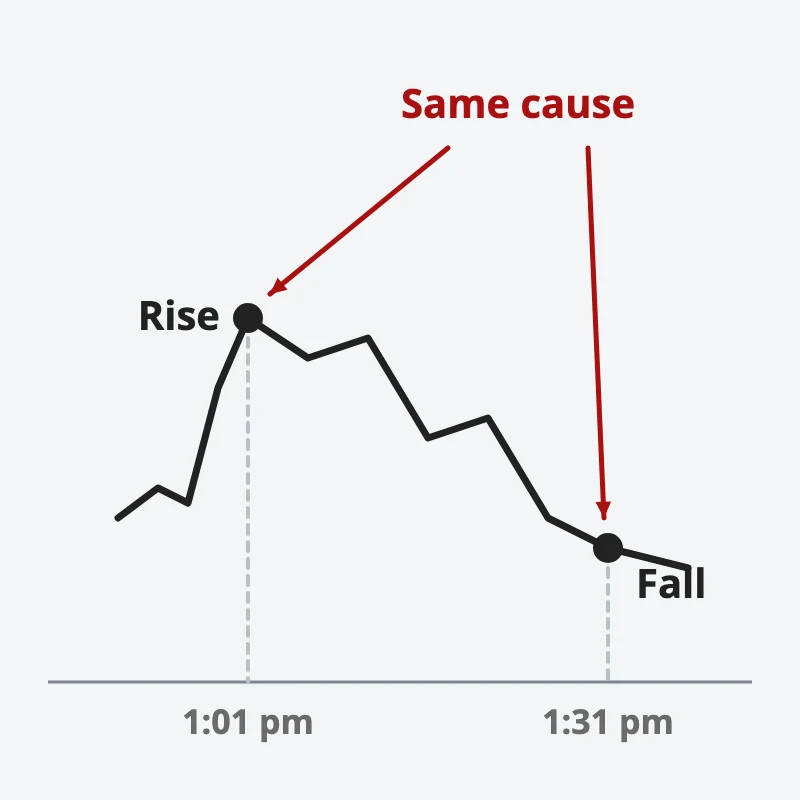
Taleb’s favourite comes from Bloomberg in December 2003, the day Saddam Hussein was captured. At 1:01 pm, the headline said “U.S. Treasuries rise”, and gave the reason as “Hussein capture may not curb terrorism”. Bond prices then fell. At 1:31 pm, the new headline said “U.S. Treasuries fall”, and the reason was now “Hussein capture boosts allure of risky assets”.
Read those 2 lines again. The same event was given as the cause of a rise and then, half an hour later, of a fall. The capture did not change in those 30 minutes. The price did, and the story followed the price.
This is how most daily market commentary works. A headline writer has to explain the move, the move already happened, and there is always some piece of news nearby to hang it on. The story feels like an explanation, and because it arrives with a confident tone and a neat cause, few readers stop to ask whether it would have been written the other way round. Often it is just a caption.
Why do our brains fall for the narrative fallacy?
Because stories are how we make sense of the world, and a world without them would be exhausting. Taleb borrows an example from the novelist E. M. Forster. “The king died and the queen died” is 2 facts. “The king died, and then the queen died of grief” is a story. The second is easier to remember, and it feels like more information, even though the link between the 2 deaths is something we added.
Daniel Kahneman, in Thinking, Fast and Slow, describes which stories we find most convincing. They are the ones that:
- are simple
- are concrete rather than abstract
- “assign a larger role to talent, stupidity, and intentions than to luck”
- “focus on a few striking events that happened rather than on the countless events that failed to happen”
Every point on that list fits market commentary perfectly. A fund manager is a genius, a central banker made a blunder, one dramatic day caused the whole move. Luck, and all the things that could have happened but did not, are left out because they make a bad story.
Morgan Housel makes a related point in The Psychology of Money. Everyone sees only part of the world, but we build a complete story to fill in the gaps, and then we act on the story as if it were the whole picture.
| The story you hear | What it leaves out |
| “Stocks fell on rate fears.” | the same fears were around yesterday, when stocks rose |
| “He called the top.” | the other tops he called that never came |
| “The market rewarded discipline.” | the disciplined traders who lost money in the same move |
| “The selloff was obvious.” | how few people sold before it |
How does the narrative fallacy hurt traders?
It hurts in 3 ways, and the third is the one that costs the most.
First, it makes you trade the news story instead of the chart, which usually means arriving late, because by the time a move has been explained in the evening news the price has already done most of its moving. You read why something moved, you feel you understand it, and you act on the story after the price has already moved.
Second, it makes you trust the wrong people. A trader who tells a great story about why the last move happened sounds like someone who can predict the next one. Those are different skills.
Third, and worst, it rewrites your own trades. After a loss, you tell yourself a story that makes the mistake look obvious, so you feel you have learnt the lesson. After a win, you tell yourself a story about your skill. Both stories feel true. Neither one is a test.
I have caught myself doing exactly this. One day in June 2026, after a short night, I went to play padel and correctly read that I should play it safe on court: simpler shots, fewer risks. Then, later that same tired day, I added a new, concentrated risk to my portfolio. Same body, same impaired state, opposite decision. Looking back, the link is obvious. In my journal I wrote that it was “obvious in the rear-view and invisible in the moment.” That sentence is the narrative fallacy in a nutshell. The clean story only exists afterwards.
If you want a daily routine that keeps you trading the chart instead of the headline, the free 15-Minute Swing Trader’s Checklist is at the end of this post.
How do you avoid the narrative fallacy in trading?
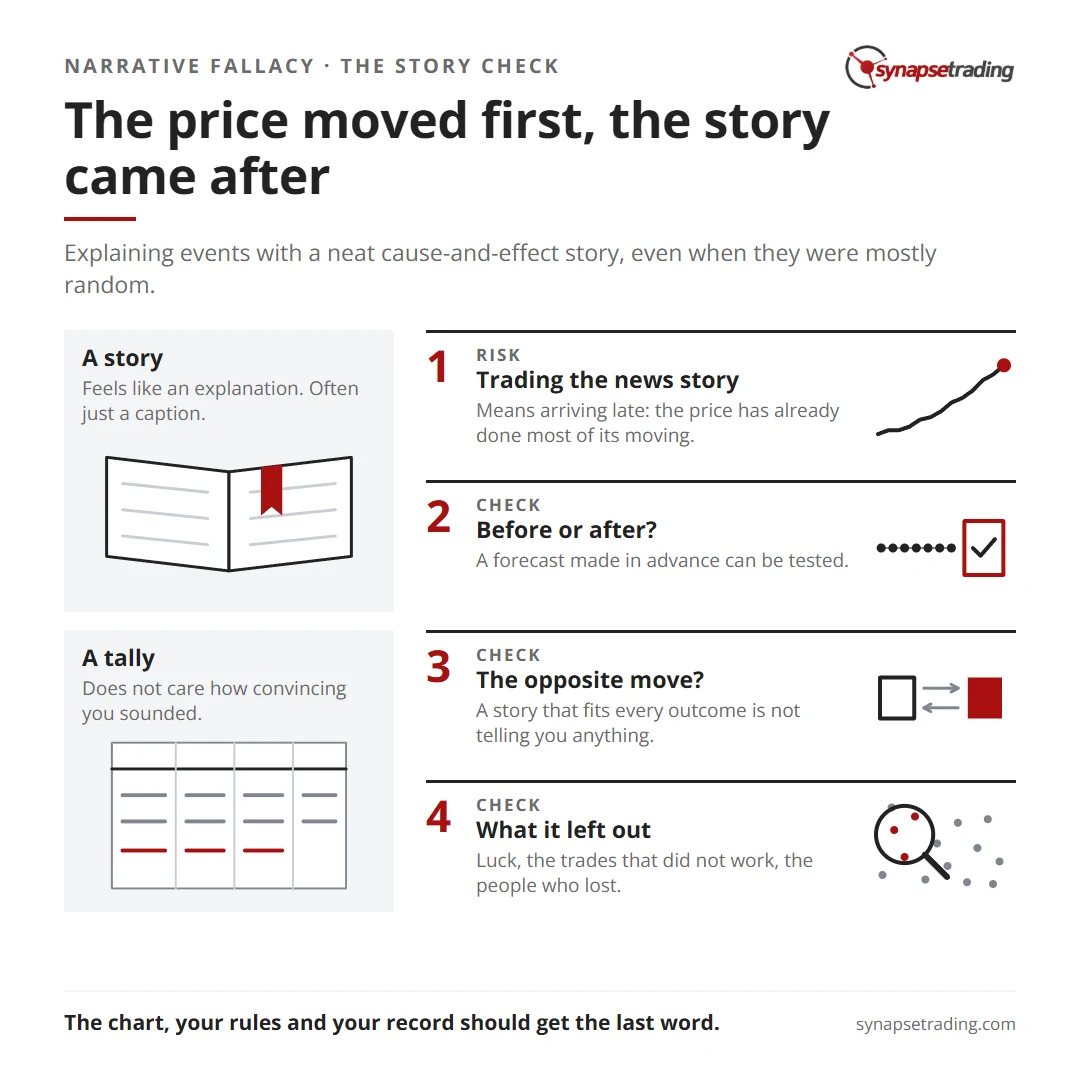
You cannot switch off the need for stories. What you can do is test them. Before acting on any explanation of a market move, run it through the 3-question story check:
- Was the story written before or after the move? A forecast made in advance can be tested. An explanation written afterwards cannot, because it was built to fit.
- Could the same story explain the opposite move? If “the capture” can explain a rise and a fall, it explains neither. A story that fits every outcome is not telling you anything.
- What did the story leave out? Luck, the trades that did not work, the people who did the same thing and lost. If the story only has heroes and villains, something is missing.
Taleb’s own antidotes point the same way. He favours experiments over stories, and he suggests making predictions in advance and keeping a tally of how they turn out. A tally is the opposite of a story. It does not care how convincing you sounded.
That is also why I keep a public trade log: every trade since April 2024, dated, losses left in. It makes it much harder to tell myself a flattering story about last month. A trading journal does the same job privately.
Are stories ever useful in trading?
Yes, as long as they are treated as ideas to test. A theme that explains why a group of stocks is rising can be a fine reason to look at the charts. It becomes a fallacy when the story replaces the evidence.
Personally, I think the most useful habit is to notice the moment an explanation makes you feel certain. That feeling is the story working on you. The chart, your rules and your record should get the last word.
The narrative fallacy has close relatives: hindsight bias, which makes past events look predictable, and confirmation bias, which makes us look only for evidence that fits our story. Taleb’s wider argument is in our summary of The Black Swan. Two other posts in this series cover status quo bias and herd mentality in trading, and the full trading psychology guide ties them together.
Those 2 Bloomberg headlines, 30 minutes apart, are worth keeping in mind every time a market move arrives with a reason attached. The reason may be right. But the price moved first, and the story came after.
FAQ
What is the narrative fallacy?
It is the tendency to explain events with a neat cause-and-effect story, even when the events were random or the causes are unknown. Nassim Nicholas Taleb named it in The Black Swan.
What is an example of the narrative fallacy?
In December 2003, Bloomberg explained a rise in US Treasuries with Saddam Hussein’s capture, then 30 minutes later explained a fall in Treasuries with the same capture.
Why is the narrative fallacy dangerous for traders?
It makes past moves look predictable, which makes traders overconfident about the next move. It also lets traders explain away their own mistakes with stories instead of testing them.
How is the narrative fallacy different from hindsight bias?
Hindsight bias is the feeling that an outcome was predictable after you know it. The narrative fallacy is the wider habit of building a cause-and-effect story to explain events, which is one way hindsight bias takes hold.
How do you avoid the narrative fallacy?
Ask whether the story came before or after the move, whether it could explain the opposite outcome, and what it left out. Keep a dated record of your predictions and trades so the record, not the story, has the last word.
Go deeper
The free 15-Minute Swing Trader’s Checklist has the daily routine, the questions to ask before every trade, and the five rules that keep you in the game.
About the author. Spencer Li is The 15-Minute Trader and the founder of Synapse Trading. He is a Certified Financial Technician (CFTe) with 15+ years of trading, run from 70+ countries. He holds a B.Acc and B.BM from SMU. Every trade he takes is public, dated, losses left in. He teaches rules-based swing trading in 15 minutes a day, one system for any market.
Educational content only, not personalised financial advice. Trading carries risk, including loss of capital. Past performance is not indicative of future results. Synapse Trading is not licensed or regulated by MAS.
Want the daily routine? Enter your email for the free 15-Minute Swing Trader's Checklist.
Free 5-page PDF, then occasional trading emails. Education only, not financial advice. Unsubscribe anytime. Kit stores your email in the US: see our privacy policy.
Want to learn the full method? The Trading Mastery Program teaches the 4 strategies I have traded since 2011. It suits beginners and experienced traders.
Rather follow the trades as they happen? Daily Trading Signals is our Telegram channel: my trade ideas with entry, stop and exit, and every trade is public.
Questions about this post? Ask in the free Telegram channel →
Educational content only, not personalised financial advice. Trading carries risk, including loss of capital. Past performance is not indicative of future results. Synapse Trading is not licensed or regulated by MAS.

