

Long-Legged Doji (Rickshaw Man): What It Means and When It Matters
Want the daily routine? Get the free 15-Minute Swing Trader’s Checklist. Get it free →
By Spencer Li, CFTe · Last updated: 26 October 2026
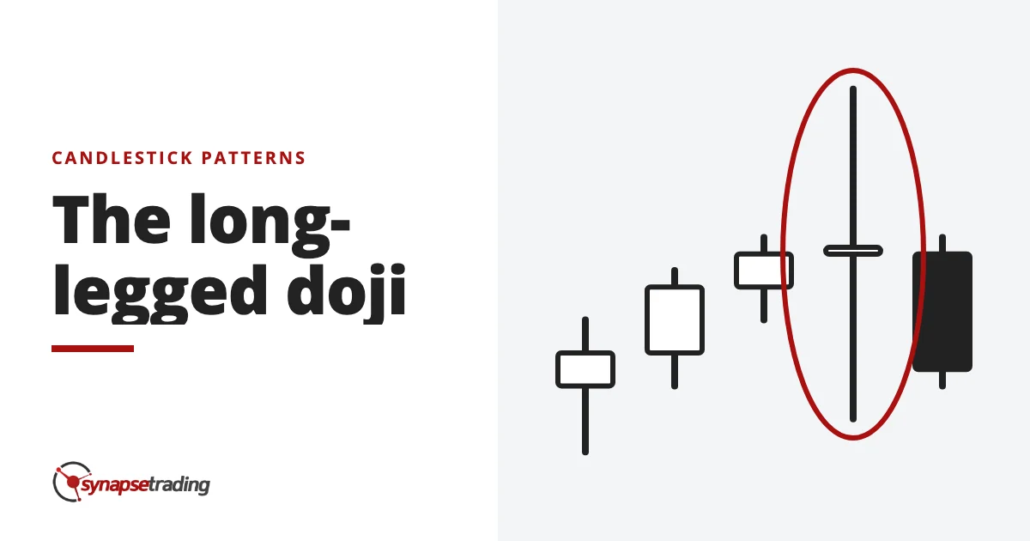
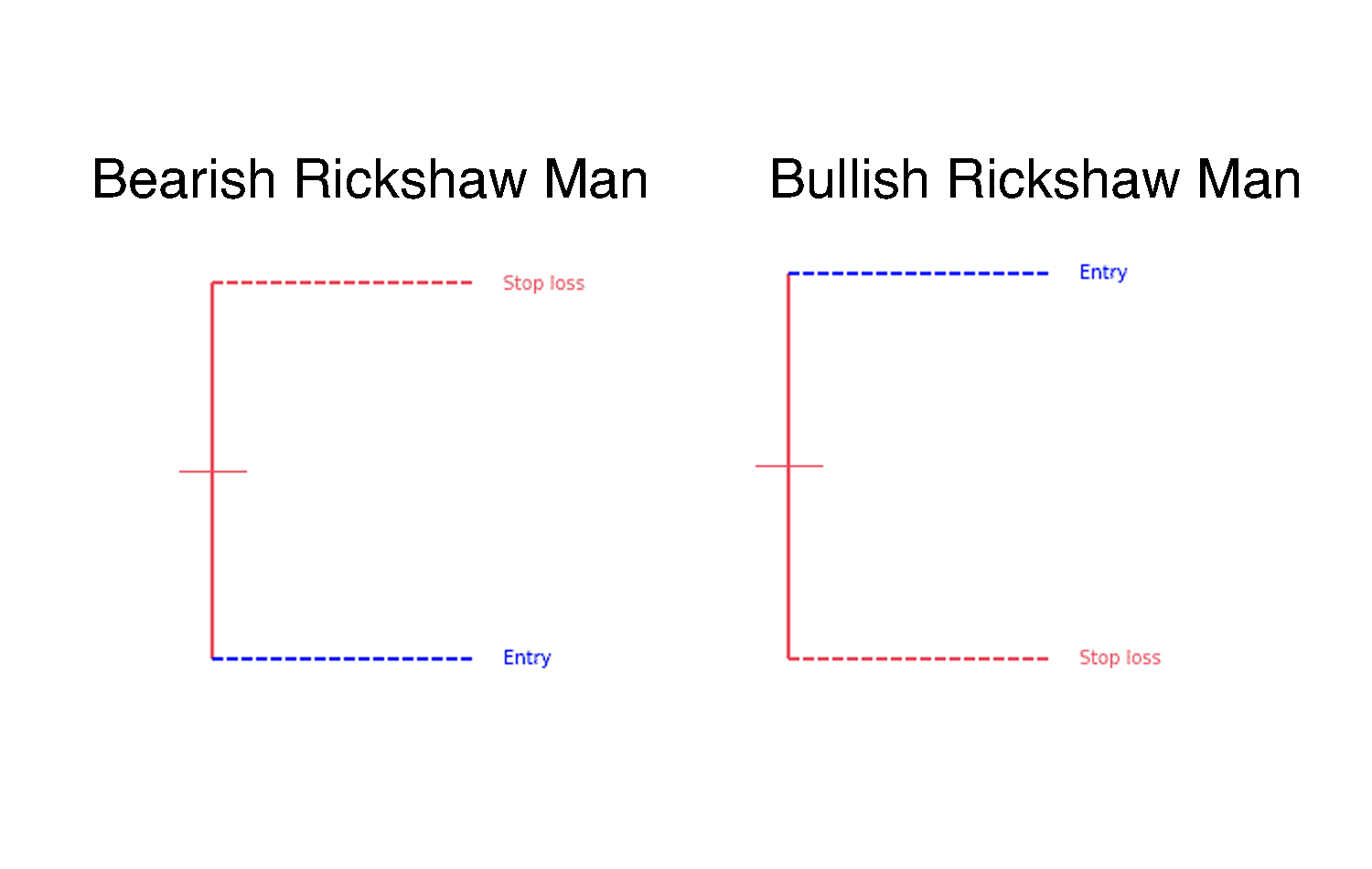
A rickshaw man is a long-legged doji whose tiny body sits right in the middle of the candle. The open and the close are almost the same price, and a long shadow stretches out above the body and another one below it, roughly equal in length. It tells you that buyers and sellers both pushed price a long way during the session and that neither side could hold what it took. So the candle means indecision. On its own, it says nothing about direction. It earns your attention after a long run or at a level that matters, and it earns very little anywhere else.
Where does the name come from?
The word rickshaw comes from the Japanese jinrikisha, which literally means “human-powered vehicle”. Rickshaws appeared in Japan around 1869, and if you walk down Neil Road in Tanjong Pagar you can still see the old Jinrikisha Station, one of the first buildings in the area that the URA restored, back in 1987. It is a fitting name for a candle that goes nowhere while somebody does a lot of running.
Every candle is built from four prices, the open, the high, the low and the close. In a rickshaw man the open and the close land at or very near the same level, which makes it a doji, a candle with almost no real body. The high and the low are far apart, so the shadows, the thin lines above and below the body, stretch out on both sides.
Any doji with long shadows on both sides is a long-legged doji. The rickshaw man is the case where the body sits at or very close to the middle of the range rather than near the top or the bottom.
What does a rickshaw man actually tell you?
Who had the worse day when a rickshaw man prints?
Think about the buyer who chased the session’s high, only to watch price slide all the way back to the open by the close, so they go home holding a position that is already underwater. The seller who shorted near the low had the same afternoon in reverse, watching a quick profit vanish as price climbed back to where it started, only hours after it looked like their best trade of the week. Both sides spent a lot of money and a lot of nerve. The scoreboard at the close reads exactly what it read at the open. Nobody won.
Steve Nison, whose 1991 book Japanese Candlestick Charting Techniques brought these candles to most Western traders, describes the long-legged doji as a market that has “lost its sense of direction”. The candlestick course I took in Singapore back in 2009 put it more plainly, as a candle where neither bull nor bear is in control.
Most guides say that supply and demand are near equilibrium, and that is true, but a physicist would ask which kind. A marble resting at the bottom of a bowl is in stable equilibrium, so a nudge makes it roll back to the middle. A marble balanced on top of an upturned bowl is in equilibrium too, except that the smallest nudge sends it off one side for good. The rickshaw man shows you the balance. It cannot tell you whether the market is sitting in the bowl or on top of it. Where the candle sits on the chart answers that.
Is the rickshaw man bullish or bearish?
In December 2023, a trader on Reddit’s r/technicalanalysis asked about a long-legged doji on RIVN, right after a run up: “Is this an indicator of a reversal or continuation of the recent uptrend?”
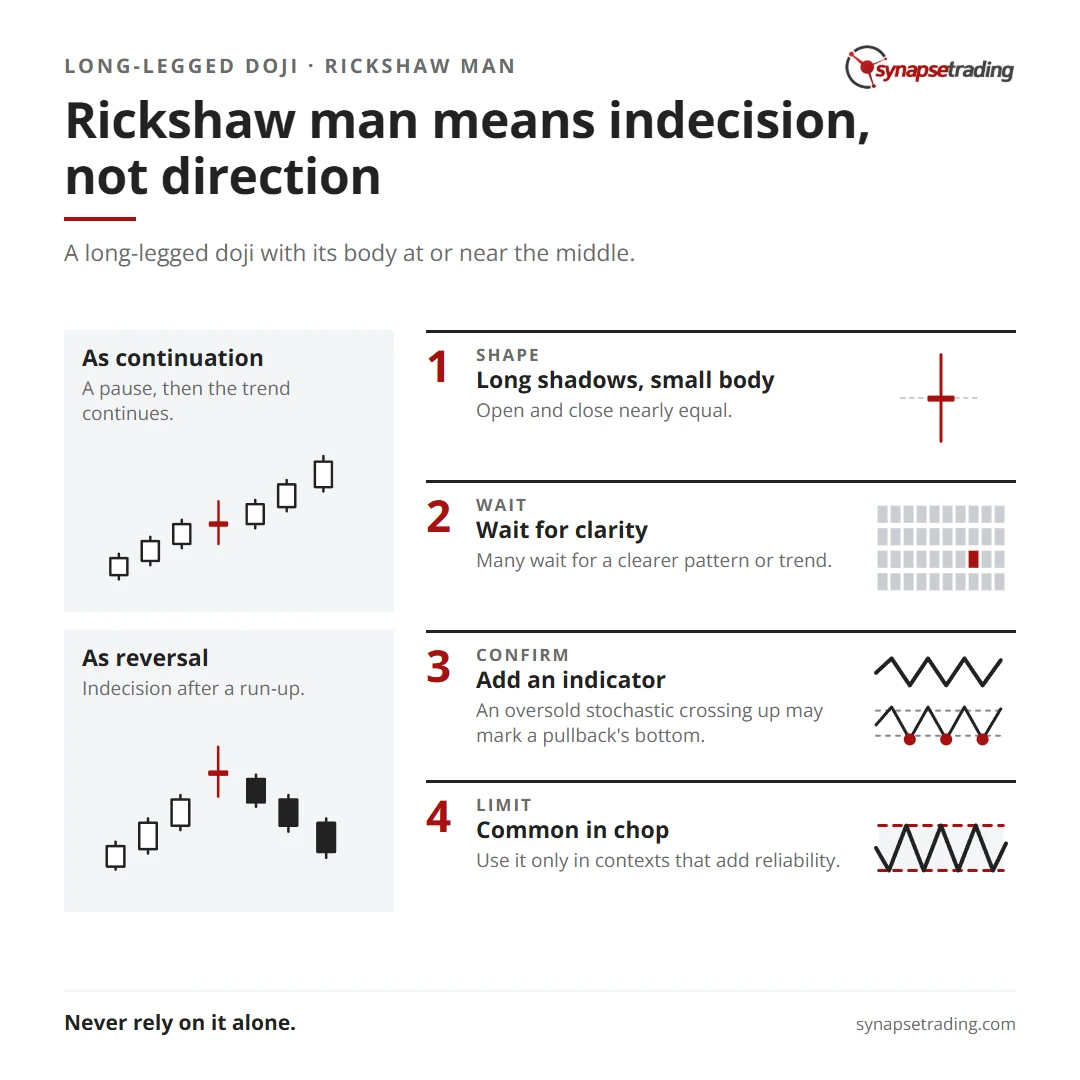
It is the most common question about this candle. The candle cannot answer it. The setting can. In the middle of a choppy range, a rickshaw man is usually just a pause, and the trend that came before it often carries on afterwards. After a long, strong run up, the same candle is a warning that buyers are running out of conviction, and Nison treats it as a strong top warning in that spot.
Nison also points out an asymmetry that most beginners never hear about. Doji call tops better than bottoms. In his words, a falling market “could fall due to its own weight”. So a doji in a downtrend needs more confirmation, while the same doji after a long rise is already a warning. John Person says the same thing from experience in Pivot Point Analysis: “I personally do not trust dojis as the holy grail of buy signals.”
For the RIVN candle, the useful questions were how far the run had come and what the next session did.
Reading context like this is a daily habit, and my free 15-minute swing trader checklist is the short routine I run myself.
What does a real one look like?
In my weekly outlook on 5 November 2025, I pointed to a doji on the US market’s daily chart and called it a sign of indecision. The candle was 29 October, which also happened to be the day the Fed cut rates by a quarter point. It is hard to think of a better recipe for a doji than a whole market spending its afternoon arguing about one press conference.
On the QQQ chart, the fund that tracks the Nasdaq 100, here is what happened around it. These prices come from Yahoo Finance’s daily data, pulled on 26 October 2026.
- QQQ had climbed about 6% in five sessions, from its 22 October low to the doji’s high.
- On 29 October it opened and closed only a few cents apart, so the body was under 3% of the day’s range, while the shadows covered a swing of about 1%.
- On 30 October it closed below the doji’s low, which I called at the time “kind of like confirming” the correction.
- On 31 October it opened above the previous day’s high and then closed lower anyway.
- On 4 November it fell about 2% in a single session.
By the time I recorded, the last four bars were all black, and I said I would stay bearish “until I see more bullishness on the price action”. I also noted that most of the big companies had already reported results, so the market had run out of reasons to go higher.
Now, it would be easy to tell this as a textbook rickshaw man. It was not one. The body sat near the top of the range, with a long lower shadow and a short upper one, so strictly it leaned towards a dragonfly doji. The confirmation also took its time, with a bounce in between that would have shaken out anyone who acted on the doji alone. What made the candle worth noticing was where it sat, at the end of a fast run, on a day of maximum uncertainty, with no catalyst left on the calendar. The shape only told me the buyers had stalled. The location told me why that mattered.
When does a rickshaw man deserve your attention?
Nison has a line I keep coming back to: doji are important only in markets where there are not many doji. On a 5-minute chart half the candles look like doji, so none of them mean much, and he suggests ignoring charts shorter than about 30 minutes for this reason. A rickshaw man on a daily or weekly chart carries more weight, because a lot more money and a lot more people went into building it, and a stalemate between that many people is harder to dismiss.
Three settings make it worth a look.
- After a long run. Indecision after a strong rise is a change in behaviour. Inside a messy range, it is more mess.
- At a level that matters. An old high or low, a moving average the market respects, the edge of a range. Alan Farley adds in The Master Swing Trader that long-legged dojis printing on high volume can come before a sharp move the other way.
- With a second, independent signal. The original version of this post gave a fair example, so here it is again. In an uptrend that has pulled back, a rickshaw man at the low of the pullback, alongside an oversold stochastic, a momentum gauge, turning up, suggests the pullback may be ending. Even then the candle is a reason to watch, and the move that follows is the reason to act.
Nison treats a near-doji at a major junction as a doji anyway, because it is “better to attend to a false warning than to ignore a real one”. If you already hold a position, the 2009 course taught one sensible response to a doji, which was to tighten your stop.
How is it different from the other doji?
The names overlap, so anchor on two things, where the body sits and how long the shadows are.
| Candle | Where the body sits | Shadows | What it usually says |
|---|---|---|---|
| Rickshaw man | Middle of the range | Long on both sides, roughly equal | Strong indecision, neither side in control |
| Long-legged doji | Anywhere in the range | Long on both sides | Indecision, with the rickshaw man as its centred case |
| Gravestone doji | At the low | Long upper shadow, little or no lower | Buyers pushed up and failed, a warning at tops |
| Dragonfly doji | At the high | Long lower shadow, little or no upper | Sellers pushed down and failed, a hint at bottoms |
| Plain doji | Near the middle | Short on both sides | Mild indecision, a weaker message |
A candle with long shadows on both sides and a body slightly too big for a doji is a high-wave candle, which says much the same thing more quietly.
If you would rather check candles like these once a day than all day, the free 15-minute swing trader checklist is the routine I use.
What are the rickshaw man’s limits?
Some very good traders think candle names are close to useless. Al Brooks describes a doji as a one-bar trading range and a terrible bar to act on. He has a point. A trading range is a place where both sides agree on price, and that agreement tells you nothing about who wins next.
So the limits are worth stating plainly.
- It has no direction. You need the trend, the level or another tool to say whether the indecision matters.
- It has no target. The candle projects no move, so any profit target has to come from the chart, such as the next support or resistance.
- It shows up all the time. Choppy markets are full of them, and frequency is the enemy of meaning. A candle that appears everywhere predicts nothing in particular.
The QQQ example above is my own concession here. Even with the location in its favour, the doji was not a clean rickshaw man, and the market bounced once before it fell. One example that worked out proves very little. I also have no count of how often a candle like this led to a real reversal in my own trades, because my records do not tag the candle behind each entry.
Personally, I treat the rickshaw man as a reason to look closer at the chart, and the bars that follow it decide what I do. If you want every candle in one place, the Definitive Guide to Candlestick Patterns has them, and my summary of Nison’s Japanese Candlestick Charting Techniques covers the book these names come from.
FAQ
What is a rickshaw man in trading?
It is a long-legged doji whose small body sits in the middle of the candle, with long upper and lower shadows of about the same length. It shows that price moved a long way in both directions and closed near where it opened.
Is a rickshaw man bullish or bearish?
Neither on its own. After a long rise it warns that the trend may be tiring. In a choppy range it usually marks a pause, and the earlier trend often continues.
What is the difference between a rickshaw man and a long-legged doji?
A rickshaw man is one kind of long-legged doji, the kind whose body sits in the middle of the range. A long-legged doji’s body can sit anywhere between the high and the low.
Do doji work better at tops or bottoms?
Nison found that doji call tops better than bottoms. A falling market can keep falling under its own weight, so a doji in a downtrend needs more confirmation.
Which timeframe is best for the rickshaw man?
Daily and weekly. On very short charts so many candles look like doji that the pattern means little, and Nison suggests skipping charts under about 30 minutes.
Is the rickshaw man reliable?
Only in the right setting. It appears often, so it becomes useful only after a strong move, at a key level, or alongside another signal.
Have you ever acted on a doji that turned out to be just another quiet day in a range? And when a rickshaw man prints after a long run, do you wait for the next close or act straight away? Let me know in the comments.
For the bigger picture beyond candles, start with my free trading guides.
And if you want a routine that spots these candles without hours at the screen, grab the free 15-minute swing trader checklist.
About the author. Spencer Li is The 15-Minute Trader and the founder of Synapse Trading. He is a Certified Financial Technician (CFTe) with 15+ years of trading, run from 70+ countries. He holds a B.Acc and B.BM from SMU. Every trade he takes is public, dated, losses left in. He teaches rules-based swing trading in 15 minutes a day, one system for any market.
Education, not financial advice. Synapse Trading is not licensed by MAS to advise on investment products. Trading carries risk of loss, and past performance is not indicative of future results.
Want the daily routine? Enter your email for the free 15-Minute Swing Trader's Checklist.
Free 5-page PDF, then occasional trading emails. Education only, not financial advice. Unsubscribe anytime. Kit stores your email in the US: see our privacy policy.
Want to learn the full method? The Trading Mastery Program teaches the 4 strategies I have traded since 2011. It suits beginners and experienced traders.
Rather follow the trades as they happen? Daily Trading Signals is our Telegram channel: my trade ideas with entry, stop and exit, and every trade is public.
Questions about this post? Ask in the free Telegram channel →
Educational content only, not personalised financial advice. Trading carries risk, including loss of capital. Past performance is not indicative of future results. Synapse Trading is not licensed or regulated by MAS.

