
• Link to Facebook
  • Link to X
  • Link to Instagram
  • Link to Youtube
  • Link to LinkedIn
  • Link to Mail
Free PDF: The 15-Minute Swing Trader's Checklist, the daily routine on the record since 2014
Synapse Trading
  • Mentoring
    • Trading Mastery Program
    • All mentoring options
  • Signals
    • Daily trading signals
    • Signals trade log
  • Results
    • Student results and testimonials
    • Public trade log, losses left in
  • Free guides
    • Start here
    • Trading foundations
    • Technical analysis
    • Strategies and systems
    • Risk and money
    • Trading psychology
    • Markets and products
    • Free trading guides
    • Tools and resources
    • Blog
  • About
    • My background
    • My trading journey
    • Media and interviews
    • Travel log
  • Contact
    • Contact me
    • Partnerships
  • Start free
  • Click to open the search input field Click to open the search input field Search
  • Menu Menu
Spencer Li

3 Biggest Financial Regrets of Retirees – And How to Avoid Them!

Risk & Money Management
Retirees' biggest money regrets - personal finance

The 3 Biggest Financial Regrets of Retirees in Singapore (and How to Avoid Them)

Last updated: 7 August 2026 · By Spencer Li, CFTe


Three money regrets retirees often name: not saving money when they were young, not investing the time to learn how to invest, and overspending on their children. All three are fixable while you still have time. Start saving early so compounding works for you, because $10,000 saved in your twenties grows far more than the same $10,000 saved in your forties or fifties. Spend a few weeks learning to invest across more than just stocks, because a stocks-only portfolio fell more than half in 2008. And spend less on expensive things for your kids and more time with them, because that is the part they actually remember.

The good news: none of these require more money. They require earlier, simpler decisions. Here is each regret, why it happens, and the fix.
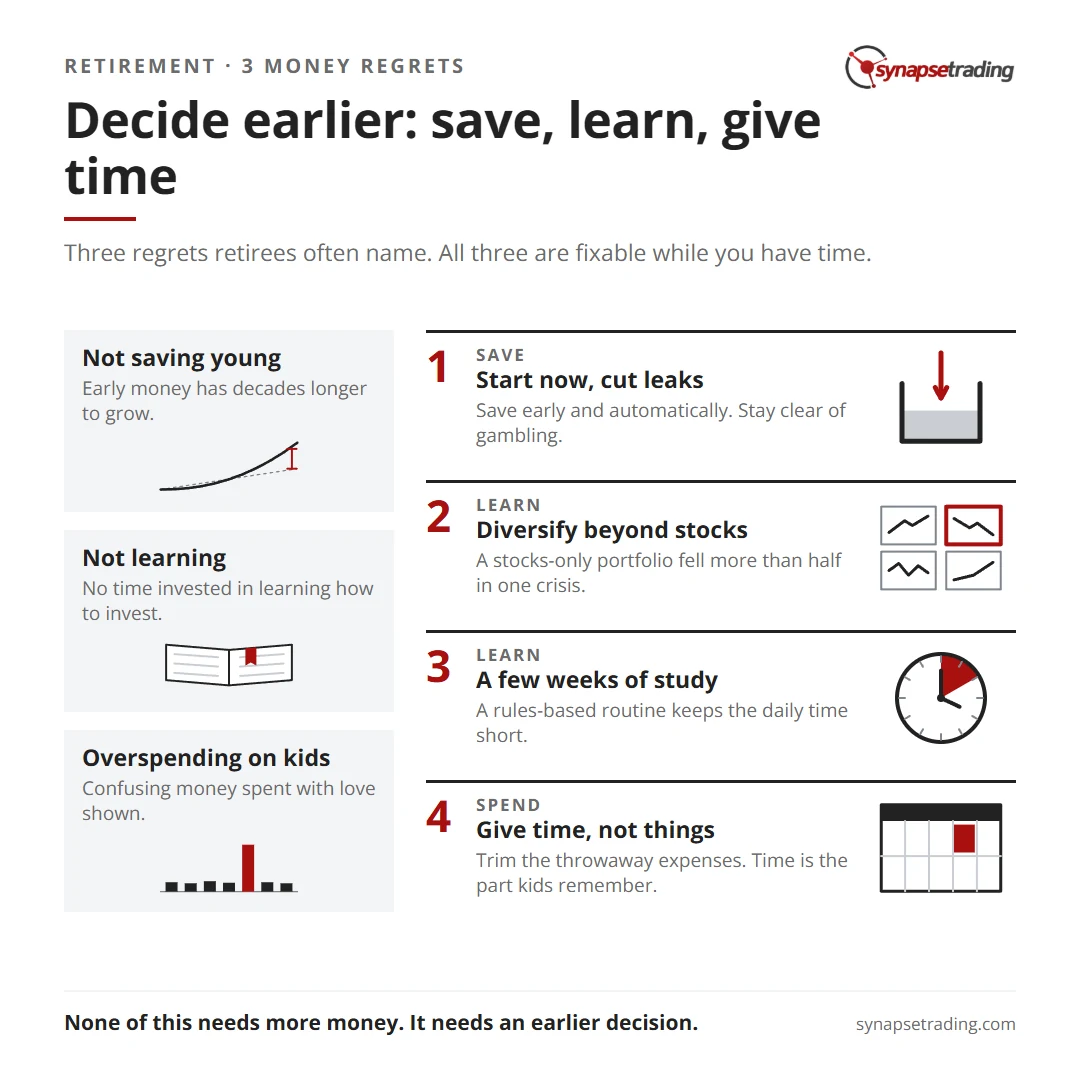
Decide earlier: save, learn, give time. Summary card for the post: 3 Biggest Financial Regrets of Retirees - And How to Avoid Them!.

Regret #1: Not saving money when young

This is the most common regret, and it is universal. Seniors all over the world say the same thing: I should have started saving earlier.

The reason is compounding. Saving $10,000 in your twenties adds up to a lot more than saving $10,000 in your forties or fifties, because the early money has decades longer to grow. The earlier you start, the more time does the work for you.
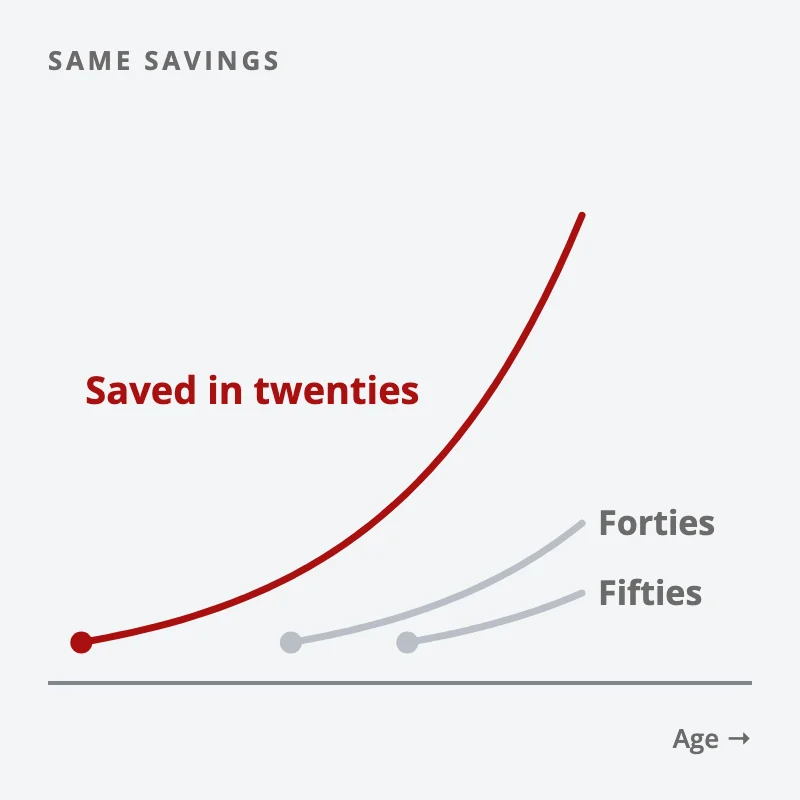
Three growth curves for the same sum saved in the twenties, forties and fifties; the one started in the twenties ends far higher
The same savings started in your twenties grow far more than savings started later.

It also gets harder with age, not easier. Expenses pile up as you get older. Property, health spending, and raising a family take up most of your money. Saving gets a lot harder when the children are begging you for the latest mobile device for their birthdays.

Gambling and entertainment quietly eat away at your nest egg, so stay clear of them. And if you are reading this past your twenties, do not despair. It is never too late to start getting your money habits sorted out.

Regret #2: Not investing the time to learn

Back in the 1980s, investing was genuinely hard to learn without the internet. Today that excuse is gone. Kids these days build a website from scratch without supervision, so you can certainly find a way to learn something that pays you dividends in the long run.

Most people complain about not knowing what to invest in. That is a reasonable complaint. But here is the deeper problem underneath it.

The reason most people cannot invest money is that they do not even invest time to learn how to invest. Time is sacred. Use it wisely, and use it on what matters.

If your entire financial vocabulary is:

  • buying blue-chip stocks for the long term
  • mutual fund investments
  • investment-linked insurance policies (insurance bundled with an investment fund)

then you are missing a large chunk of the pie. A good diversified portfolio holds much more than just stocks. Holding only stocks can be very risky. In the 2008 crisis, the S&P 500 fell about 57% from its 2007 peak. Multi-asset, multi-instrument investing (spreading money across stocks, bonds, forex, commodities, and more) is the norm now.

One more myth worth killing: people assume learning to trade or invest is hugely time-consuming. It is not. Like any skill, it takes practice at first, and a rules-based routine keeps the daily time short.

Here is the part the brochures skip. The tools are now nearly free. A screener will find a setup, a robo-advisor will rebalance a portfolio, an app will track everything. What none of them supply is the judgment to know which risk is worth taking and the discipline to sit out the rest. That judgment is the one piece you actually have to build yourself, and it is the first of the Five Edges that no tool can hold for you.

Regret #3: Spending too much on the children

Many parents look back on their years as young parents and say the same thing: we should have spent less. The bad outcomes are familiar. Spoilt children. Children who expect a lot but contribute little.

This is not about being stingy. It is about spending on the things that last instead of the things that get thrown away. Among the many unnecessary expenses, parents could do well to trim any of these:

  • Extra-curricular lessons like ballet, music, or swimming, especially if the child is not enjoying them
  • Tuition lessons, since the school system in Singapore is honestly quite robust
  • Expensive pre-school education, because they will not remember it anyway
  • Expensive holidays, which we do not remember a year later
  • Toys that get thrown away three months later
  • Expensive meals at fancy restaurants, because food is still food
  • Overseas university education, when a local degree can be just as profitable for your child
  • Expensive childcare services, when reasonably priced ones do the same job
  • A domestic helper, when teaching the kids to take care of the house makes more sense

We sometimes put too high a premium on a university degree. Pay what is fair and reasonable. Do not spend half a million dollars on one.

And here is the real point. Many parents have money but very little time for their children. Ask any child and you will find they would much rather spend time with their parents than have an expensive holiday in Paris, Dubai, or Tokyo.

In hindsight you always know better. So take the advice of our seniors: spend on what really matters, which is your time. What use is all the cool stuff, the premium lessons, and the holidays, if we miss the one thing that truly counts?

The three regrets at a glance

RegretWhy it happensThe fixStart when
#1 Not saving youngCompounding is invisible early; expenses pile up with ageSave early and automatically; cut gambling and entertainment leaksToday, at any age
#2 Not learning to invest“I don’t know what to buy” plus the myth that it takes too much timeSpend a few weeks learning; diversify beyond stocks; then a few minutes a dayAfter a few weeks of study
#3 Overspending on kidsConfusing money spent with love shownTrim the throwaway expenses; give time insteadBefore the habits set in

How to avoid all three at once

Notice the thread running through every regret. Each one is a trade of a small, early, slightly boring decision for a large, late, painful one. Saving early is boring. Spending two weeks learning to invest is boring. Choosing an evening at home over a flashy holiday is boring. The regret is what arrives when you skip the boring version.

So pick the version your future self will thank you for. Start the savings habit now. Put in the few weeks to learn investing properly, across more than one asset class. And spend on time with the people who matter, not on things they will forget. None of this needs more money. It needs an earlier decision.

FAQ

What is the most common financial regret of retirees in Singapore?
Not saving money when young. It is the single most common regret reported by seniors worldwide, because compounding rewards early savers and expenses only grow heavier with age.

Why does saving early matter so much?
Because of compounding. Saving $10,000 in your twenties grows into far more than the same $10,000 saved in your forties or fifties, since the early money has decades longer to compound.

Is investing only in stocks risky?
Yes. Holding only stocks can be very risky. In the 2008 crisis, the S&P 500 fell about 57% from its 2007 peak. A diversified, multi-asset portfolio spreads that risk.

Does learning to invest take a lot of time?
It takes practice. Like any skill it takes time to learn, and a rules-based routine keeps the daily time short.

How can I avoid these regrets if I am already past my twenties?
It is never too late. Start the savings habit now, spend a few weeks learning to invest beyond stocks, and redirect spending toward time with the people who matter.


The seniors who shared these regrets are not telling you to earn more. They are telling you to decide earlier. Which of the three regrets is the one you would most want to avoid? Let me know in the comments.

And if regret #2 is the one that stings, that is the most fixable of all. Start with the pillar: How to Start Investing and Trading in Singapore: A Beginner’s Guide.

Want the few-minutes-a-day version? Grab the free 15-Minute Swing Trading Starter Kit. It is the exact routine I use to scan once a day and trade any market in 15 minutes, which is the practical answer to regret #2.


About the author. Spencer Li is The 15-Minute Trader and the founder of Synapse Trading. He is a Certified Financial Technician (CFTe) with 15+ years of trading, run from 70+ countries. He holds a B.Acc and B.BM from SMU. Every trade he takes is public, dated, losses left in. He teaches rules-based swing trading in 15 minutes a day, one system for any market.

Education, not financial advice. Synapse Trading is not licensed by MAS to advise on investment products. Trading carries risk of loss; past performance is not indicative of future results.
Related

How to Start Investing and Trading in Singapore (pillar)

by Spencer Li
https://synapsetrading.com/wp-content/uploads/2026/10/3-biggest-financial-regrets-of-retirees-in-singapore-and-how-to-avoid-them-card.webp 630 1200 Spencer Li https://synapsetrading.com/wp-content/uploads/2026/10/synapse-logo-horizontal-light.png Spencer Li2017-04-12 05:54:292026-08-07 12:37:373 Biggest Financial Regrets of Retirees – And How to Avoid Them!
Spencer Li

An Easy Way to Diversify your Investment Portfolio

Risk & Money Management
An easy way to diversify - investing

You’ve probably heard about the importance of diversifying your portfolio.

The question is how do you do it and what if you have limited capital to invest and can’t afford to purchase a lot of different stocks at once? In this video, we’ll introduce you to two new asset classes: exchange-traded funds or ETFs and real estate investment trusts or REITs. These will enable you to diversify your portfolio and generate passive income without having to invest too much. First, let’s look at ETFs also known as tracker funds.

ETFs track the performance of a stock index like the STI Dow Jones Hang Seng or commodity and bond indices. These are useful for new investors because by simply investing in ETFs you’re effectively investing in the price movements of all the companies listed on the underlying index. This makes it much easier to diversify your portfolio, then if you picked individual stocks and commodities especially if you’re starting out with limited capital.

Besides stocks and ETFs, however, there is another popular asset class, one that’s been around for thousands of years. Yup, real estate. So, how can a new investor with limited funds, invest in this market? Through a real estate investment trust or REIT.

A REIT is a company that invests in real estate properties and by investing in a REIT, you can share the benefits and risks of owning a real estate portfolio. In short, a REIT allows you to buy and sell properties as if they were stocks by buying a stake in a REIT.

You are effectively vested in all the properties owned by the REIT, so as the REIT makes its profits from asset appreciation and rental income, you will receive regular payouts which can provide you with passive income.

We’ve come to the end of part 1 of our video series. We hope you’ve learned the importance of making your money work for you and the different asset classes and opportunities that are available to you. In the next part of our series, we’ll explore the big market cycles and find out how to better time your purchases so you can receive the biggest benefits possible.

by Spencer Li
https://synapsetrading.com/wp-content/uploads/2026/10/free-video-tutorials-basics-of-trading-investing-1c-an-easy-way-to-diversify-your-portfolio-card.webp 630 1200 Spencer Li https://synapsetrading.com/wp-content/uploads/2026/10/synapse-logo-horizontal-light.png Spencer Li2016-03-29 01:30:282026-08-30 20:56:34An Easy Way to Diversify your Investment Portfolio
Spencer Li

The 2% Money Management Rule for Trade Position-Sizing

Risk & Money Management
Position sizing with 2% - position sizing

What is the one rule that all professional traders use, but many retail traders forget, or are simply unaware of?

We all know that the goal of trading is to make money, and as long as you have an edge in the market, you will be profitable in the long-run.

So the next question is, how do you maximize your profitability without blowing up your account?

The answer lies in the 2% money management rule.

Let’s use a hypothetical example where you start betting with $10,000. In this scenario, you have hitrate (winning chance) of 60%, and you either win double of what you bet, or lose the whole sum of what you bet. How much would you bet each time?

If you bet the whole $10,000, you have a 60% chance of doubling your money, but you also have a 40% chance of losing everything. That is exciting for a gambler, but not ideal if you want to remain profitable in the long-run.

What if you split your $10,000 into 2 bets of $5000 each? Your probability of losing 2 bets in a row is only 16% (40%*40%), which means your chances of losing everything is much less. Sounds good? What if you take it one step further, and split your $10,000 into 10 bets of $1000 each? The odds of losing everything drops to just 0.01%.

In trading, the secret of money management is not to focus on making the most money, but rather to ensure that you do not lose your capital.

As Warren Buffet once said, the number one rule of his is to not lose money.

How does this apply to your trading?

According to the 2% rule, when we take a trade, we will only risk 2% of our capital on each trade, meaning for a $10,000 account, we will only be risking $200 per trade, and that is the maximum amount that we can lose for each trade. (Risk is calculated as the difference between the entry price and stoploss price, multiplied by the quantity traded.)

With this 2% money management rule, the only way to lose all your trading capital is to lose 50 times in a row, and the probability of that happening is less than 0.000000000000000001%.

We have most likely heard horror stories of traders blowing up their account, and that happens when they break this rule. If you stick to this 2% money management rule, it is almost impossible for you to blow up your account, and you will see a marked improvement in your trading results.

And this is what separates the professionals from the average trader.

Which one are you today? 😀


About the author. Spencer Li is The 15-Minute Trader and the founder of Synapse Trading. He is a Certified Financial Technician (CFTe) with 15+ years of trading, run from 70+ countries. He holds a B.Acc and B.BM from SMU. Every trade he takes is public, dated, losses left in. He teaches low-risk swing trading in 15 minutes a day, one system for any market.

Education, not financial advice. Synapse Trading is not licensed by MAS to advise on investment products. Trading carries risk of loss; past performance is not indicative of future results.
by Spencer Li
https://synapsetrading.com/wp-content/uploads/2026/10/money-management-position-sizing-card.webp 630 1200 Spencer Li https://synapsetrading.com/wp-content/uploads/2026/10/synapse-logo-horizontal-light.png Spencer Li2015-05-29 04:36:372026-09-10 13:35:18The 2% Money Management Rule for Trade Position-Sizing
Spencer Li

Shortcuts to Analyzing Financial Ratios for Stocks

Risk & Money Management
Shortcuts to financial ratios - stock analysis

Seven ratios do most of the filtering when you judge a company: gross margin, net margin, return on equity, the current ratio, debt to cash flow, net gearing and dividend yield. Each one turns two numbers from the financial statements into a single figure you can compare across companies.

Reading financial statements is one thing; analyzing them and deciphering their true meaning is another. To do that, you need to understand the seven essential financial ratios. They’re like a shortcut for filtering out good stocks.

Do note that the levels below are rough rules of thumb rather than pass marks. A healthy margin for a supermarket would be a weak one for a software company, and banks and REITs are judged on different measures altogether. So compare a company with others in its own industry before you read too much into any single ratio.

The first is gross profit margin. This represents the proportion of money left over after subtracting the cost of goods sold. To calculate gross profit margin, take gross profit and divide by sales. The higher the margin, the more profitable a company is. Margins of 15% or more are considered good.

The second ratio is net profit margin. This represents the portion of money left after subtracting all expenses. To calculate net profit margin, divide net profit by sales. The higher the margin, the more profitable the company is. In general, look for margins of 7% or more.

The third ratio is return on equity or ROE. This measures how much profit a company makes from shareholder equity. To calculate ROE, take the net profit and divide it by equity. The higher the number, the more money the company makes for its shareholders. Look for an ROE of 15% or higher.

The fourth essential ratio is the current ratio. This measures a company’s current assets against its current liabilities. To calculate the current ratio, simply divide the current assets by the current liabilities. The higher the ratio, the more likely the company will be able to cover short term liabilities. A good current ratio is anything above 1.

The fifth ratio you should know is the debt to cash flow ratio. This measures the company’s debts against its operating cash flow. To calculate this, take the company’s total debt and divide it by operating cash flow. The lower the ratio, the better the company’s ability to finance their operations, any ratio less than or equal to three is considered good.

The sixth essential ratio is the net gearing ratio. This measures the company’s debts against its shareholder equity. To calculate this ratio, first take the total debt and subtract the company’s cash, then divide that number by the equity. The higher the ratio, the more debt and therefore risk the company has. Look for a net gearing ratio of 0.5 or less.

Finally, the seventh essential ratio is the dividend yield. This measures how much in dividends the company pays out compared to their stock price. To calculate the dividend yield, take the dividend per share and divide it by share price. The higher the yield, the more dividends shareholders receive. Look for companies with consistent yields between 4 and 7 percent. A yield far above that range deserves a second look, because the price may have fallen on fears that the dividend is about to be cut.

Run these 7 ratios and most weak companies drop out in a few minutes. What is left still needs the slower work from part 1 of this series: the business itself, and the people running it.

The stock valuation series: 1. How to Find Undervalued Stocks for Investment · 2. How to Read Stock Financial Statements · 3. Shortcuts to Analyzing Financial Ratios for Stocks · Going deeper: Book Summary: The Intelligent Investor by Benjamin Graham

Want the daily routine? Get the free 15-Minute Swing Trader’s Checklist.

Educational content only, not personalised financial advice. Trading carries risk, including loss of capital. Past performance is not indicative of future results. Synapse Trading is not licensed or regulated by MAS.

by Spencer Li
https://synapsetrading.com/wp-content/uploads/2026/10/free-video-tutorials-the-abcs-of-stock-valuation-3c-financial-ratio-shortcuts-card.webp 630 1200 Spencer Li https://synapsetrading.com/wp-content/uploads/2026/10/synapse-logo-horizontal-light.png Spencer Li2015-05-08 08:00:332026-09-07 19:21:23Shortcuts to Analyzing Financial Ratios for Stocks
Spencer Li

How to Read Stock Financial Statements

Risk & Money Management
Reading financial statements - stock analysis

Every listed company publishes three financial statements. The balance sheet shows what it owns and owes on one day. The income statement shows whether it made a profit over a period. The cash flow statement shows whether real cash actually came in. You read all three together, because a company can report a profit and still run short of cash.

If you really want to know how a company is doing, you need to read their financial statements. It’s the fastest and most reliable way to know if a company is doing well or struggling to survive.

There are three different kinds of financial statements: the balance sheet, the income statement and the cash flow statement. First, let’s start with the balance sheet. This summarizes a company’s assets, liabilities and equity at a specific time.

Assets are broken down into two categories: current assets which include cash and highly liquid investment securities, and non-current assets, which include property, buildings, plant, equipment and software. Next are the company’s liabilities, also split into two. Current liabilities include bank loans, accounts payable and other payables such as payroll and accrued expenses. Non-current liabilities include long-term loans and other long-term financial obligations. If you subtract the total liabilities from the total assets, you get the total shareholders equity.

Now, let’s move to the company’s income statement. This measures how much profit or loss the company has made over a specific period of time, which is why it’s also referred to as a P&L statement. First, you have revenue which is the amount of money the company makes by selling products or providing services.

Next comes COGS, or cost of goods sold, which is the amount spent producing or acquiring the products or services, including material and labor costs. Subtract COGS from revenue and you’ve got gross profit. Then come the operating expenses, which include day-to-day things like marketing costs and indirect labor costs. Subtract those from gross profit and you’ve got operating income. Next, subtract all other miscellaneous expenses and you’ve got the company’s profit before tax. Subtract the tax and you’ve got net profit.

And that leads us to the third financial statement, the cash flow statement. This measures how much cash flows in and out of a company over a specific period because a company’s revenue and expenses can be delayed or deferred. This shows the actual cash flowing in and out of the company. First, you add together the cash flows from all operating activities including profit before taxes, trade and other receivables, and trade and other payables then you add the cash flows from investment activities along with the cash from financing activities. You then, compare the cash at the beginning of the financial year to the cash at the end, to determine if the company had a positive or negative cash flow and that’s how you read a company’s financial statements.

Where do I find a company’s financial statements?

For a company listed in Singapore, the annual report and the half-yearly or quarterly results sit on SGX’s company announcements page, and usually on the company’s own investor relations page too. For a US-listed company, the annual report is the 10-K and the quarterly one is the 10-Q, and both are free on the SEC’s EDGAR search. Start with the latest annual report. It carries all three statements in one place, along with the notes that explain them.

The next step is turning these numbers into a handful of ratios you can compare across companies: Shortcuts to Analyzing Financial Ratios for Stocks.

The stock valuation series: 1. How to Find Undervalued Stocks for Investment · 2. How to Read Stock Financial Statements · 3. Shortcuts to Analyzing Financial Ratios for Stocks · Going deeper: Book Summary: The Intelligent Investor by Benjamin Graham

Want the daily routine? Get the free 15-Minute Swing Trader’s Checklist.

Educational content only, not personalised financial advice. Trading carries risk, including loss of capital. Past performance is not indicative of future results. Synapse Trading is not licensed or regulated by MAS.

by Spencer Li
https://synapsetrading.com/wp-content/uploads/2026/10/free-video-tutorials-abcs-stock-valuation-3b-reading-financial-statements-card.webp 630 1200 Spencer Li https://synapsetrading.com/wp-content/uploads/2026/10/synapse-logo-horizontal-light.png Spencer Li2015-02-22 08:30:502026-09-21 12:27:17How to Read Stock Financial Statements
Page 5 of 6«‹3456›

Free checklist

The 15-Minute Swing Trader’s Checklist

The daily and weekly routine I use to find, manage and review trades in about 15 minutes a day, on the record since 2014.

Get the free checklist

Topics

  • Trading foundations
  • Technical analysis
  • Strategies and systems
  • Risk and money
  • Trading psychology
  • Markets and products

Synapse Trading

Swing trading for busy professionals, in 15 minutes a day.

Start free

Learn

  • Start here
  • Free trading guides
  • Blog
  • Tools and resources

Programs

  • Trading Mastery Program
  • Daily trading signals
  • Student results
  • Public trade log

Company

  • About
  • Contact me
  • Partnerships
  • Disclaimer
  • Privacy policy
  • Terms & Conditions

Synapse Trading Pte Ltd
Registration No. 201316168H
WhatsApp +65-8897-1204
info@synapsetrading.com

Contact Us

Synapse Trading Pte Ltd
Registration No. 201316168H

Whatsapp: +65-8897-1204
Telegram: @iamrecneps
Email: info@synapsetrading.com

Links

Disclaimer
Privacy policy
Terms & Conditions
Contact us
Partnerships

© 2012-2026 Synapse Trading | All rights reserved. Educational content only, not personalised financial advice. Trading carries risk, including loss of capital. Past performance is not indicative of future results. Synapse Trading is not licensed or regulated by MAS.
  • Link to Facebook
  • Link to X
  • Link to Instagram
  • Link to Youtube
  • Link to LinkedIn
  • Link to Mail
Scroll to top Scroll to top Scroll to top