Last updated: 20 July 2026 · By Spencer Li, CFTe
The Kelly criterion is a formula for how much of your account to risk on each trade so that the account grows as fast as possible over the long run. For trading, it reads: Kelly % = W − (1 − W) ÷ R, where W is your win rate and R is your average win divided by your average loss.
A hypothetical example: a strategy wins 50% of the time and its average win is twice its average loss. Kelly says to risk 0.5 − 0.5 ÷ 2, which is 25% of the account on every trade. Most traders risk 1% to 2%.
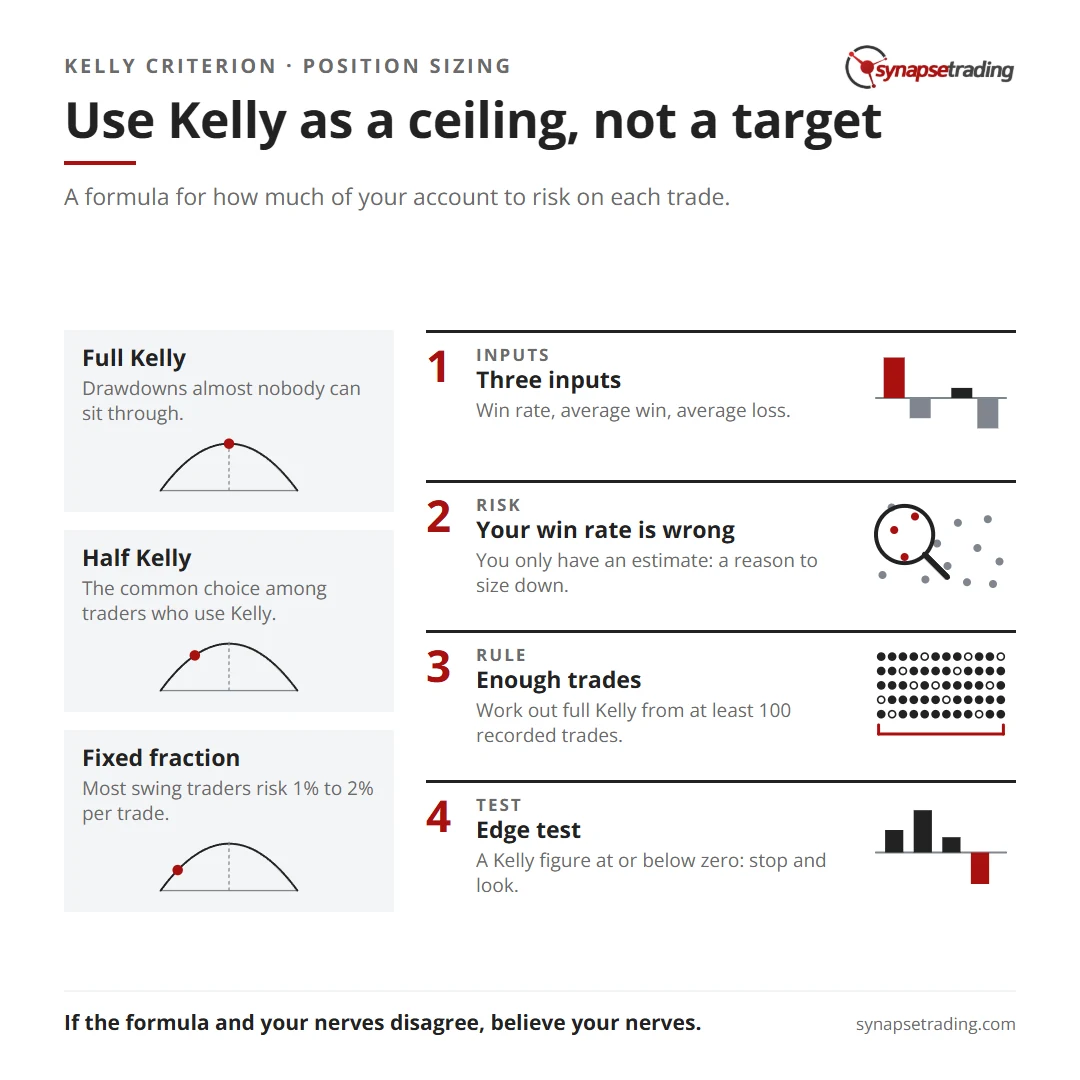
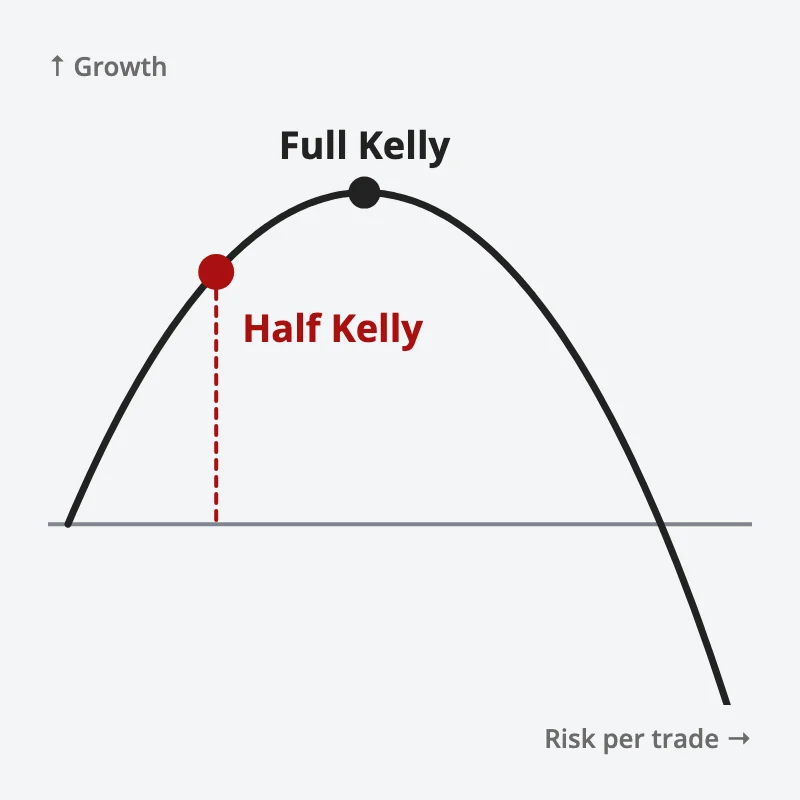
That gap is the whole story of this post. Full Kelly is the mathematically fastest growth rate, and it comes with drawdowns almost nobody can sit through. Most traders who use Kelly at all use half of it or less, and treat it as a ceiling on their position size instead of a target.
Where does the Kelly criterion come from?
From a 1956 paper by J. L. Kelly Jr., a researcher at Bell Labs, titled “A New Interpretation of Information Rate.” He was working on how a gambler with an edge should size bets to grow wealth fastest over many rounds. Traders borrowed it because a trade with a stop loss looks a lot like a bet: a known amount at risk, a chance of winning, and a payoff if it works.
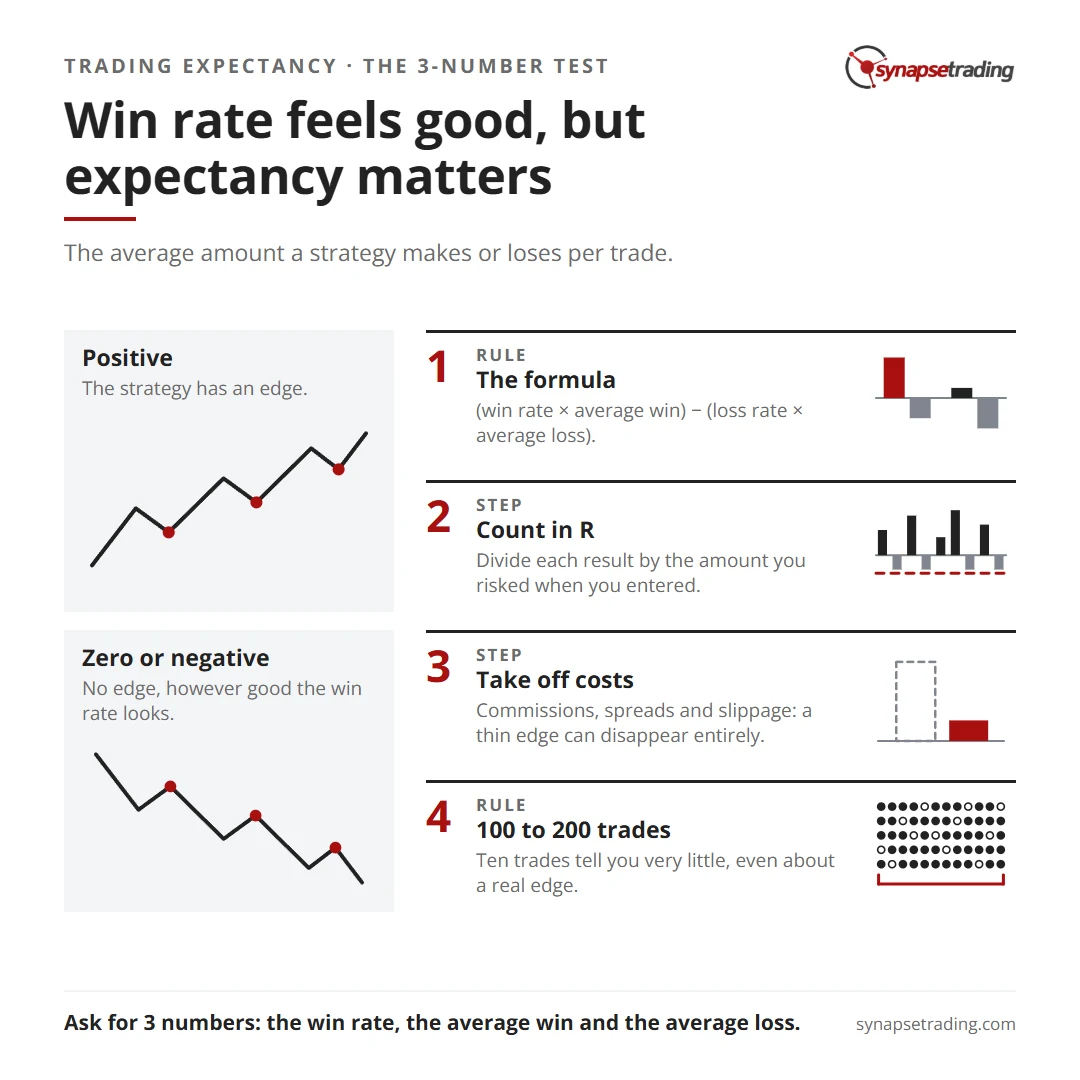
The formula needs 3 inputs, the same 3 that give you your trading expectancy: the win rate, the average win and the average loss. Here is what it says for a few hypothetical strategies:
| Win rate | Average win ÷ average loss | Kelly % (share of account to risk per trade) |
| 30% | 2 | −5%, so do not trade it |
| 40% | 2 | 10% |
| 55% | 1 | 10% |
| 40% | 2.5 | 16% |
| 60% | 1 | 20% |
| 50% | 2 | 25% |
| 50% | 3 | 33.3% |
Do note the first row. When a strategy has no edge, Kelly comes out at zero or below. That is the formula’s most useful answer, and it costs nothing to apply.
Why is full Kelly too much for real trading?
Because the fastest growth comes with brutal swings along the way. Take the 50% win rate, 2-to-1 strategy, where full Kelly is 25%.
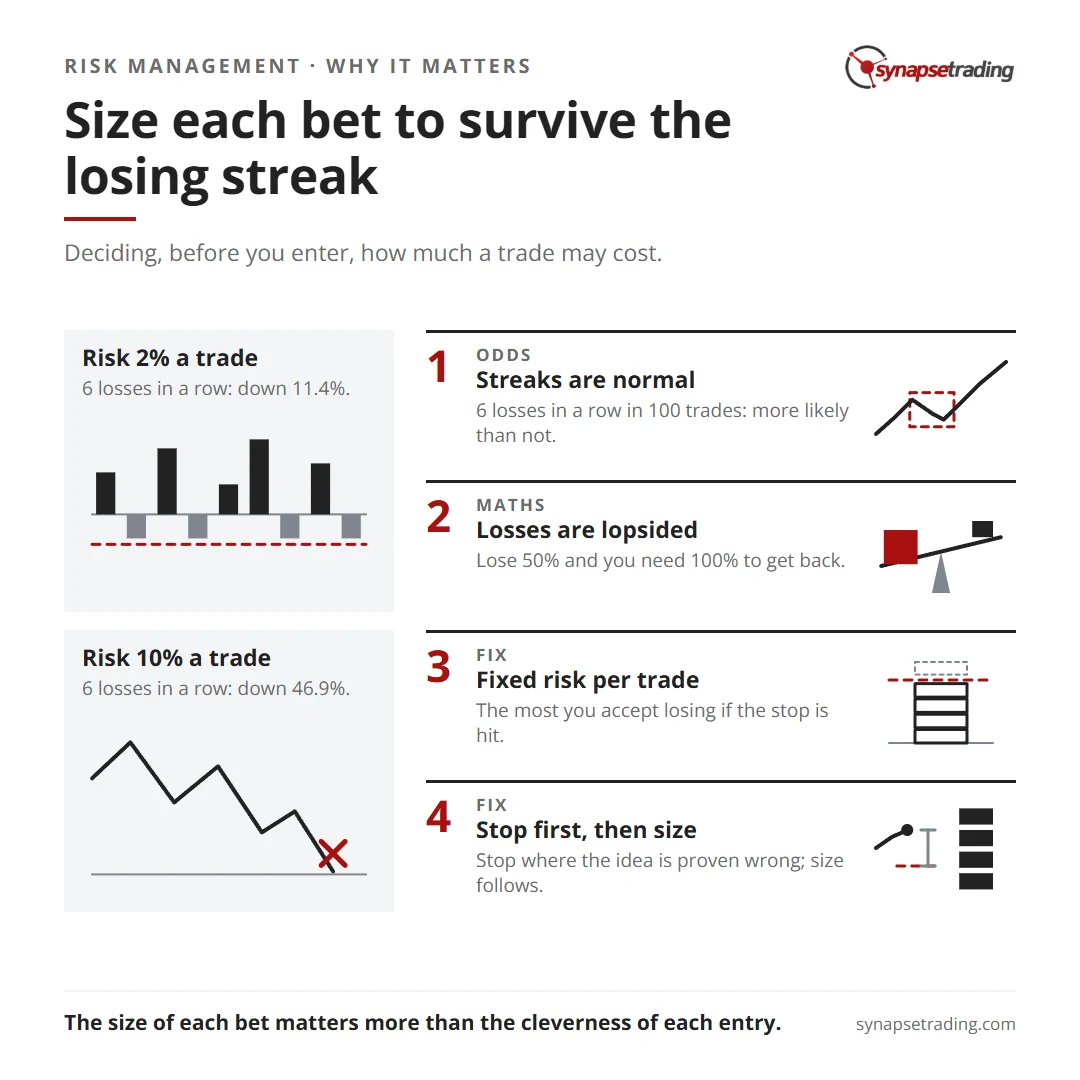
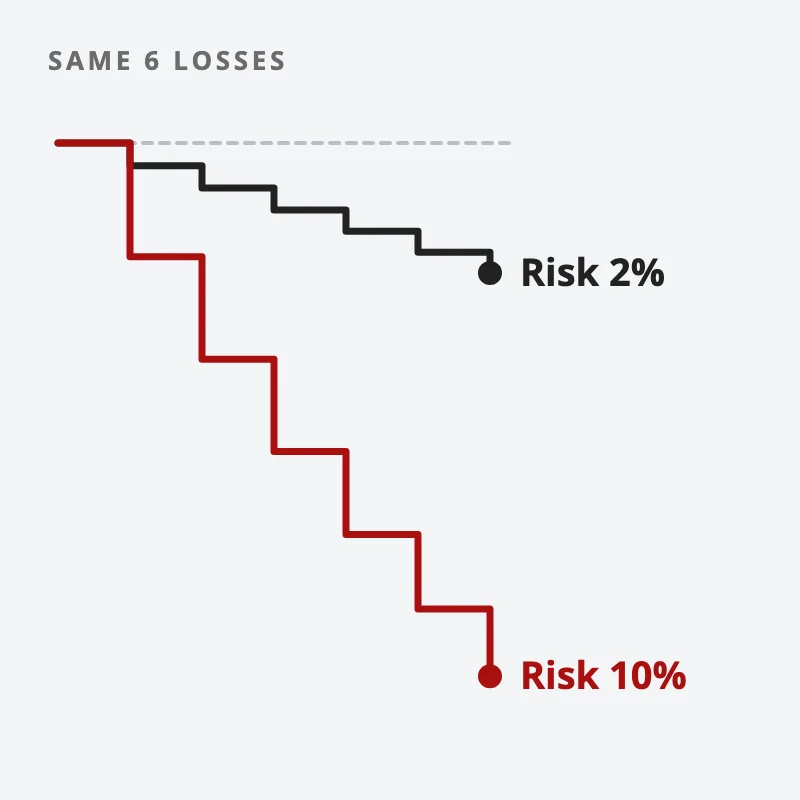
At 25% risk, 4 losses in a row take the account down 68.4%. With a 50% win rate, the chance of at least one run of 4 straight losses somewhere in 100 trades is 97.3%. It will happen, probably more than once. At 1% risk the same 4 losses cost 3.9%.
I ran the same strategy through 1,000 simulated trades, thousands of times over, at different fractions of Kelly:
| Sizing | Risk per trade | Growth, as a share of full Kelly’s | Chance the account falls to half its start | Chance of a 50% fall from a peak |
| Full Kelly | 25% | 100% | 42.6% | 100% |
| Half Kelly | 12.5% | 76.1% | 10.8% | 100% |
| Quarter Kelly | 6.25% | 45.2% | 0.7% | 62.7% |
Hypothetical, 50% win rate, average win 2R, each trade independent, 1,000 trades per run.
Half Kelly keeps about three quarters of the growth and cuts the chance of halving the account by about three quarters. That trade-off is why it is the common choice among traders who use Kelly at all. Even so, look at the last column. At half Kelly, a 50% drop from a high point still turned up in every single simulated run, which tells you how aggressive even “conservative” Kelly is for most people.
Going the other way is worse. At twice full Kelly the long-run growth rate falls to zero, and anything beyond that shrinks the account over time, even with a real edge.
If you want a daily routine that keeps every position inside your limits, the free 15-Minute Swing Trader’s Checklist is at the end of this post.
What if your win rate is wrong?
This is the strongest objection to Kelly, and it is a good one. A trader on r/algotrading titled his July 2025 post “The Flaw in the Kelly Criterion – Betting Under Uncertainty”. Kelly assumes you know your true win rate and payoff. You never do. You only have an estimate, taken from a limited number of past trades.
The concession matters, because Kelly punishes overestimates hard. Say you measured a 50% win rate at 2-to-1 and sized at 25%, but the true win rate is 45%. The true Kelly figure is 17.5%, so you are betting more than 1.4 times the right amount. In that case, half of your estimated Kelly, 12.5%, actually grows the account faster than the full 25% you calculated.
So the uncertainty itself is a reason to size down. A win rate measured over 30 trades can easily be several points off the truth, which is why the law of large numbers matters before any sizing formula does.
How should a swing trader actually use Kelly?
As a ceiling. Work out full Kelly from at least 100 recorded trades, then treat it as the absolute maximum you could ever justify risking on one trade. Your real risk per trade sits far below it.
This is Kelly as a ceiling, and it does 2 useful jobs. First, it is a quick edge test. A Kelly figure at or below zero tells you to stop and look at the strategy. Second, it is a sanity check on your sizing. If your risk per trade is anywhere near the Kelly figure, you are taking far more risk than you need to.
For the day-to-day number, most swing traders use a fixed fraction of the account, typically 1% to 2% per trade. The 2% money management rule for position sizing walks through how to turn that into a share count. A fixed small fraction grows more slowly than Kelly in theory, and it keeps you far away from the drawdowns in the table above, which is where risk of ruin lives.
Personally, I treat Kelly as an upper bound and size well below it. The exact sizing rules we teach stay in the course, but the principle is simple enough to use today: if the formula and your nerves disagree, believe your nerves and bet smaller.
The full map of these ideas is in the practical guide to money and risk management.
The formula said 25%. It was right about the growth, and it said nothing about the morning you open the account to find two thirds of it gone.
FAQ
What is the Kelly criterion formula for trading?
Kelly % = W − (1 − W) ÷ R, where W is the win rate and R is the average win divided by the average loss. The answer is the share of the account to risk per trade.
Is the Kelly criterion good for trading?
It is useful as an edge test and as an upper limit on size. Used at full strength, it produces drawdowns most traders cannot sit through.
What is half Kelly?
Risking half of what the Kelly formula gives. In the example above it kept about 76% of the long-run growth while cutting the chance of halving the account from 42.6% to 10.8%.
What does a negative Kelly number mean?
It means the strategy has no edge on the numbers you entered. The formula’s answer is to risk nothing.
How many trades do I need before using Kelly?
At least 100, and more is better. A win rate measured on a small sample is often several points off, and Kelly turns that error into oversized bets.
Go deeper
The free 15-Minute Swing Trader’s Checklist has the daily routine, the questions to ask before every trade, and the five rules that keep you in the game.
About the author. Spencer Li is The 15-Minute Trader and the founder of Synapse Trading. He is a Certified Financial Technician (CFTe) with 15+ years of trading, run from 70+ countries. He holds a B.Acc and B.BM from SMU. Every trade he takes is public, dated, losses left in. He teaches low-risk swing trading in 15 minutes a day, one system for any market.
Educational content only, not personalised financial advice. Trading carries risk, including loss of capital. Past performance is not indicative of future results. Synapse Trading is not licensed or regulated by MAS.