• Link to Facebook
  • Link to X
  • Link to Instagram
  • Link to Youtube
  • Link to LinkedIn
  • Link to Mail
Free PDF: The 15-Minute Swing Trader's Checklist, the daily routine on the record since 2014
Synapse Trading
  • Mentoring
    • Trading Mastery Program
    • All mentoring options
  • Signals
    • Daily trading signals
    • Signals trade log
  • Results
    • Student results and testimonials
    • Public trade log, losses left in
  • Free guides
    • Start here
    • Trading foundations
    • Technical analysis
    • Strategies and systems
    • Risk and money
    • Trading psychology
    • Markets and products
    • Free trading guides
    • Tools and resources
    • Blog
  • About
    • My background
    • My trading journey
    • Media and interviews
    • Travel log
  • Contact
    • Contact me
    • Partnerships
  • Start free
  • Click to open the search input field Click to open the search input field Search
  • Menu Menu
Spencer Li

Top 17 Finance & Investment Books to Read (With Key Ideas)

Trading Foundations
17 finance books worth reading - book list

The Best Finance and Investment Books to Read (and Where to Start)

Last updated: 12 July 2026 · By Spencer Li, CFTe


If you want the single best finance book to start with, read Benjamin Graham’s “The Intelligent Investor” (1949), because it teaches the two ideas the rest of the field is built on: margin of safety (only buy when the price is well below your estimate of value) and treating “Mr. Market” as a moody business partner you can ignore. From there, the right next book depends on what you actually want. To grow real-world wealth and stop leaking money, read John C. Bogle and Dave Ramsey. To understand risk and the rare events that blow people up, read Nassim Taleb. To build the right portfolio rather than pick the right stock, read William Bernstein. To fix the mindset behind the money, read Stanley and Danko, Kiyosaki, and Robin and Dominguez. You do not need to read all seventeen. You need the right six or seven, in roughly the right order, and the patience to apply one idea before reaching for the next.

Below is the short, curated version, grouped by what you are trying to learn, with a one-line note on each so you can pick fast.
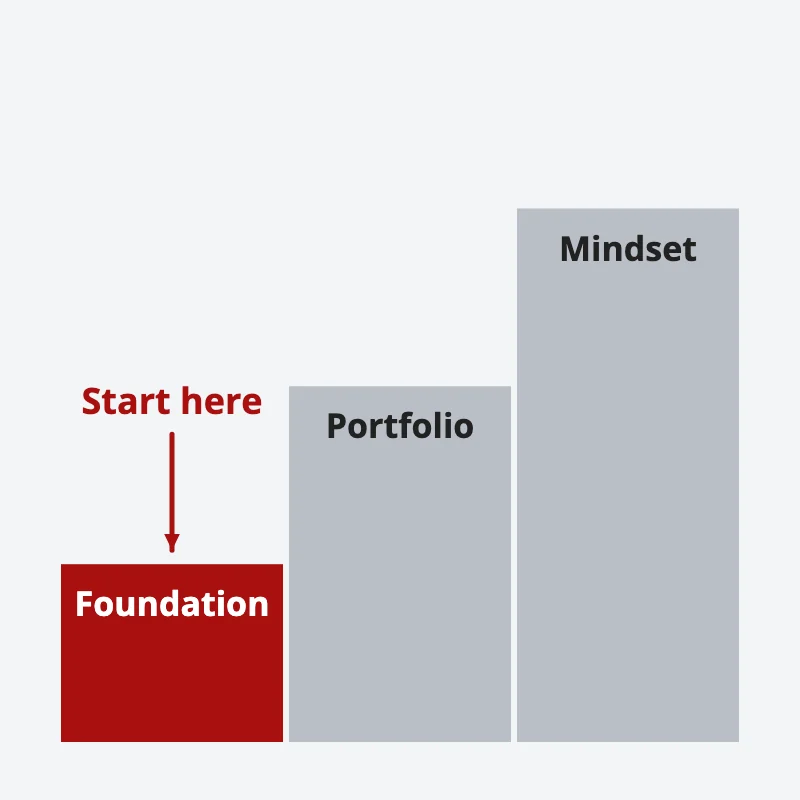
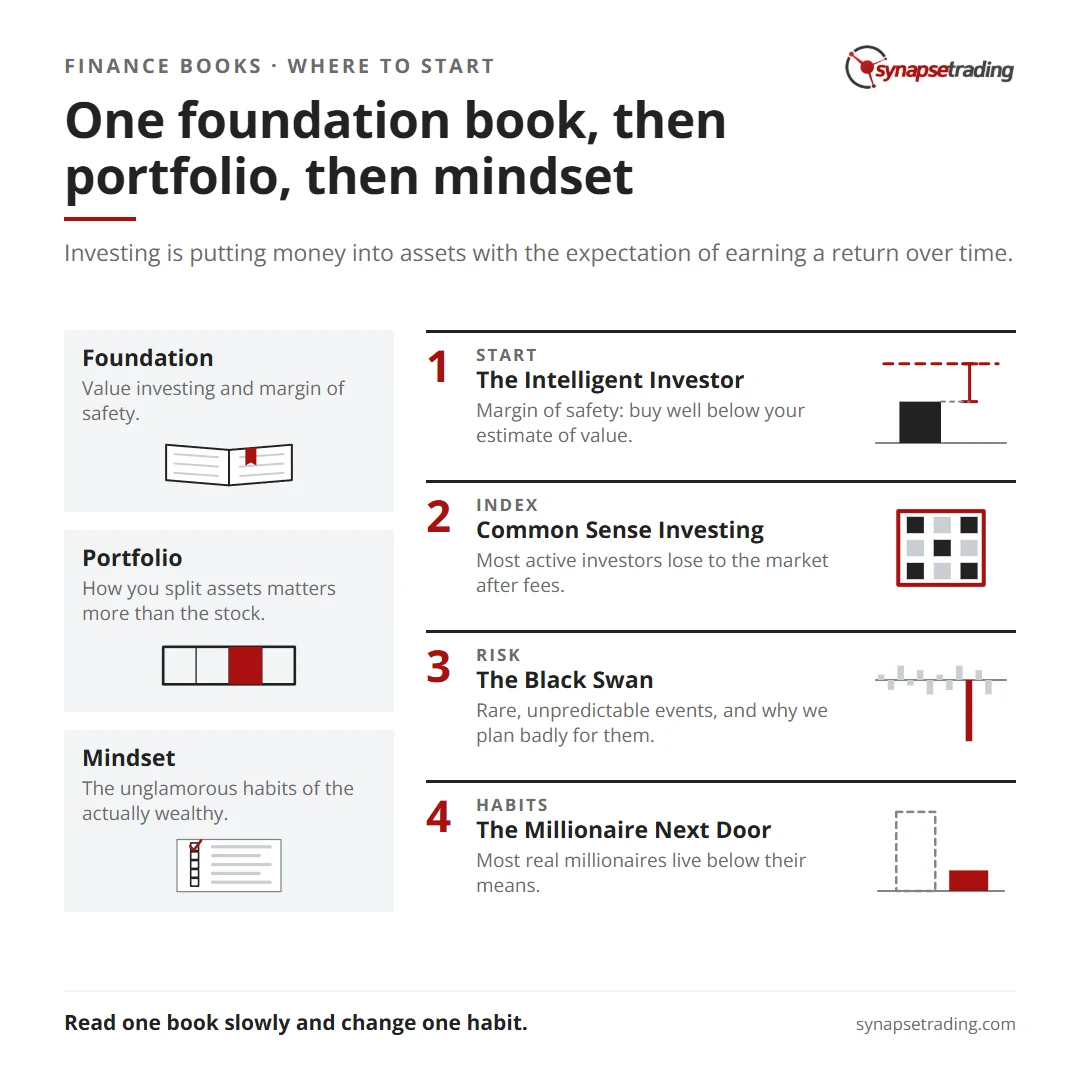
Three steps of a reading order: a foundation book first, then a portfolio book, then a mindset book
Read one foundation book first, then one on portfolio building, then one on mindset.

One foundation book, then portfolio, then mindset. Summary card for the post: Top 17 Finance & Investment Books to Read (With Key Ideas).

Why learn about investing at all?

Investing is putting money into assets (stocks, bonds, funds, property, commodities) with the expectation of earning a return over time. People learn it for a few honest reasons: to grow wealth, to save for long goals like retirement or a child’s education, to diversify so one bad bet does not sink them, and to understand the economy they live and work in.

Personally, I think books are the cheapest way to do that. A good finance book is years of someone else’s expensive mistakes for the price of a coffee or two. The trap is collecting them instead of using them. Reading thirty summaries does nothing. Reading one book slowly and changing one habit does a lot.

What are the best finance and investment books, grouped by what you want to learn?

Here are the genuine standouts from the longer list, sorted so you can find the one that fits.

BookAuthorYearWhat it teachesRead it if you want to
The Intelligent InvestorBenjamin Graham (commentary by Jason Zweig)1949Value investing, margin of safety, “Mr. Market”Start with the foundation
Security AnalysisBenjamin Graham and David Dodd1934The deeper, technical roots of value investingGo one level beneath Graham’s classic
The Little Book of Common Sense InvestingJohn C. Bogle2007Why low-cost index funds beat most active investorsStop overpaying and just own the market
The Black SwanNassim Nicholas Taleb2007How rare, unpredictable events shape outcomesTake risk and uncertainty seriously
The Intelligent Asset AllocatorWilliam Bernstein2000Asset allocation and portfolio constructionBuild the portfolio first
The Millionaire Next DoorThomas Stanley and William Danko1996The unglamorous habits of the actually wealthySee where real wealth comes from
Rich Dad Poor DadRobert Kiyosaki1997Financial literacy, assets vs liabilitiesShift how you think about money
The Total Money MakeoverDave Ramsey2003A step-by-step plan to clear debt and build wealthGet out of debt and start saving
Your Money or Your LifeVicki Robin and Joe Dominguez1992Aligning money with your values and timeSpend on what actually matters

Start here: the foundations of investing

  • “The Intelligent Investor” by Benjamin Graham (1949). The classic on value investing and risk. Margin of safety and the Mr. Market parable are the two ideas the rest of the field keeps re-explaining. If you read one book on this list, read this one. The widely sold modern edition carries Jason Zweig’s commentary alongside Graham’s original text. (Full summary: The Intelligent Investor.)
  • “Security Analysis” by Benjamin Graham and David Dodd (1934). Graham’s earlier, heavier work. The deep, technical roots of value investing. Read it after “The Intelligent Investor”. (Full summary: Security Analysis.)
  • “The Theory of Investment Value” by John Burr Williams (1938). The book that put discounted cash flow analysis (valuing an asset by the future cash it will produce, discounted back to today) on the map. Foundational, and dry. For the genuinely curious reader.

Index investing and building the portfolio

  • “The Little Book of Common Sense Investing” by John C. Bogle (2007). The case for low-cost index funds from the man who built the first one. The argument is simple: most active investors lose to the market after fees, so just own the market cheaply. (Full summary: The Little Book of Common Sense Investing.)
  • “The Intelligent Asset Allocator” by William Bernstein (2000). A clear guide to asset allocation and portfolio management. The point that lands: how you split between asset classes matters more than which stock you pick. (Full summary: The Intelligent Asset Allocator.)

Risk, uncertainty, and the rare event

  • “The Black Swan” by Nassim Nicholas Taleb (2007). On rare, unpredictable, high-impact events and why we are bad at planning for them. Reads as much like philosophy as finance, and it changes how you size risk.

The mindset and habits behind the money

  • “The Millionaire Next Door” by Thomas Stanley and William Danko (1996). The research surprise that most real millionaires live below their means and look nothing like the magazine version. Quietly the most useful book on this list.
  • “The Millionaire Mind” by Thomas Stanley (2000). The follow-up, on the habits and decisions of the self-made wealthy. Same vein, more depth on mindset.
  • “Rich Dad Poor Dad” by Robert Kiyosaki (1997). On financial literacy and the asset-versus-liability distinction. Light on specifics, but the framing shift it gives beginners is real.
  • “Your Money or Your Life” by Vicki Robin and Joe Dominguez (1992). On aligning spending with your values and treating money as life energy you traded for it. The book behind a lot of the modern financial-independence movement.

Debt, personal finance, and wealth building

  • “The Total Money Makeover” by Dave Ramsey (2003). A blunt, step-by-step plan for getting out of debt and building savings. Not sophisticated, and that is the point. It works because it is simple enough to follow.
  • “The Millionaire Fastlane” by MJ DeMarco (2011). Argues that slow saving alone is not the path, and that entrepreneurship and calculated risk are. A useful counterweight to the index-and-wait crowd, taken with a pinch of salt.

Economics and the big picture

  • “The Wealth of Nations” by Adam Smith (1776). The founding text of modern economics: free trade, specialisation, and the market’s “invisible hand”. Historical heavyweight. Read an abridged version unless you are committed.
  • “Capital in the Twenty-First Century” by Thomas Piketty (2013). A data-heavy argument about wealth and income inequality over the long run. Important and demanding. Worth knowing the thesis even if you do not finish it.
  • “The Paradox of Choice” by Barry Schwartz (2004). Not strictly finance, but it explains why more options can make us worse off and more anxious, which matters the moment you open a brokerage account with ten thousand things to buy.

A note on the entries I trimmed

The original list also carried “The Millionaire Mindset” by Gerry Robert. Do note that, when a “best books” list runs long, the back end fills with general motivation rather than finance. If a book is not in the curated sections above, it is not a knock on the book. It is a vote for your time. I would rather hand you the dozen that actually change how you handle money than seventeen you half-remember.

Where the human edge comes in

Here is the part I care about most. Every book on this list is, underneath, a book about decision-making under uncertainty. So is investing itself. A robo-advisor can build you a perfectly allocated portfolio in a minute, and a screener can rank value stocks in a second. What no tool will do is stop you from panic-selling that portfolio in a crash, or from chasing the hot stock your friend just doubled on. Graham’s margin of safety is not really a formula. It is a discipline. That discipline, and the judgment to know when to sit still, is the first of the Five Edges no tool can trade for you. The book teaches the idea. You still have to be the one who holds the line.

FAQ

What is the best finance book for beginners?
“The Intelligent Investor” by Benjamin Graham is the most recommended starting point, because it teaches margin of safety and the “Mr. Market” mindset that underpins almost everything else in investing. If it feels dense, start with “Rich Dad Poor Dad” by Robert Kiyosaki or “The Total Money Makeover” by Dave Ramsey, which are simpler and more immediately practical.

What is the single best investing book of all time?
Most investors point to “The Intelligent Investor” by Benjamin Graham (1949). Warren Buffett, Graham’s most famous student, has called it the best book on investing ever written. For low-cost index investing specifically, “The Little Book of Common Sense Investing” by John C. Bogle is the standard recommendation.

Which finance book should I read to build wealth, not just understand it?
“The Millionaire Next Door” by Thomas Stanley and William Danko shows the real, unglamorous habits of wealthy people, and “Your Money or Your Life” by Vicki Robin and Joe Dominguez reframes spending around your values. For a step-by-step debt and savings plan, “The Total Money Makeover” by Dave Ramsey is the most actionable.

Do I need to read all the famous finance books?
No. A focused six or seven, read slowly and applied, will do more for you than seventeen skimmed. Pick one foundation book, one on portfolio building, and one on mindset, and start there.

What is the difference between investing and trading books?
Investing books, like the ones on this list, focus on owning assets for the long term and on valuation, allocation, and risk. Trading books focus on shorter-term price action, charts, and execution. For the trading-focused companion list, see “Best Investing and Trading Books of All Time” linked below.


So, which one are you starting with? Tell me in the comments, and if there is a finance book that changed how you handle money that I left off, I want to hear it.

If you want the trading-focused cousin of this list, with the charts-and-execution side covered, read the companion roundup: Best Investing and Trading Books of All Time.

Want to put the investing principles to work? Grab the free 15-Minute Swing Trading Starter Kit. It is the exact once-a-day routine I use to stay consistent and keep emotion out of the decision in any market.


About the author. Spencer Li is The 15-Minute Trader and the founder of Synapse Trading. He is a Certified Financial Technician (CFTe) with 15+ years of trading, run from 70+ countries. He holds a B.Acc and B.BM from SMU. Every trade he takes is public, dated, losses left in. He teaches low-risk swing trading in 15 minutes a day, one system for any market.

Education, not financial advice. Synapse Trading is not licensed by MAS to advise on investment products. Trading carries risk of loss; past performance is not indicative of future results.


Related

Best Investing and Trading Books of All Time · The Intelligent Investor (book summary) · The Little Book of Common Sense Investing (Bogle) · The Intelligent Asset Allocator (Bernstein) · Best Psychology Books to Read
by Spencer Li
https://synapsetrading.com/wp-content/uploads/2026/10/finance-investment-books-card.webp 630 1200 Spencer Li https://synapsetrading.com/wp-content/uploads/2026/10/synapse-logo-horizontal-light.png Spencer Li2022-12-23 04:00:322026-07-12 10:42:43Top 17 Finance & Investment Books to Read (With Key Ideas)
Spencer Li

Top 86 Philosophy Books to Read (With Key Ideas)

Trading Foundations
Summary card for the post: Top 86 Philosophy Books to Read (With Key Ideas)

Best Philosophy Books to Read: A Curated List for Beginners and Beyond

Last updated: 1 July 2026 · By Spencer Li, CFTe


If you want one place to start, read Marcus Aurelius’s “Meditations” (180 AD) for how to think clearly under pressure, then Plato’s “The Republic” (380 BC) for the foundations of justice and the good life. Those two give you Stoic practice and Western philosophy’s starting point in a single weekend. From there, the field opens into a few clear tracks: ethics and how to live (Aristotle’s “Nicomachean Ethics”, Mill’s “Utilitarianism”), the limits of what we can know (Descartes, Kant, Hume’s tradition through Russell), power and politics (Machiavelli, Rousseau, Marx), and meaning in a world without easy answers (Nietzsche, Camus, Sartre). Below is a full reading list of 86 books, each with its author, year, and what it is actually about, plus a short table on where to begin depending on what you want out of it.

You do not read philosophy to win arguments. You read it to think more carefully about your own life. That is the whole return on the time.

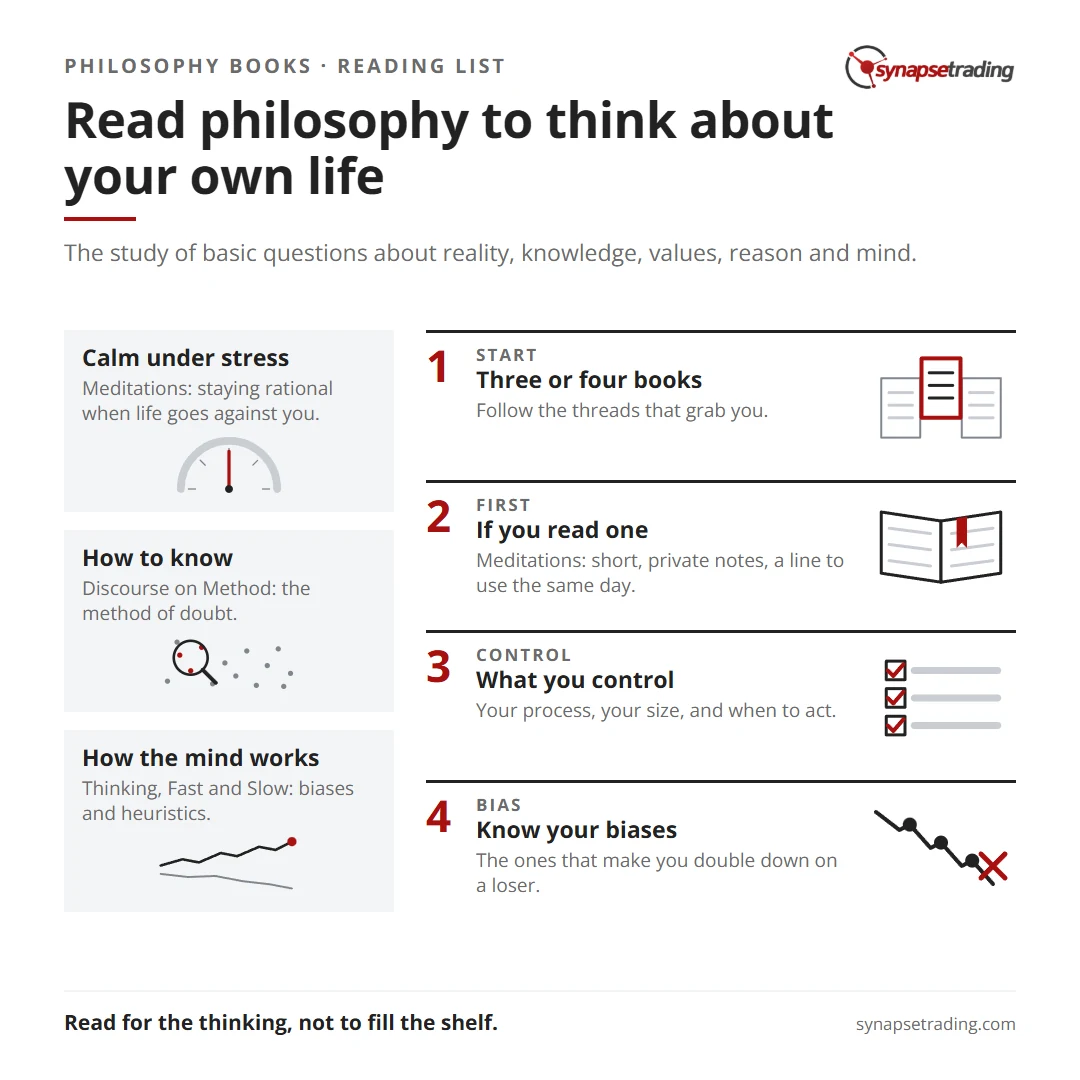
Read philosophy to think about your own life. Summary card for the post: Top 86 Philosophy Books to Read (With Key Ideas).

Why read philosophy at all?

Philosophy is the study of fundamental questions about reality, existence, knowledge, values, reason, mind, and language. It is a broad field, and it splits into a few core disciplines: metaphysics (what exists), epistemology (how we know), ethics (how to act), politics (how to live together), aesthetics (what is beautiful), and logic (how to reason well).

People come to it for different reasons. Some want to explore the big questions of life and understand the world better. Some want to apply philosophical ideas to real, practical problems. Others are drawn to the discipline itself: critical thinking, logical reasoning, and the ability to argue and defend a position.

Here is the honest benefit. Philosophy sharpens how you think. It pushes you to stay open-minded, to weigh perspectives you do not already hold, and to follow your beliefs through to their consequences. It also makes you more self-aware, more reflective, and more honest about the values that actually drive your decisions.

That last part is why a trader should care, and I will come back to it at the end.

Where should a beginner start?

Do note that you do not need to read all of these. Most people who “get into philosophy” start with three or four books and follow the threads that grab them. Here is how I would group the entry points by what you are after.

If you want…Start withWhy
Practical calm under stress“Meditations” (Marcus Aurelius), “The Consolation of Philosophy” (Boethius)Stoic and late-classical writing on staying rational when life goes against you
The foundations of Western thought“The Republic” (Plato), “Nicomachean Ethics” (Aristotle)Justice, the ideal state, and what a flourishing life (eudaimonia) actually means
How to know what is true“Discourse on Method” (Descartes), “Critique of Pure Reason” (Kant)The method of doubt and the limits of reason itself
Meaning without easy answers“The Myth of Sisyphus” (Camus), “Thus Spoke Zarathustra” (Nietzsche)The absurd, and making your own meaning
Eastern philosophy“Tao Te Ching” (Lao Tzu), “Zen and the Art of Motorcycle Maintenance” (Pirsig)Living in harmony with the natural world, and the nature of quality
How the mind really works“Thinking, Fast and Slow” (Kahneman), “The Interpretation of Dreams” (Freud)Cognitive biases, heuristics, and the unconscious

Pick the row that matches where your head is right now. Read one book from it. Then follow your curiosity to the next.

The full list of top philosophy books to read

Here is the list, with each book’s author, year, and a one-line summary of what it covers.

Ancient and classical

  • “The Republic” by Plato (380 BC) – The nature of justice and the ideal form of government.
  • “The Euthyphro” by Plato (380 BC) – A dialogue on the nature of piety and the role of the gods in human experience.
  • “The Gorgias” by Plato (380 BC) – A dialogue on the nature of justice and the role of the soul.
  • “The Nicomachean Ethics” by Aristotle (350 BC) – Eudaimonia (happiness or flourishing) and how it can be achieved.
  • “The Tao Te Ching” by Lao Tzu (6th century BC) – The principles of Taoist philosophy and living in harmony with the natural world.
  • “The Iliad” by Homer (8th century BC) – An epic on war, honour, and the human condition.
  • “The Meditations” by Marcus Aurelius (180 AD) – Stoic philosophy and developing a rational, detached perspective in the face of life’s challenges.
  • “Confessions” by Augustine of Hippo (401 AD) – An autobiographical work on faith, redemption, and the nature of the self.
  • “The Consolation of Philosophy” by Boethius (524 AD) – The nature of happiness and the role of reason in human experience.

Medieval, Renaissance, and Enlightenment

  • “The Divine Comedy” by Dante Alighieri (1308-1321) – An epic poem on faith, redemption, and the nature of the self.
  • “Don Quixote” by Miguel de Cervantes (1605) – A classic on chivalry, love, and the nature of reality.
  • “The Prince” by Niccolo Machiavelli (1532) – The use of power and manipulation in politics and government.
  • “The Discourse on Method” by Rene Descartes (1637) – The method of doubt and the concept of “I think, therefore I am.”
  • “Essay Concerning Human Understanding” by John Locke (1689) – The nature of knowledge and the role of experience in shaping understanding.
  • “The King James Bible” (1611) – A classic translation that has shaped Western culture and literature.
  • “Gulliver’s Travels” by Jonathan Swift (1726) – A satire on human nature, politics, and the nature of reality.
  • “The Spirit of the Laws” by Montesquieu (1748) – The principles of government and the importance of separating powers.
  • “The Theory of Moral Sentiments” by Adam Smith (1759) – The psychological foundations of moral behaviour and the role of empathy in moral judgment.
  • “The Social Contract” by Jean-Jacques Rousseau (1762) – The social contract and the role of government in protecting natural rights.
  • “Discourse on the Origin of Inequality” by Jean-Jacques Rousseau (1755) – The nature of inequality and the role of society in shaping human experience.
  • “The Wealth of Nations” by Adam Smith (1776) – The principles of economics and the role of free markets in promoting prosperity.
  • “Common Sense” by Thomas Paine (1776) – An argument for the independence of the American colonies from British rule.
  • “The Age of Reason” by Thomas Paine (1794) – The importance of reason and the dangers of superstition and religious authority.
  • “The Federalist Papers” by Hamilton, Madison, and Jay (1787-1788) – Essays on the principles of the Constitution and the role of government.
  • “The Decline and Fall of the Roman Empire” by Edward Gibbon (1776-1789) – The decline and fall of Rome and the factors behind its collapse.
  • “The Critique of Pure Reason” by Immanuel Kant (1781) – The nature of knowledge and the limits of reason.
  • “The Critique of Practical Reason” by Immanuel Kant (1788) – The nature of morality and the role of reason in guiding moral action.
  • “The Sorrows of Young Werther” by Goethe (1774) – The role of emotion and passion in shaping human experience.

19th century

  • “The Phenomenology of Spirit” by G.W.F. Hegel (1807) – The “Absolute” and the development of human consciousness.
  • “The World as Will and Representation” by Arthur Schopenhauer (1818) – The “Will” and the role of suffering in human experience.
  • “Democracy in America” by Alexis de Tocqueville (1835) – The principles and practice of democracy in the United States.
  • “Fear and Trembling” by Soren Kierkegaard (1843) – The nature of faith and the role of religious belief in human experience.
  • “The Communist Manifesto” by Marx and Engels (1848) – The principles of communist ideology and the role of class struggle in history.
  • “Capital” by Karl Marx (1867) – The principles of Marxist economics and the role of class struggle in shaping history.
  • “The Law” by Frederic Bastiat (1850) – The principles of economic liberty and the role of government.
  • “Walden” by Henry David Thoreau (1854) – Living a simple, self-sufficient life, close to nature.
  • “On Liberty” by John Stuart Mill (1859) – The principles of individual liberty and the role of government in protecting it.
  • “Utilitarianism” by John Stuart Mill (1863) – The principle of utility: the greatest happiness for the greatest number.
  • “On the Origin of Species” by Charles Darwin (1859) – The theory of evolution and the concept of natural selection.
  • “The Birth of Tragedy” by Friedrich Nietzsche (1872) – The role of art and culture in shaping human experience.
  • “The Gay Science” by Friedrich Nietzsche (1882) – The role of truth and knowledge in shaping human experience.
  • “Thus Spoke Zarathustra” by Friedrich Nietzsche (1883-1885) – Nietzsche’s ideas on God, morality, and the meaning of life.
  • “Beyond Good and Evil” by Friedrich Nietzsche (1886) – The nature of morality and the role of power in human experience.
  • “On the Genealogy of Morality” by Friedrich Nietzsche (1887) – The nature of morality and its historical development. (Also published as “The Genealogy of Morals”.)
  • “Time and Free Will” by Henri Bergson (1889) – The nature of time and the role of free will in human experience.
  • “War and Peace” by Leo Tolstoy (1869) – A historical epic on love, loss, and the human condition against the Napoleonic Wars.

20th century and modern

  • “The Interpretation of Dreams” by Sigmund Freud (1900) – The unconscious mind and the role of dreams in revealing hidden desires.
  • “The Will to Power” by Friedrich Nietzsche (1901) – The “Will to Power” and the role of power and ambition in human experience.
  • “The Problems of Philosophy” by Bertrand Russell (1912) – An introduction to the major problems of philosophy, from knowledge to the existence of God.
  • “The Portable Nietzsche” by Friedrich Nietzsche (1954) – A collection of Nietzsche’s writings on morality, religion, and the self.
  • “Nausea” by Jean-Paul Sartre (1938) – Identity, meaning, and the human condition.
  • “Being and Nothingness” by Jean-Paul Sartre (1943) – The nature of consciousness and the role of freedom in human experience.
  • “Escape from Freedom” by Erich Fromm (1941) – The nature of freedom and how it can be pursued and achieved.
  • “The Myth of Sisyphus” by Albert Camus (1942) – The absurd, and the role of meaning and purpose in human experience.
  • “The Open Society and Its Enemies” by Karl Popper (1945) – The principles of an open society and the dangers of totalitarianism.
  • “Economics in One Lesson” by Henry Hazlitt (1946) – An introduction to economics and the role of markets in promoting prosperity.
  • “The General Theory of Employment, Interest, and Money” by John Maynard Keynes (1936) – The role of government in managing the economy and addressing unemployment.
  • “The Hero with a Thousand Faces” by Joseph Campbell (1949) – The hero’s journey and the role of myths and archetypes in human experience.
  • “The Myth of Mental Illness” by Thomas Szasz (1961) – A challenge to the medical model of mental illness.
  • “The Structure of Scientific Revolutions” by Thomas S. Kuhn (1962) – The nature of scientific change and the role of paradigms.
  • “A Theory of Justice” by John Rawls (1971) – The principles of justice and the foundations of a just society.
  • “The Selfish Gene” by Richard Dawkins (1976) – The “selfish gene” and the role of natural selection in evolution.
  • “Zen and the Art of Motorcycle Maintenance” by Robert M. Pirsig (1974) – A meditation on the nature of quality and creativity in problem-solving.
  • “A Brief History of Time” by Stephen Hawking (1988) – An introduction to the fundamental principles of physics and the nature of the universe.
  • “The Power of Now” by Eckhart Tolle (1997) – Living in the present moment as a path to peace and fulfilment.
  • “The Purpose Driven Life” by Rick Warren (2002) – Discovering and pursuing one’s purpose in life.
  • “Thinking, Fast and Slow” by Daniel Kahneman (2011) – How cognitive biases and heuristics influence our thoughts and decisions.
  • “The Kantian Theory of Law and Justice” by Jeremy Waldron (1991) – Kant’s ideas on the nature of law and justice.
  • “The Limits of Power” by Andrew Bacevich (2008) – The dangers of overreach and respecting the limits of power in foreign policy.

Literature with a philosophical core

These are not philosophy textbooks, but they carry as much philosophy as any treatise, and they are easier to start with.

  • “Hamlet” by William Shakespeare (1600) – Madness, revenge, and the nature of identity.
  • “Pride and Prejudice” by Jane Austen (1813) – Love, class, and social norms.
  • “Wuthering Heights” by Emily Bronte (1847) – Love, passion, and revenge.
  • “Jane Eyre” by Charlotte Bronte (1847) – Love, independence, and the human condition.
  • “Moby-Dick” by Herman Melville (1851) – Obsession, fate, and the human condition.
  • “The Happy Prince” by Oscar Wilde (1888) – Love, sacrifice, and the human condition.
  • “Heart of Darkness” by Joseph Conrad (1899) – Imperialism, morality, and the human condition.
  • “The Invisible Man” by H.G. Wells (1897) – Identity, isolation, and the human condition.
  • “Metamorphosis” by Franz Kafka (1915) – Isolation, alienation, and the human condition.
  • “The Great Gatsby” by F. Scott Fitzgerald (1925) – Love, corruption, and the human condition.
  • “The Little Prince” by Antoine de Saint-Exupery (1943) – Love, friendship, and the human condition.
  • “The Education of Henry Adams” by Henry Adams (1907) – The nature of education and the role of experience in shaping understanding.
  • “To Kill a Mockingbird” by Harper Lee (1960) – Racism, prejudice, and social justice in the Deep South.
  • “Invisible Man” by Ralph Ellison (1952) – Race, identity, and the human condition.
  • “One Hundred Years of Solitude” by Gabriel Garcia Marquez (1967) – Family, history, and the human condition.
  • “The Dreadful Lemon Sky” by John D. MacDonald (1974) – Detective fiction on morality, justice, and the human condition.

On writing and reasoning well

  • “The Elements of Style” by William Strunk Jr. and E.B. White (1959) – A classic guide to the principles of effective writing and communication.

Which philosophy book should I read first if I only read one?

Read “Meditations” by Marcus Aurelius. It is short, it is written as private notes rather than a lecture, and almost every page has a line you can use the same day. It is the rare 1,800-year-old book that reads like advice from a calm, experienced person who has already lived through worse than your week.

If you want a single book on how your own mind tricks you, read “Thinking, Fast and Slow” by Daniel Kahneman instead. It is modern, it is evidence-based, and it explains the cognitive biases that quietly run most of our decisions.

What does philosophy have to do with trading?

Here is where I will tie it back. Markets do not punish you for not knowing enough facts. They punish you for the gap between what you believe and how you actually behave under pressure. That gap is a philosophy problem before it is a trading problem.

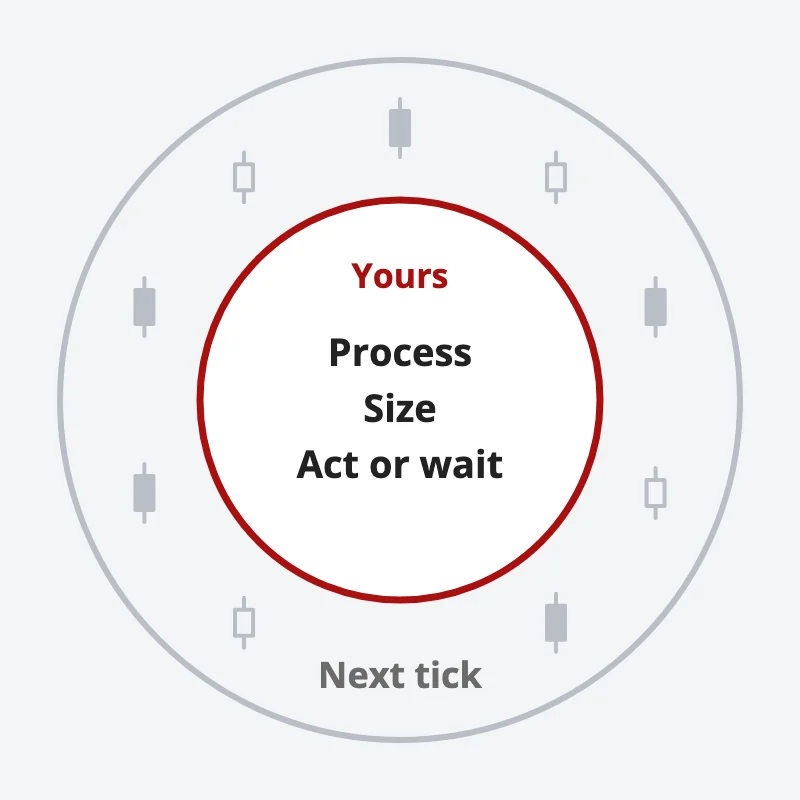
The Stoics teach you to separate what you control (your process, your size, your decision to act or wait) from what you do not (the next tick). Kahneman shows you the biases that make you double down on a loser. Nietzsche and Camus, in their own strange way, are about taking full responsibility for your choices instead of blaming the world. A scanner can find a setup in a second. It cannot supply the self-honesty to follow your own rules when real money is on the line. That part is judgment, and judgment is the first of the human edges no tool trades for you.

An inner circle of what a trader controls (process, size, the decision to act or wait) inside an outer ring of the market's next tick, which they do not control
Put your effort into what you control: your process, your size, and when to act.

So read for the thinking. The books that change how you decide are worth more than the ones that just fill the shelf.

FAQ

What is the best philosophy book for beginners?
“Meditations” by Marcus Aurelius (180 AD) is the most beginner-friendly entry point. It is short, practical, and written as personal notes, so there is no dense jargon to wade through before you get value.

What are the most important philosophy books of all time?
The most frequently cited foundational works are Plato’s “The Republic”, Aristotle’s “Nicomachean Ethics”, Kant’s “Critique of Pure Reason”, Nietzsche’s “Thus Spoke Zarathustra” and “Beyond Good and Evil”, and in the 20th century Sartre’s “Being and Nothingness” and Rawls’s “A Theory of Justice”.

In what order should I read philosophy books?
A common path is chronological: start with the ancients (Plato, Aristotle, Marcus Aurelius), move through the Enlightenment (Descartes, Locke, Kant), then the 19th century (Nietzsche, Mill, Marx), and finish with the modern era (Camus, Sartre, Kahneman). You do not have to be strict about it. Following one thread that interests you is better than forcing the order.

What is the difference between philosophy and self-help books?
Philosophy asks why a way of living is justified and argues the case from first principles. Self-help usually skips the argument and gives you the conclusion as a set of steps. The two overlap (the Stoics are both), but philosophy is built to make you reason, not just comply.

Do I need a background in philosophy to read these?
No. Start with “Meditations”, “The Republic”, or “Thinking, Fast and Slow”, all of which are written to be read by non-specialists. Save the dense systematic works (Hegel, Kant’s first Critique) for after you have a few accessible books behind you.


That is the list. Which ones have actually changed how you think? Let me know in the comments below.

And if you want the same treatment for markets, read the companion list: Best Investing and Trading Books of All Time.


About the author. Spencer Li is The 15-Minute Trader and the founder of Synapse Trading. He is a Certified Financial Technician (CFTe) with 15+ years of trading, run from 70+ countries. He holds a B.Acc and B.BM from SMU. Every trade he takes is public, dated, losses left in. He teaches rules-based swing trading in 15 minutes a day, one system for any market.

Education, not financial advice. Synapse Trading is not licensed by MAS to advise on investment products. Trading carries risk of loss; past performance is not indicative of future results.


Related

Best Investing and Trading Books of All Time · Trading psychology and discipline · The Five Edges AI cannot trade for you

by Spencer Li
https://synapsetrading.com/wp-content/uploads/2026/10/top-86-philosophy-books-card.webp 630 1200 Spencer Li https://synapsetrading.com/wp-content/uploads/2026/10/synapse-logo-horizontal-light.png Spencer Li2022-12-23 03:21:522026-10-20 10:08:36Top 86 Philosophy Books to Read (With Key Ideas)
Spencer Li

Top 76 Psychology Books to Read (With Key Ideas)

Trading Foundations
76 psychology books worth reading - book list

The Best Psychology Books to Read (and Where to Start)

Last updated: 11 September 2026 · By Spencer Li, CFTe


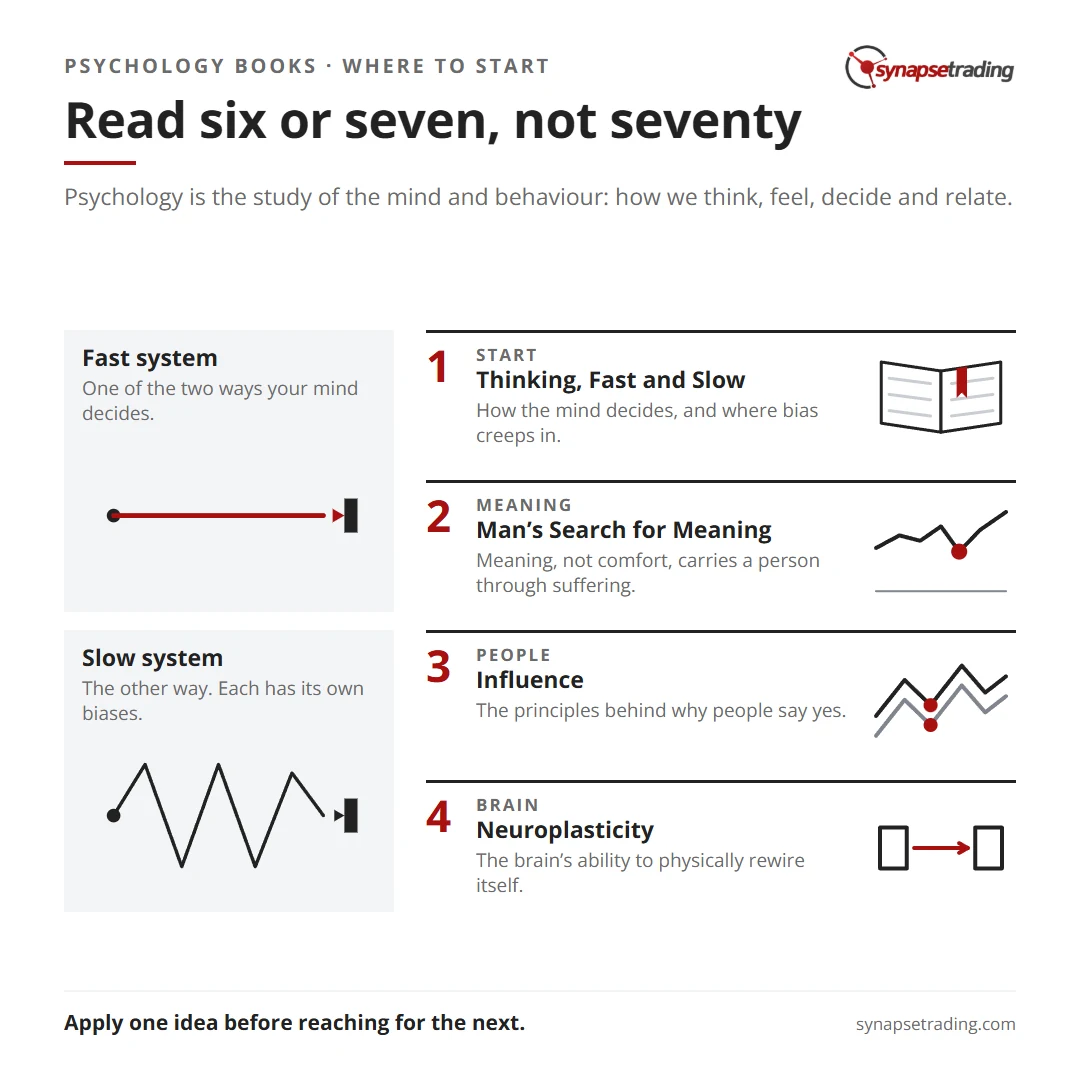
If you want the single best psychology book to start with, read Daniel Kahneman’s “Thinking, Fast and Slow” (2011), because it explains the two systems your mind uses to make decisions and the biases that quietly steer them, and that one idea touches everything else on this list. From there, the most rewarding reads depend on what you actually want. For meaning and resilience, read Viktor Frankl’s “Man’s Search for Meaning”. For how to read and influence people, read Robert Cialdini and Dale Carnegie. For how the brain physically changes, read Norman Doidge. For relationships, read John Gottman. You do not need to read seventy books. You need the right six or seven, in roughly the right order, and the patience to apply one idea before reaching for the next.

Below is the short, curated version, grouped by what you are trying to learn, with a one-line note on each so you can pick fast.

Read six or seven, not seventy. Summary card for the post: Top 76 Psychology Books to Read (With Key Ideas).
Why read psychology books at all?

Psychology is the study of the mind and behaviour: how we think, feel, perceive, decide, and relate to each other. People pick it up for different reasons. Some want to understand their own patterns. Some want to help others. Some want an edge in business, leadership, or negotiation, where everything eventually comes down to people.

Personally, I came to it sideways, through trading. You can have a perfect system and still lose money, because the hard part is not the chart, it is the person reading it. Once you start studying decision-making, fear, and bias on purpose, you stop blaming the market and start fixing the operator. That is the most useful thing psychology ever did for me.

What are the best psychology books, grouped by what you want to learn?

Here are the genuine standouts from a much longer list, sorted so you can find the one that fits.

BookAuthorWhat it teachesRead it if you want to
Thinking, Fast and SlowDaniel KahnemanTwo systems of thought and the biases in eachUnderstand how you actually decide
Man’s Search for MeaningViktor FranklFinding meaning in sufferingBuild resilience and purpose
Influence / The Science of PersuasionRobert CialdiniThe principles behind why people say yesPersuade ethically, or resist being persuaded
How to Win Friends and Influence PeopleDale CarnegiePractical relationship and influence skillsGet along with and lead people
The Brain That Changes ItselfNorman DoidgeNeuroplasticity, how the brain rewiresBelieve change is physically possible
The Science of TrustJohn GottmanWhat builds and breaks trust in couplesStrengthen a relationship
The Hidden BrainShankar VedantamHow unconscious bias shapes behaviourSee your own blind spots
The Man Who Mistook His Wife for a HatOliver SacksReal neurological case studiesBe fascinated by the brain’s edges

Start here: how we think and decide

  • “Thinking, Fast and Slow” by Daniel Kahneman (2011). The map of how the mind processes information and where bias creeps into decisions. If you read one book on this list, read this one.
  • “The Hidden Brain” by Shankar Vedantam (2010). How unconscious processes shape your thoughts and choices without your permission.
  • “The Drunkard’s Walk” by Leonard Mlodinow (2008). How much of life is randomness and probability that we wrongly read as skill or fate. Useful, and humbling.

Meaning, suffering, and how to live

  • “Man’s Search for Meaning” by Viktor Frankl (1946). Written out of the concentration camps. The argument that meaning, not comfort, is what carries a person through suffering.
  • “The Antidote” by Oliver Burkeman (2013). The case for facing negative emotions instead of forcing positivity. A quiet corrective to the happiness-industrial complex.
  • “The Power of Now” by Eckhart Tolle (1997). On presence and getting out of your own looping thoughts. Take what is useful, leave the rest.

People: influence, persuasion, relationships

  • “Influence / The Science of Persuasion” by Robert Cialdini. The principles behind why people comply. Read it to persuade honestly, and to notice when it is being done to you.
  • “How to Win Friends and Influence People” by Dale Carnegie (1936). Old, plain, and still works. Practical advice on dealing with people that has aged better than most.
  • “The Science of Trust” by John Gottman (2011). What actually predicts whether a relationship lasts, from decades of research.

The brain itself

  • “The Brain That Changes Itself” by Norman Doidge (2007). Neuroplasticity (the brain’s ability to physically rewire itself) told through real cases. The hopeful one.
  • “The Man Who Mistook His Wife for a Hat” by Oliver Sacks (1985). Case studies of neurological disorders that teach you more about the normal brain than any textbook.
  • “The Emotional Brain” by Joseph LeDoux (1996). The neuroscience of emotion, especially fear, and how it drives behaviour before you are even aware of it.

Personality and self-knowledge

  • “The Enneagram” by Helen Palmer (1988). One framework for the nine personality types. Use it as a starting lens.
  • “The Mismeasure of Man” by Stephen Jay Gould (1981). A sharp critique of how intelligence testing has been used to justify bias. Read it before you trust any single score.

Bonus: the books that cross over into strategy and thinking well

A few classics on the original list are not strictly psychology, but they teach how minds and groups behave, so they earn a place.

  • “The Demon-Haunted World” by Carl Sagan (1995). A defence of critical thinking and scepticism against pseudoscience. The mental-hygiene book.
  • “The Art of War” by Sun Tzu. Strategy and conflict, ancient and still quoted because it is mostly about reading people and situations.
  • “Man’s Search for Meaning” pairs well here too, if you want strategy with a soul.

A note on the long lists you will see online

The original version of this post listed close to seventy titles. Do note that, when a “best books” list gets that long, a lot of it is padding, and several entries are not really about psychology at all. I would rather hand you the dozen that actually changed how I think than seventy I half-remember. If a book is not on this shorter list, it is not a knock on the book. It is a vote for your time.

Where the human edge comes in

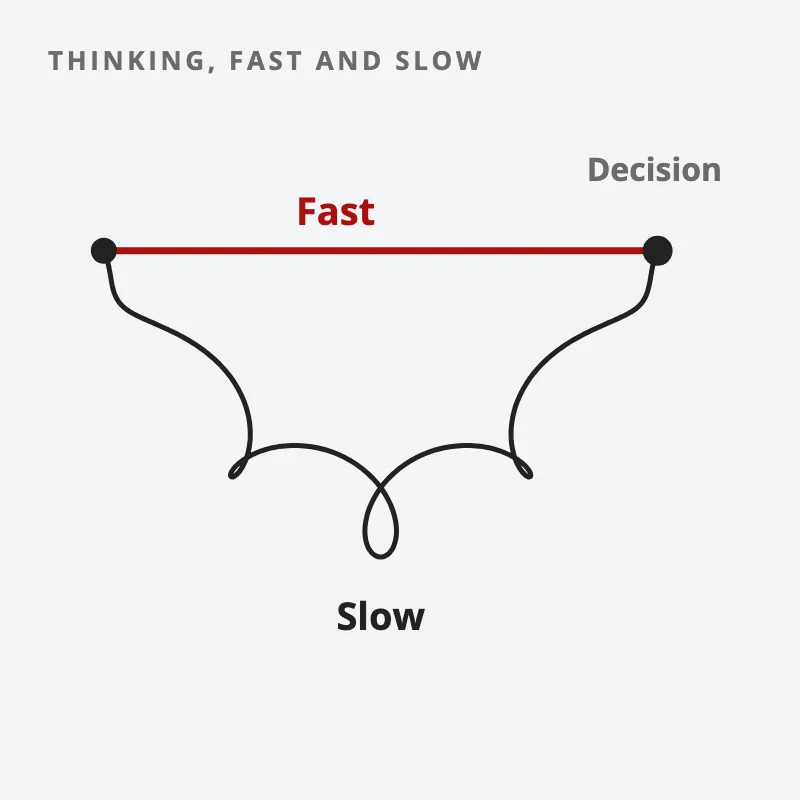
Here is the part I care about most, because it is where these books stop being theory. Every one of them is, underneath, a book about decision-making under uncertainty. That is also the entire job of a trader. A screener can flag a setup in a second, but it cannot tell you that you are about to break your own rules out of fear, or that you are sizing up because you feel lucky, not because the edge improved. That self-knowledge is the first of the Five Edges no tool can trade for you. Kahneman will not make you money. But knowing which of his two systems is driving when your hand reaches for the buy button just might save you some.

Two paths from the same start to one decision: a short direct red path labelled fast and a long winding path labelled slow
Your mind decides with two systems, one fast and one slow, each with its own biases.

FAQ

What is the best psychology book for beginners?
“Thinking, Fast and Slow” by Daniel Kahneman is the most recommended starting point, because it explains the two systems your mind uses to make decisions and the biases inside each. If it feels dense, start with “How to Win Friends and Influence People” by Dale Carnegie, which is shorter and immediately practical.

What psychology book should I read to understand myself?
For self-understanding, “The Hidden Brain” by Shankar Vedantam shows how unconscious bias shapes your choices, and “Man’s Search for Meaning” by Viktor Frankl reframes how you relate to hardship. A personality framework like “The Enneagram” by Helen Palmer can give you a starting vocabulary, as long as you hold it loosely.

Which psychology book helps with relationships?
“The Science of Trust” by John Gottman is built on decades of research into what makes couples last, and “Influence” by Robert Cialdini teaches the persuasion principles at work in every human interaction.

Are psychology books useful for trading and investing?
Yes. Most trading mistakes are psychological. “Thinking, Fast and Slow” and “The Emotional Brain” both explain the fear and bias that wreck good plans. For the trading-specific version, see the trading and investing book list linked below.

Do I need to read all the famous psychology books?
No. A focused six or seven, read slowly and applied, will do more for you than seventy skimmed. Pick one from each section above that matches what you want right now, and start there.


So, which one are you starting with? Tell me in the comments, and if there is a psychology book that changed how you think that I left off, I want to hear it.

If you want the trading-specific cousin of this list, read the companion roundup: Best Investing and Trading Books of All Time.

Want to put the decision-making psychology to work? Grab the free 15-Minute Swing Trading Starter Kit. It is the exact once-a-day routine I use to keep emotion out of the trade and stay consistent in any market.


About the author. Spencer Li is The 15-Minute Trader and the founder of Synapse Trading. He is a Certified Financial Technician (CFTe) with 15+ years of trading, run from 70+ countries. He holds a B.Acc and B.BM from SMU. Every trade he takes is public, dated, losses left in. He teaches low-risk swing trading in 15 minutes a day, one system for any market.

Education, not financial advice. Synapse Trading is not licensed by MAS to advise on investment products. Trading carries risk of loss; past performance is not indicative of future results.


Related

Best Investing and Trading Books of All Time · Trading psychology and the mental game · Existentialism in everyday life

by Spencer Li
https://synapsetrading.com/wp-content/uploads/2026/10/top-psychology-books-card.webp 630 1200 Spencer Li https://synapsetrading.com/wp-content/uploads/2026/10/synapse-logo-horizontal-light.png Spencer Li2022-12-23 02:44:282026-09-11 20:14:44Top 76 Psychology Books to Read (With Key Ideas)
Spencer Li

Trading for a Living by Alexander Elder: A Summary, and the Lessons I Still Trade With

Trading Foundations
Trading for a Living, summarised - book summary

By Spencer Li, CFTe · Last updated: 1 October 2026

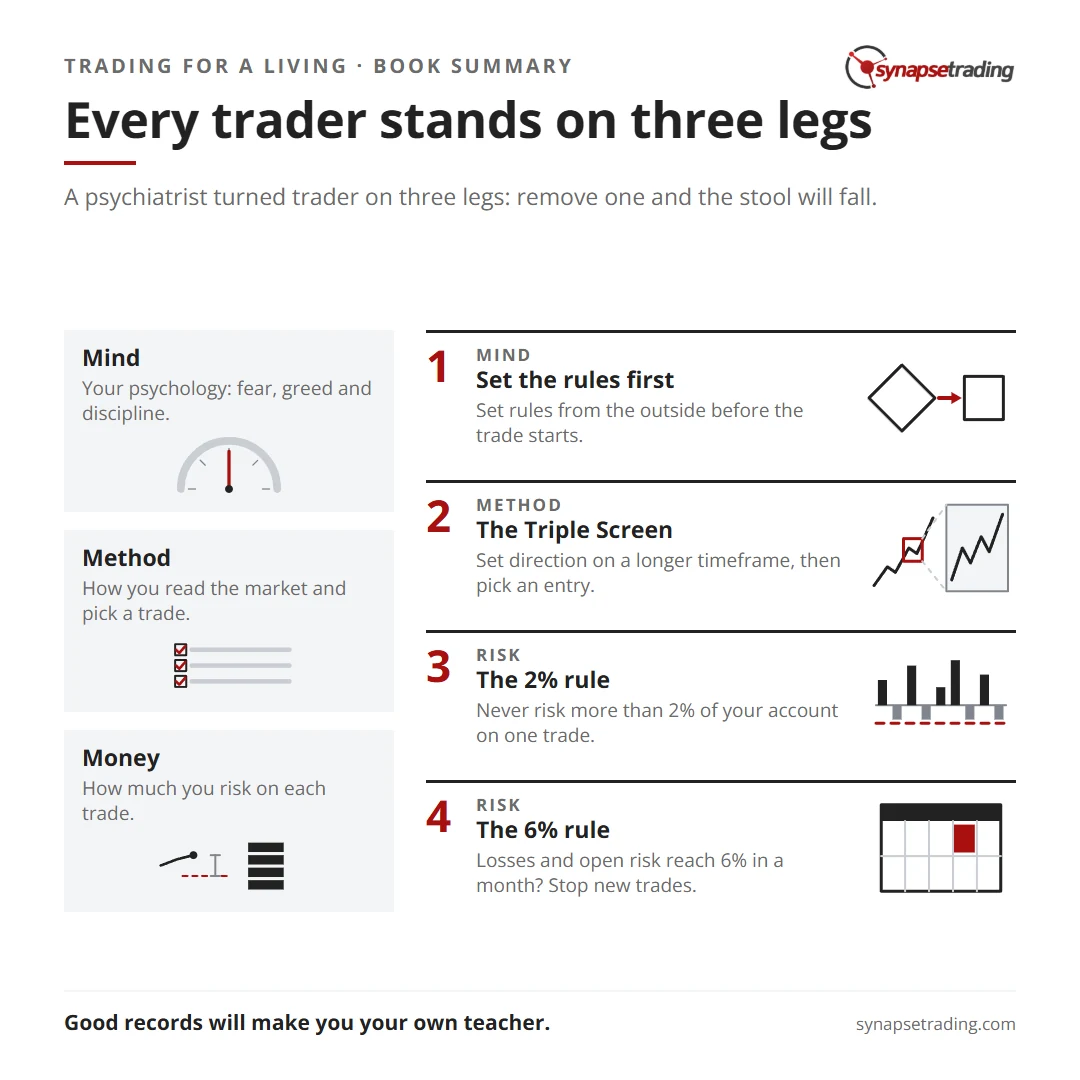
Trading for a Living is a 1993 trading book by Dr. Alexander Elder, a psychiatrist who became a full-time trader, and its main argument is that every trader stands on three legs: Mind, Method and Money. Mind is your psychology, Method is how you read the market and pick a trade, and Money is how much you risk on each one. Elder puts it plainly: “remove one and the stool will fall.”

The book is also where many traders first meet the Triple Screen trading system, which checks three timeframes before any trade, and the 2% and 6% risk rules. In 2014 Elder rewrote the whole thing as The New Trading for a Living. He kept the psychology almost untouched, rewrote the money chapters, and added record-keeping as a fourth factor that ties the other three together.

I first read it as a student at SMU, around 2008, while working through the classic trading books. Two of its rules still sit in my own trading plan today, which is a fair compliment for a book that is now over 30 years old.

thumbnail trading for a living

Every trader stands on three legs. Summary card for the post: Trading for a Living by Alexander Elder: A Summary, and the Lessons I Still Trade With.

Who is Dr. Alexander Elder?

At 23, Alexander Elder was working as a doctor on a Soviet ship. In Africa, he jumped ship, and he later received political asylum in the United States.

That is quite an unusual start for a trading author. According to the author note from his publisher, Wiley, he was born in Leningrad and grew up in Estonia, where he entered medical school at 16. In America he worked as a psychiatrist in New York City and taught at Columbia University. He founded his trading school, now elder.com, in 1988, and Trading for a Living came out 5 years later and became an international bestseller.

So why should a trader care about any of this? Because the background explains the book. Plenty of trading authors are chart people who come to psychology late, after a few painful years. Elder was a psychiatrist first, so he came to the market already knowing how people behave under stress, and one line from the book sums up his view quite well: “Most failures in life are due to self-sabotage.”

What is Trading for a Living about?

Early on, Elder lays out an uncomfortable fact. Trading is a minus-sum game, because commissions and slippage drain money out of the pool on every single trade, so the average trader does worse than break-even before skill even enters the picture.

From there the book follows his three legs, starting with the psychology of the trader and the crowd, moving on to the indicators and trading systems, and ending with money management. The quotes below come from the 2014 edition, where Elder says the psychology barely changed.

Personally, I think the structure is the real value. A lot of trading books are a pile of tactics with no skeleton, and you finish them knowing 40 indicators and no idea which one to use. This one gives you the skeleton first, so even the chapters that have aged badly still have a place to go.

What are the 3 M’s of trading?

Imagine a stool with three legs. It works fine on three, it wobbles on two, and on one it is basically firewood.

That is Elder’s picture of a trader, and the 3 M’s are the three legs.

The MWhat it coversWhat goes wrong without it
MindYour psychology: fear, greed, discipline and how you handle a losing streakYou break your own rules the moment a trade turns against you
MethodHow you read the market and decide on an entry, a target and a stopEvery trade is a fresh guess, so there is nothing to review or improve
MoneyHow much of your account you risk on each trade, and in totalOne oversized loss wipes out months of good trades

The three depend on each other. A trader with a brilliant method and no risk control will eventually blow up the account. A trader with perfect risk control and no method will simply bleed slowly, which is a gentler way of reaching the same place.

Elder admits his own breakthrough came late, when he “realized that the key to winning was inside my head and not inside a computer.” Coming from a man who invented several indicators, that is quite a confession.

I teach the same three ideas at Synapse under slightly different names, Method, Money management and Mindset, and my own trading plan is built around them. If you trade around a full-time job, the free 15-minute swing trader checklist is the daily routine I use myself.

Why does a psychiatrist think most traders lose?

Elder’s most memorable idea comes from his medical work. He compares a losing trader to an alcoholic, and he means it quite literally: “loss is to a loser what alcohol is to an alcoholic.”

Both problems feed on themselves. A trader feels the sting of a loss, takes a bigger trade to win it back, loses again, and the fear and regret keep piling up until the next decision is made by the feelings rather than the plan. Elder’s cure borrows from Alcoholics Anonymous. You admit that you cannot trust yourself in the heat of the moment, you set the rules from the outside before the trade starts, and you take it one day at a time.

He also treats the market as a crowd, with price as the leader of that crowd at any given moment. On the hard right edge of the chart, where the next bar has not printed yet, nobody knows what comes next, and “trying to be right is an unaffordable luxury.”

That line hit me harder than I expected. When I wrote down my own weaknesses as a trader, one of them was a perfectionist desire to be right, which in practice meant tweaking my systems endlessly instead of trading them. Elder’s answer is that a good trader’s goal is to trade well, and the money is a by-product. It sounds like a fortune cookie, right up until you notice how much of your stress comes from wanting each trade to prove you right.

How does the Triple Screen trading system work?

Why does a setup that looks perfect on the daily chart so often fail? Elder’s answer, first published in Futures magazine in April 1986, is that you looked at the wrong chart first. So the Triple Screen puts every trade through three tests, in a fixed order.

  1. The first screen is the market tide. Start on a timeframe about 5 times longer than the one you trade, so a daily trader starts on the weekly chart, and decide from that chart alone whether you are a bull or a bear.
  2. The second screen is the market wave. Go back to the daily chart and use an oscillator to find moves against the tide. In a weekly uptrend, a daily dip is a chance to buy, and the oscillator’s sell signals are ignored.
  3. The third screen is the entry. Pick a precise way to get in, then place the stop off the daily chart and the target off the weekly.

Elder later added the Impulse system, which colours each bar green, red or blue. He first traded it as a buy-and-sell system, it got chopped up in sideways markets, and he concluded that it “told me what not to do.” The long-term screen does the same job. It forbids a buy when the tide is falling and a short when it is rising, and it never tells you to trade.

Personally, I use it the same way. My trading plan keeps Elder’s long-term screen purely as a censor, and the entries come from my own setups.

What are Elder’s 2% and 6% rules?

Elder names his two risk rules after two kinds of fish. The 2% rule protects you from the shark, the single bite that takes off a leg. The 6% rule protects you from piranhas, the many small bites that strip you to the bone before you notice.

The 2% rule says you never risk more than 2% of your trading account on one trade. It caps the risk. The size of the position follows from where your stop sits. Say your stop is 5% below your entry.

2% risk ÷ 5% stop distance = a position worth 40% of your account

Move the stop to 10% away and the same rule allows only 20%. The position shrinks as the stop widens, and the most you can lose stays at 2% either way.

The strictness comes from simple arithmetic, since losses do not recover evenly. Lose 25% on one trade and you need a gain of about 33% just to get back to where you started. Elder adds that a trader who survives a bite that size often loses the nerve to pull the trigger.

The 6% rule works across a whole month. Once your closed losses plus the open risk on your current trades add up to 6% of the account you started the month with, you stop opening new trades until the month is over. It changes the question from “do I have enough money for this trade?” to “do I have enough risk left?”

My own plan keeps the 6% monthly rule as Elder wrote it. On the 2% rule I am more cautious, and most of my trades risk well under Elder’s ceiling. The free 15-minute swing trader checklist is the daily routine I run alongside it.

Is Trading for a Living good for beginners?

In March 2024, a trader on Reddit’s r/Daytrading listed four books, Elder’s rewrite among them, and asked a fair question. “I am an absolute beginner and wondering which of these I should read first.”

My honest answer is yes, with one warning. The psychology and risk chapters cover exactly the ground most beginners skip. The indicator chapters are another story, and a beginner can easily come away thinking that trading means stacking MACD, RSI and Stochastic until they all agree.

Elder seems to agree, at least partly. When he rewrote the book in 2014, he cut the number of technical chapters and moved some of them into a download, on the view that less is often more.

So personally, I would read it out of order. Start with the psychology, then go straight to the 2% and 6% rules, and read the indicator chapters last, with a pencil, picking 1 or 2 tools at most. Then start keeping records, which is the fourth pillar of the 2014 edition. Elder says good records “will make you your own teacher,” and of everything in the book, that is the habit I would least want to give up.

FAQ

What are the 3 M’s of trading?
Mind, Method and Money: your psychology, how you pick trades, and how much you risk. Alexander Elder’s point is that a weakness in any one can sink the other two.

When was Trading for a Living published?
The original came out in 1993. Elder rewrote it in 2014 as The New Trading for a Living, which adds record-keeping as a fourth factor.

What is the Triple Screen trading system?
It puts each trade through three tests. You set your direction on a longer timeframe, look for a move against it on your trading timeframe, then pick a precise entry.

What is the 2% rule in trading?
You never risk more than 2% of your trading account on one trade. The position size follows from the stop distance, so a stop 5% away allows a position worth 40% of the account.

What is Elder’s 6% rule?
Once your closed losses for the month plus the open risk on current trades reach 6% of the account you started the month with, you stop opening new trades until the next month.

Is Trading for a Living still worth reading?
Yes, mainly for the psychology and the risk rules, which have aged well. The indicator chapters are dense for a beginner, and Elder himself trimmed them in the 2014 rewrite.


Have you read Trading for a Living, and which of the three legs is the one that wobbles for you? Let me know in the comments.

My full reading list is in Best Investing and Trading Books of All Time, and more of Elder’s lines are in Best Trading Tips and Quotes from Alexander Elder. For the Mind leg, read my Complete Guide to Trading Psychology. For the Method leg, start with my guide to building a trading plan, and the rest is in my free trading guides.

best books on trading and investing

If you would like to find more book summaries and recommendations, also check out: “Best Investing & Trading Books of All Time”

And if you want a trading routine that fits into 15 minutes a day, grab the free 15-minute swing trader checklist.


About the author. Spencer Li is The 15-Minute Trader and the founder of Synapse Trading. He is a Certified Financial Technician (CFTe) with 15+ years of trading, run from 70+ countries. He holds a B.Acc and B.BM from SMU. Every trade he takes is public, dated, losses left in. He teaches low-risk swing trading in 15 minutes a day, one system for any market.

Education, not financial advice. Synapse Trading is not licensed by MAS to advise on investment products. Trading carries risk of loss, and past performance is not indicative of future results.

by Spencer Li
https://synapsetrading.com/wp-content/uploads/2026/10/trading-living-alexander-elder-card.webp 630 1200 Spencer Li https://synapsetrading.com/wp-content/uploads/2026/10/synapse-logo-horizontal-light.png Spencer Li2022-12-13 20:42:112026-10-01 21:16:48Trading for a Living by Alexander Elder: A Summary, and the Lessons I Still Trade With
Spencer Li

How to Buy US T-Bills on Interactive Brokers, and When They Beat Idle Cash

Trading Foundations
US Treasury bills on IBKR - investing

By Spencer Li, CFTe · Last updated: 4 September 2026

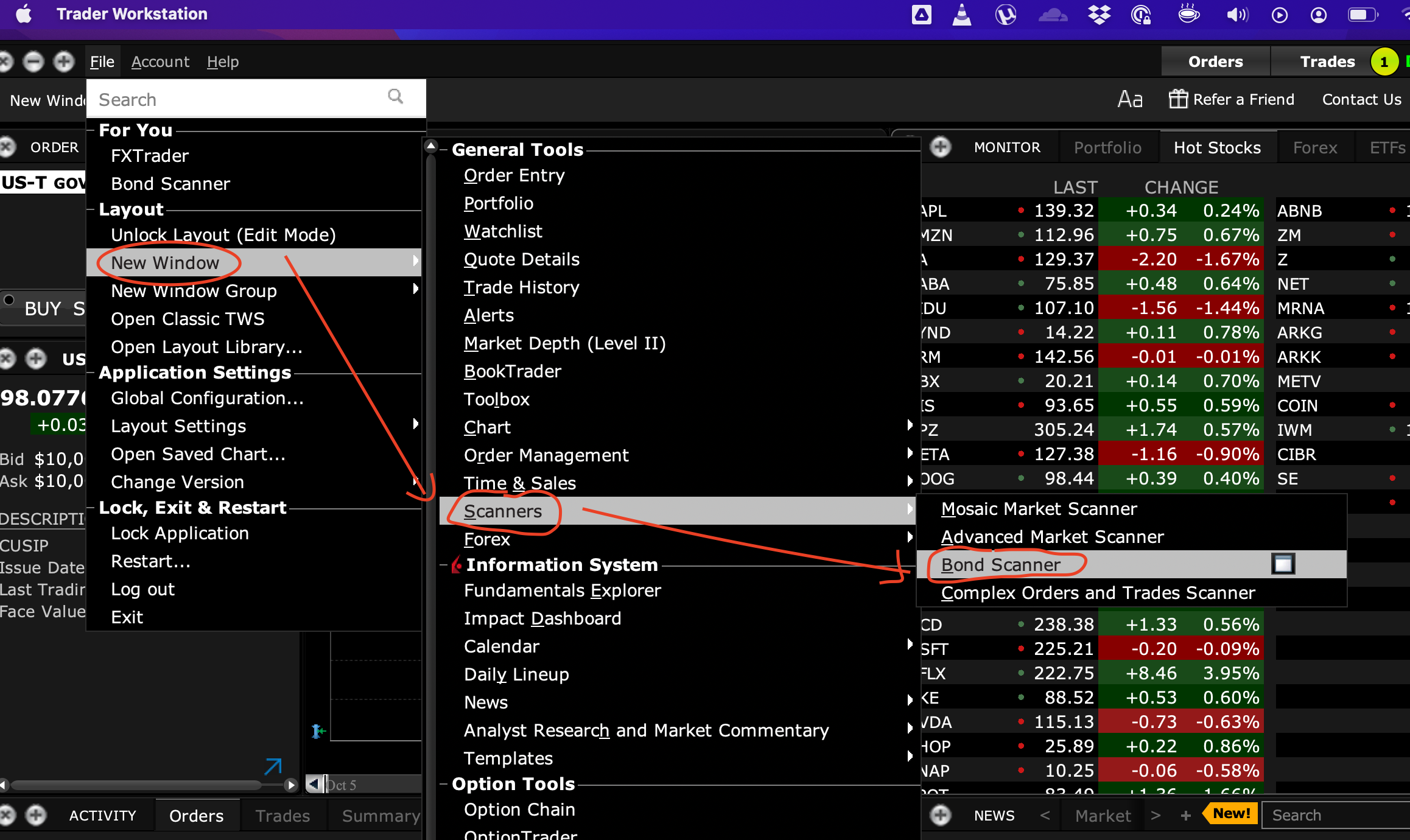
To buy US Treasury bills on Interactive Brokers, you switch on bond trading permissions and open Trader Workstation. Then you go to New Window, Scanners, Bond Scanner, filter for US Treasury bills, pick a maturity date and place a limit order. A T-bill is a short loan to the US government, lasting 4 to 52 weeks, and you buy it below face value and get the full face value back at maturity.

The harder question is whether it is worth doing at all, because IBKR already pays interest on idle US dollars. On 16 October 2026 a 13-week bill yielded 4.18%, against the 3.38% IBKR was paying on cash on 17 October. The bill won, but by less than you might expect, and your account size decides how much of the gap you keep.

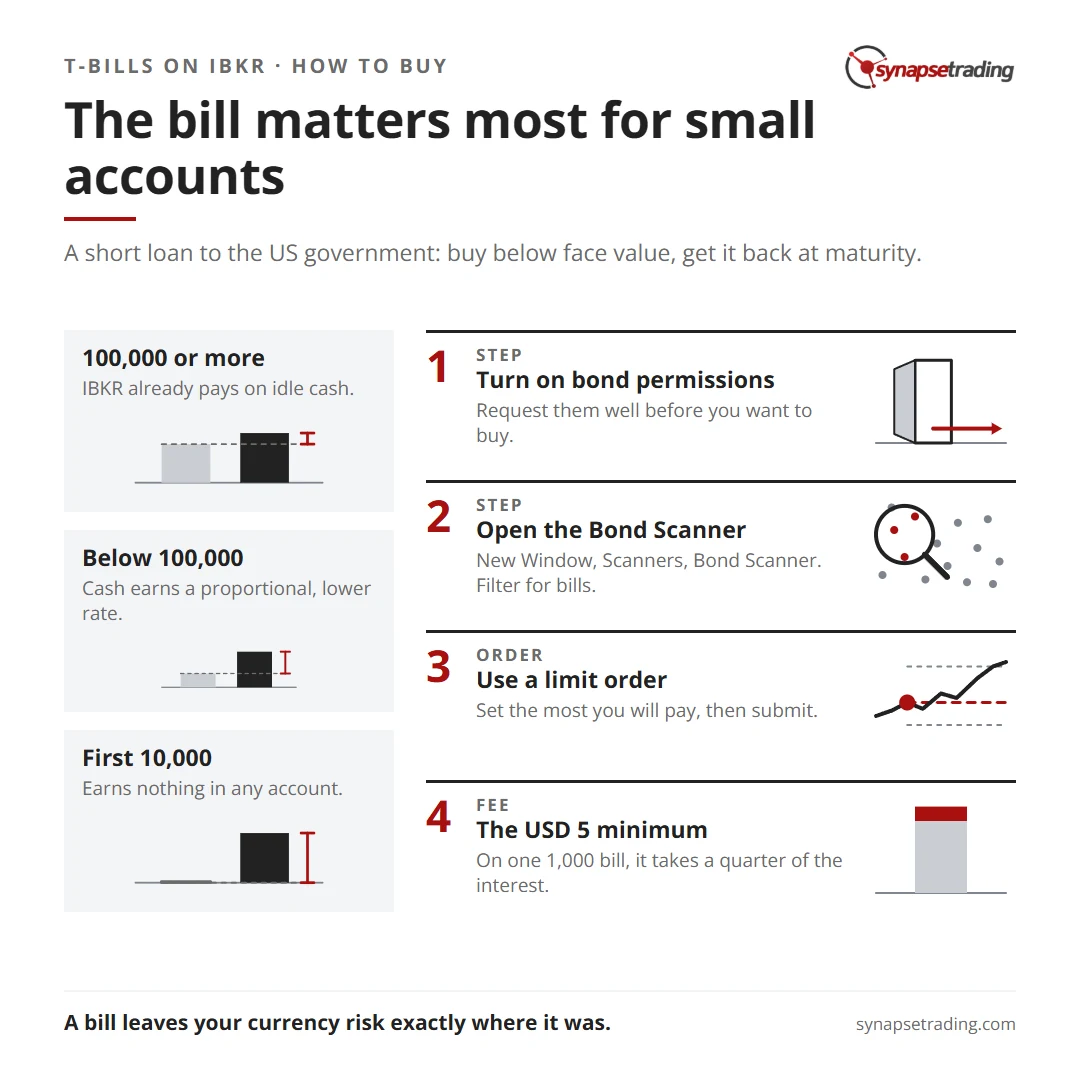
The bill matters most for small accounts. Summary card for the post: How to Buy US T-Bills on Interactive Brokers, and When They Beat Idle Cash.

Why does a T-bill never pay interest?

A T-bill is a slightly odd kind of loan. The US government tells you up front that it will never send you a single interest payment, and every week investors still line up to lend it money.

The trick is in the price. TreasuryDirect, the Treasury’s own site, says that when the bill matures “you are paid its face value”. You pay less than that when you buy, so the interest is simply the gap between what you paid and what comes back.

The real numbers make it clearer. On 16 October 2026 the Treasury’s daily table showed the 26-week bill at a discount rate of 4.20%. A 26-week bill runs 182 days, so the price works out like this:

100 − (4.20 × 182 ÷ 360) = about 97.88 per 100 of face value

You pay roughly 97.88, wait 26 weeks, and receive 100. The 2.12 in between is your interest. The Treasury quoted the same bill at a coupon-equivalent yield of 4.35% a year, and that is the figure to hold up against a deposit rate, because it measures the interest against what you actually paid.

Bills come in 4, 6, 8, 13, 17, 26 and 52 weeks. TreasuryDirect adds that you “can hold a bill until it matures or sell it before it matures”, and that second option is what makes bills useful to a trader. Cash parked in one can come back out early.

How do you buy a T-bill in Trader Workstation?

The first hurdle is that the bills are easy to miss. They sit inside a scanner rather than in the usual symbol search, and an account opened for stocks may not have permission to trade bonds at all, so the first order can bounce before you see a price.

  1. Turn on bond permissions. When a client asked, IBKR replied that “you will need bond trading permissions enabled in your account to trade T-Bills”. You request them in the trading permissions section of your account settings, well before the day you want to buy.
    Screenshot 2022 10 13 at 12 23 58 AM
  2. Open the Bond Scanner. In Trader Workstation, IBKR’s free desktop platform, click New Window at the top left, then Scanners, then Bond Scanner. IBKR says it searches US Treasuries “by type, maturity date range and additional category”.
    Screenshot 2022 10 13 at 12 27 32 AM
  3. Filter for bills. Choose US Treasuries, pick bills as the type and run the search. Every bill on offer appears with its maturity date, the day you get paid face value. Pick the date that lands where you think you will need the cash.
    Screenshot 2022 10 13 at 12 32 03 AM
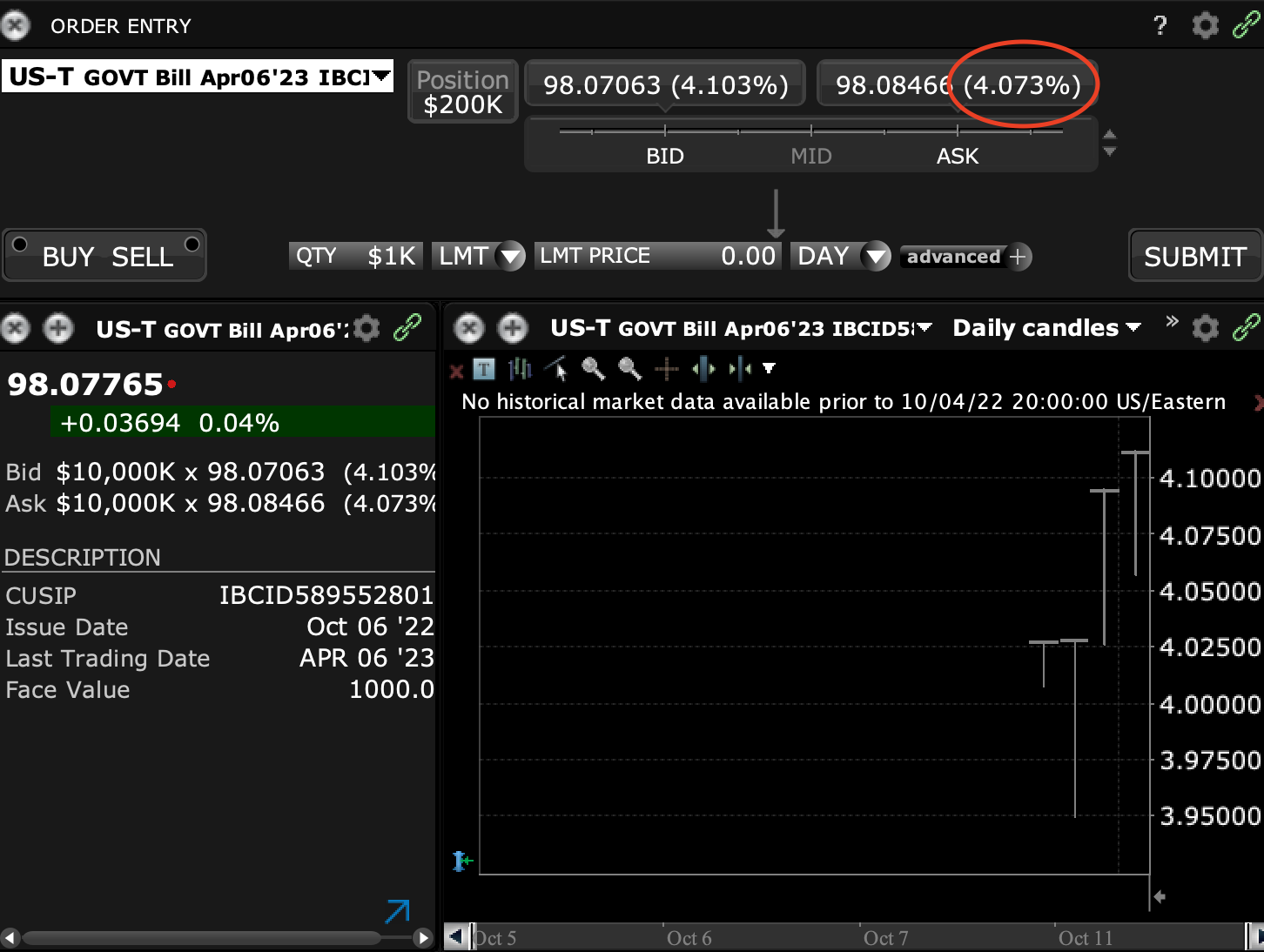
  4. Check the quantity. Click a bill to load it into the order panel, and Trader Workstation fills in the smallest quantity you can buy. IBKR notes that bonds are typically issued at 1,000 US dollars of face value, so a quantity of 10 means 10,000 of face value.
  5. Use a limit order. IBKR itself recommends a limit price, because some venues it routes Treasury orders to do not accept market orders. Set the most you will pay, then submit.

Then comes the commission. For US Treasuries IBKR charges 0.002% of face value on the first one million US dollars, with a minimum of USD 5 an order. The percentage only climbs past USD 5 once an order goes above 250,000 of face value, so on nearly every retail order you simply pay the USD 5.

Say you buy a single 1,000 bill with 26 weeks to run. It pays roughly 2.1% of face over those weeks, and the USD 5 fee is 0.5% of face, so about a quarter of your interest is gone before the bill has done anything. Buy 10 bills in one order and the fee shrinks to 0.05%, about a fortieth of the interest.

If you would rather spend your 15 minutes a day on the market than on fee arithmetic, my free 15-minute swing trader checklist is the daily routine I use myself.

Is a T-bill better than leaving cash at IBKR?

Suppose you have US dollars sitting in IBKR between trades. The natural assumption is that they earn nothing, which is close to true at plenty of banks and quite wrong here.

On 17 October 2026 IBKR’s interest page showed 3.38% for IBKR Pro clients on US dollar balances above the first 10,000, and the first 10,000 itself earns nothing. The same page carries a second rule that is easy to skim past, that accounts worth less than 100,000 “will be paid at a rate proportional to” accounts worth more. In plain terms, an account worth 50,000 earns half the rate.

Your situationIBKR cash rate, 17 Oct 202613-week bill, 16 Oct 2026What the bill adds
Account worth 100,000 or more3.38%4.18%about 0.8 points
Account worth 50,000about 1.69%4.18%about 2.5 points
The first 10,000 of cash, any account0%4.18%4.18 points

So the bill matters most for exactly the people who think they are too small to bother.

A large account gains about 0.8 of a point by moving its cash into bills. If it rolls one 10,000 order every 13 weeks, four commissions a year cost 0.2% of that money, which takes back about a quarter of the gain. A 50,000 account loses about 2.5 points a year by leaving the cash alone. That is the kind of slow leak people only notice, with some regret, at the end of the year.

Do Singapore investors pay US withholding tax on T-bills?

On 21 December 2025, a trader on Reddit’s r/singaporefi described parking spare US dollars in a T-bill ETF on IBKR, then opening the activity report and finding 30% US withholding tax taken from its payouts. The question that followed was a fair one: “what’s the current meta for holding idle USD without the tax drag?”

The 30% is the IRS default. Publication 515 says that “most types of U.S. source income received by a foreign person are subject to U.S. tax of 30%” and then lists the exceptions. One of them covers interest and original issue discount on “an obligation that is payable 183 days or less from the date of its original issue”, provided the rules that keep the debt out of US taxpayers’ hands are met. Every bill of 26 weeks or less falls inside that line.

The 52-week bill runs past 183 days, so it relies instead on the separate portfolio interest exemption, which needs documentation that the owner is not a US person.

On the Singapore side, IRAS says that for most individuals, overseas income received in Singapore “is not taxable”, and the exceptions include income received through a Singapore partnership.

Whether that fund’s payout should have been withheld at all is a separate question. The same IRS publication has its own rules for funds, and that is where I hand over to a tax adviser, because I teach trading and your own tax position deserves someone who does it for a living.

So the direct bill does answer the tax question. My concession is about the reward. As at 16 October 2026 it came to about 0.8 of a point over IBKR’s own cash rate for a large account. A reader with 100,000 or more sitting idle may fairly decide that rolling bills every quarter is not worth 0.8 of a point.

What about the currency?

For a reader in Singapore, the yield is only half the story, because the money is in US dollars.

On 5 November 2025, in my weekly outlook, stocks were correcting, and gold, silver and crypto were all still above the prices we wanted to buy at. So I told viewers that “it is not a bad idea to sit in cash also”, and the reason was the US dollar, which was rising quite strongly against the Singapore dollar. If it climbed back to its prior resistance, I said, that alone was about a 3% gain on the whole portfolio, “which is not too bad for holding cash”.

The same logic runs backwards just as easily. A bill yielding about 4% a year earns about 1% over 13 weeks, and a 1% fall in the US dollar against the Singapore dollar over those weeks wipes that out completely. The bill takes away the fear of the borrower not paying, and leaves your currency risk exactly where it was.

Converting costs a little too. IBKR charges 0.20 basis points of the trade value on spot currency, with a minimum of USD 2 an order, which is small next to the currency move itself.

I have held T-bills myself in the past, though I do not hold any right now.

When should you sell a bill early?

Mostly when a trade needs the money. Because a bill is so short, its price barely moves.

A rough rule is that the price changes by about the yield change times the years left to run. If yields jumped a full point on a 13-week bill with a quarter of a year to go, the price would drop by roughly 0.25%. That is a terrible week for a bill and a quiet hour for most stocks.

Selling early does cost a second USD 5 commission, and you sell at whatever buyers are bidding that day. So if you know you will need the cash in six weeks, a bill that matures in six weeks saves you both, along with the small relief of having nothing to decide.

How much cash to keep parked is really a sizing question, and the free 15-minute swing trader checklist is the routine I use to keep that decision small.

FAQ

How do I buy US T-bills on Interactive Brokers?
Enable bond trading permissions and open Trader Workstation. Go to New Window, Scanners, Bond Scanner, choose US Treasuries with bills as the type, pick a maturity and place a limit order.

Do I need special permissions to trade T-bills on IBKR?
Yes. IBKR says you need bond trading permissions enabled before you can trade T-bills. You request them in the trading permissions section of your account settings.

How much does IBKR charge to buy T-bills?
IBKR charges 0.002% of face value on the first one million US dollars, with a minimum of USD 5 an order. On most retail orders the minimum is what you pay.

Do Singapore investors pay US withholding tax on T-bills?
IRS Publication 515 exempts interest on obligations payable 183 days or less from issue from the usual 30% withholding, which covers bills of 26 weeks or less. Check your own case with a tax adviser.

Is a T-bill better than IBKR’s interest on cash?
On 16 October 2026 a 13-week bill yielded 4.18%. On 17 October IBKR paid 3.38% on US dollar cash above 10,000 for accounts worth 100,000 or more, and less to smaller accounts, so the bill helps them most.

Can I sell a T-bill before it matures?
Yes. TreasuryDirect says you can hold a bill to maturity or sell it before then. You pay a second commission and sell at the price buyers are bidding that day.


Do you keep your spare US dollars in cash, in bills or in a fund, and did the 10,000 and 100,000 rules change the sum for you? Let me know in the comments.

If you are starting from scratch, read how to open and set up an Interactive Brokers account. The cash side of the same question is in how IBKR pays interest on idle cash. How much of your money belongs in the market at all is covered in my guide to money and risk management, and the rest is in my free trading guides.

And if you want a routine that keeps your trading to 15 minutes a day, grab the free 15-minute swing trader checklist.


About the author. Spencer Li is The 15-Minute Trader and the founder of Synapse Trading. He is a Certified Financial Technician (CFTe) with 15+ years of trading, run from 70+ countries. He holds a B.Acc and B.BM from SMU. Every trade he takes is public, dated, losses left in. He teaches low-risk swing trading in 15 minutes a day, one system for any market.

Education, not financial advice. Synapse Trading is not licensed by MAS to advise on investment products. Trading carries risk of loss, and past performance is not indicative of future results.

by Spencer Li
https://synapsetrading.com/wp-content/uploads/2026/10/usd-tbills-ib-card.webp 630 1200 Spencer Li https://synapsetrading.com/wp-content/uploads/2026/10/synapse-logo-horizontal-light.png Spencer Li2022-11-27 19:38:442026-09-04 14:02:29How to Buy US T-Bills on Interactive Brokers, and When They Beat Idle Cash
Page 7 of 12«‹56789›»

Free checklist

The 15-Minute Swing Trader’s Checklist

The daily and weekly routine I use to find, manage and review trades in about 15 minutes a day, on the record since 2014.

Get the free checklist

Topics

  • Trading foundations
  • Technical analysis
  • Strategies and systems
  • Risk and money
  • Trading psychology
  • Markets and products

Synapse Trading

Swing trading for busy professionals, in 15 minutes a day.

Start free

Learn

  • Start here
  • Free trading guides
  • Blog
  • Tools and resources

Programs

  • Trading Mastery Program
  • Daily trading signals
  • Student results
  • Public trade log

Company

  • About
  • Contact me
  • Partnerships
  • Disclaimer
  • Privacy policy
  • Terms & Conditions

Synapse Trading Pte Ltd
Registration No. 201316168H
WhatsApp +65-8897-1204
info@synapsetrading.com

Contact Us

Synapse Trading Pte Ltd
Registration No. 201316168H

Whatsapp: +65-8897-1204
Telegram: @iamrecneps
Email: info@synapsetrading.com

Links

Disclaimer
Privacy policy
Terms & Conditions
Contact us
Partnerships

© 2012-2026 Synapse Trading | All rights reserved. Educational content only, not personalised financial advice. Trading carries risk, including loss of capital. Past performance is not indicative of future results. Synapse Trading is not licensed or regulated by MAS.
  • Link to Facebook
  • Link to X
  • Link to Instagram
  • Link to Youtube
  • Link to LinkedIn
  • Link to Mail
Scroll to top Scroll to top Scroll to top