

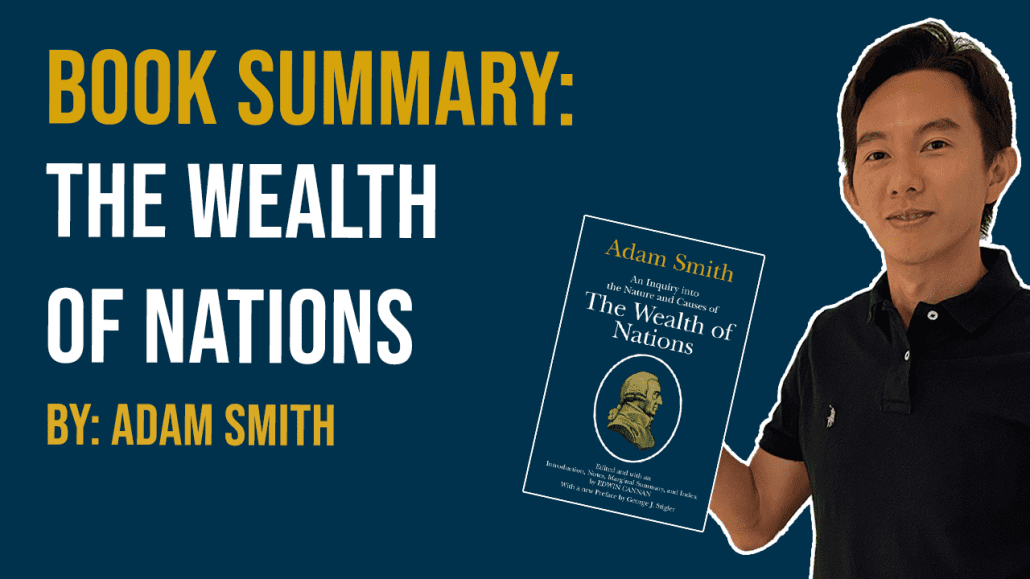
Book Summary: The Wealth of Nations by Adam Smith
Join our Telegram channel for more market analysis & trading tips: t.me/synapsetrading
Table of Contents
The Wealth of Nations by Adam Smith: Summary, Key Ideas, and What It Teaches Traders
Last updated: 3 July 2026 · By Spencer Li, CFTe
The Wealth of Nations, written by Adam Smith in 1776, is the book that laid the foundation for modern free-market economics, and its core idea is the “invisible hand”: individuals acting in their own self-interest, inside a competitive market, tend to produce outcomes that benefit society as a whole. Smith’s argument is that a free market, where prices are set by supply and demand rather than by government, is the most efficient way to allocate resources. The book’s most quoted ideas are the division of labour (specialisation raises productivity), the price system as a coordination tool, and the case for free trade and competition. For a trader or investor, the practical takeaway is simple: markets are run by self-interested participants reacting to supply, demand, and price, so your edge comes from reading that behaviour, not from arguing with it.
Here is the author, the central ideas, and how I actually apply the book to trading.
Who was Adam Smith?
Adam Smith was a Scottish economist and philosopher, born in 1723, widely regarded as one of the founders of modern economics. Besides The Wealth of Nations, he wrote The Theory of Moral Sentiments, which deals with human sympathy and morality. People forget that Smith was a moral philosopher first and an economist second. That matters, because the “invisible hand” was never an excuse for greed. It was an observation that, under the right conditions, private interest and public good can line up.
What is The Wealth of Nations about?
The book is a broad analysis of how an economy works and what role it plays in society. The central message is the invisible hand (the idea that self-interested individuals, transacting freely, can collectively benefit society without anyone planning it). From there, Smith builds the case for a free-market economy where supply and demand set prices, and where the government’s job is limited rather than central.
Do note that, this is an 18th-century book. The world it describes is simpler than ours. But the mechanics it identifies, specialisation, price signals, competition, capital accumulation, still drive every market you trade today.
The 10 key ideas, and how they apply
Smith’s argument is usually compressed into ten ideas. Here they are next to the practical move each one suggests, so you can see the theory and the application side by side.
| # | Key idea from the book | What it means | How to apply it |
|---|---|---|---|
| 1 | Division of labour | Specialising on one task raises efficiency and output | Specialise. Get good at one market or one setup before spreading thin. |
| 2 | Role of self-interest | People acting in their own interest can benefit the whole | Make decisions that serve your real goals, not what looks impressive. |
| 3 | The price system | Prices set by supply and demand allocate resources | Read price as information. It is the market telling you where demand is. |
| 4 | Benefits of free trade | Free exchange across borders raises prosperity | Stay open to opportunities outside your home market. |
| 5 | Limited role of government | The state should supply public goods, not run the market | Recognise that intervention distorts prices. Factor policy risk in, do not assume it. |
| 6 | Capital drives growth | Accumulated capital powers economic growth | Build and reinvest capital. Compounding is the long game. |
| 7 | Importance of competition | Competition lowers prices and raises quality | Compete to improve. Assume the other side of your trade is sharp. |
| 8 | Role of wages | Wages are set by the supply and demand for labour | Understand that your pay, and your edge, is priced by the market too. |
| 9 | Education and skills | Skills drive individual and collective prosperity | Invest in your own learning. It is the highest-return capital you own. |
| 10 | Market sets prices | Prices come from the market, not an authority | Respect the market’s price. Do not fight the tape because you “know better”. |
The thread running through all ten, for a trader, is the price system. Smith’s whole framework says prices are not random and they are not handed down. They are the running output of millions of self-interested decisions. That is exactly what a chart is. Price action is the invisible hand drawn on a screen.
A few more points worth keeping
Beyond the headline ten, Smith makes four observations that still hold up:
- Entrepreneurship drives growth. Starting and running a business is one of the main engines of an economy.
- Technological progress raises efficiency and productivity. New tools let the same effort produce more.
- The financial system (banks and other institutions) matters, because it moves capital to where it is useful.
- Taxes can drag on the economy by distorting prices and discouraging activity.
Hence, when you read a market, you are not just reading a chart. You are reading the combined effect of entrepreneurs, technology, credit, and policy, all of it expressed back to you as price.
Where the human edge comes in
Smith’s market is a crowd of self-interested participants competing on price. That is also a fair description of every market you trade. An AI can summarise this book in a second, and it can scan a thousand charts for you. What it cannot do is sit in that competitive crowd and supply the judgment, the discipline, and the emotional control to act well when your own self-interest is screaming the wrong thing at you. Smith described the game. Playing it well is still your job, and that is the first of the Five Edges that AI cannot trade for you.
My view: read it for the mental model, not the tactics
Personally, I would not read The Wealth of Nations for a trading edge. It will not give you a setup. What it gives you is a mental model: a clear picture of why prices move, why competition matters, and why specialisation pays. That model is worth more over a career than any single pattern.
I would recommend it to anyone who wants to understand how markets actually work underneath the candles. Just go in knowing it is a foundation, not a playbook.
FAQ
What is the main idea of The Wealth of Nations?
The main idea is the “invisible hand”: individuals acting in their own self-interest, within a free and competitive market, tend to benefit society as a whole. Smith argued that prices set by supply and demand allocate resources more efficiently than government planning.
When was The Wealth of Nations written, and by whom?
It was written by Adam Smith, a Scottish economist and philosopher, and published in 1776. It is widely considered one of the founding works of modern economics and capitalism.
What is the “invisible hand”?
The invisible hand is Smith’s term for the way self-interested individuals, transacting freely in a market, can collectively produce outcomes that benefit society without anyone directing them to. It is the book’s most famous concept.
Is The Wealth of Nations useful for traders and investors?
Indirectly, yes. It will not give you a strategy, but it explains why prices move and why markets are efficient at allocating resources. That mental model helps you read price action as information rather than noise.
What is the difference between The Wealth of Nations and The Theory of Moral Sentiments?
The Wealth of Nations is Smith’s work on economics and markets. The Theory of Moral Sentiments, his earlier book, deals with human sympathy and morality. Together they show Smith saw self-interest and moral behaviour as connected, not opposed.
Now that you have the key learning points, would you add The Wealth of Nations to your reading list? And if you have already read it, what stuck with you? Let me know in the comments.
For more summaries like this, read the roundup: Best Investing and Trading Books of All Time.
Want a system to put the theory to work? Grab the free 15-Minute Swing Trading Starter Kit. It is the exact routine I use to scan once a day and trade any market in 15 minutes.
About the author. Spencer Li is the founder of Synapse Trading and a Certified Financial Technician (CFTe) with 15+ years of trading across stocks, forex, crypto, commodities, and bonds. His trade log is public: every trade since April 2024, dated, losses left in. He has taught a 15-minute daily trading routine since 2014, one system for any market.
Education, not financial advice. Synapse Trading is not licensed by MAS to advise on investment products. Trading carries risk of loss; past performance is not indicative of future results.
Related
Best Investing and Trading Books of All Time (pillar) · The Intelligent Investor summary · Reminiscences of a Stock Operator summary
Want our free trading resources by email? Leave your address below.
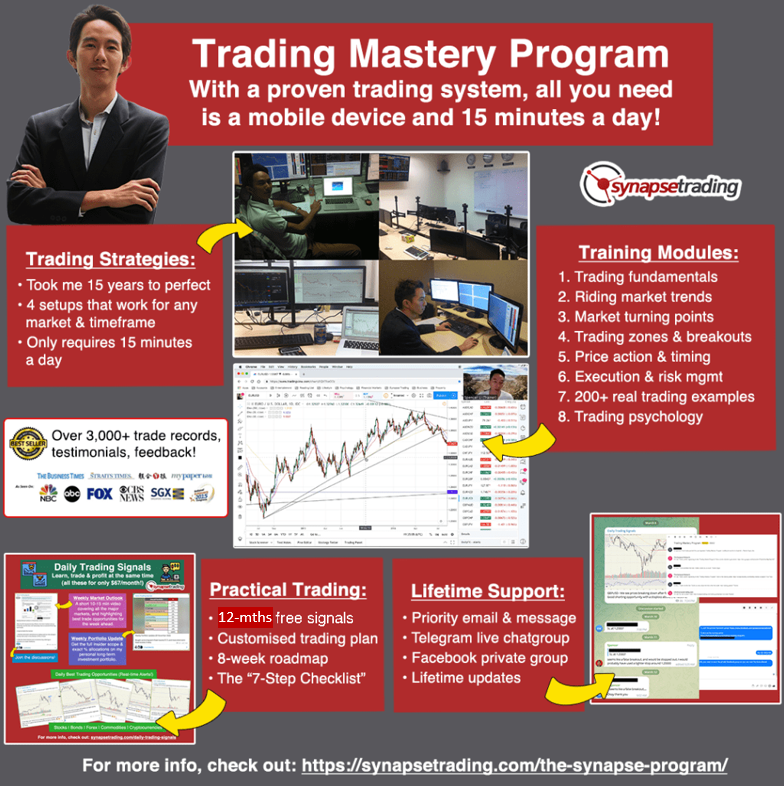 Our flagship mentoring program is suitable for both beginners and advanced traders, covering the 4 strategies which I used over the past 15 years to build up my 7-figure personal trading portfolio.
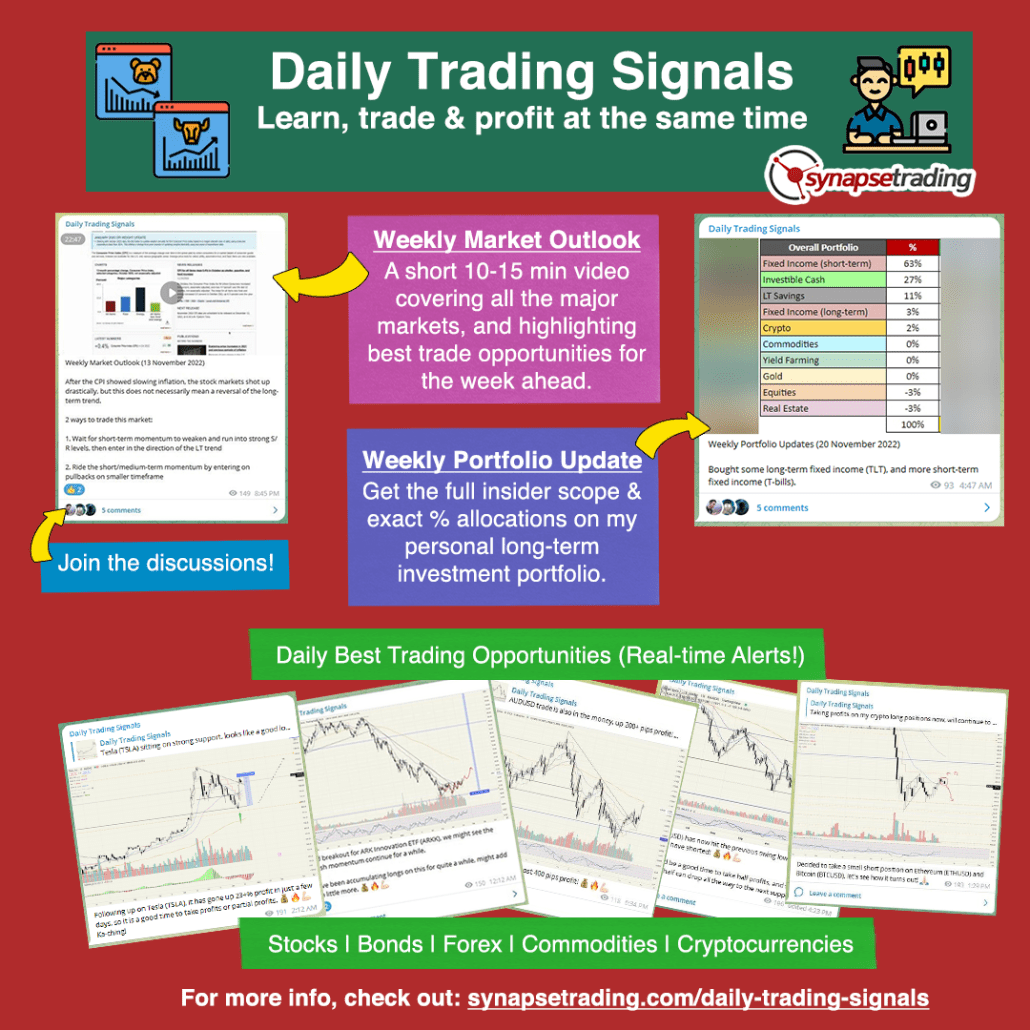 If you're looking for the best trading opportunities every day across various markets, and don't want to spend hours doing the research yourself, check out our private Telegram channel!


Leave a Reply
Want to join the discussion?Feel free to contribute!