

The 47/2 Problem: Why AI Trading Tools Make Picking Trades Harder
Want the daily routine? Get the free 15-Minute Swing Trader’s Checklist. Get it free →
Why AI trading tools make picking trades harder, and how to get better at saying no
Published: 28 October 2026 · By Spencer Li, CFTe
In March 2026, a trader on Reddit started a weekly diary called “Prompting my way into profitability with AI”. I understand the hope behind that title. If a machine can read every chart in the market overnight, surely the hard part of trading is done?
The trouble is that finding setups has always been the easy part of trading.
Not long ago, a proper scan took a whole evening. You flipped through charts one at a time, and by the time you had found 5 decent setups you were tired enough to take only 1 of them. The tiredness did some of the filtering for you. (Nobody teaches that as a method, though it probably worked better than it had any right to.)
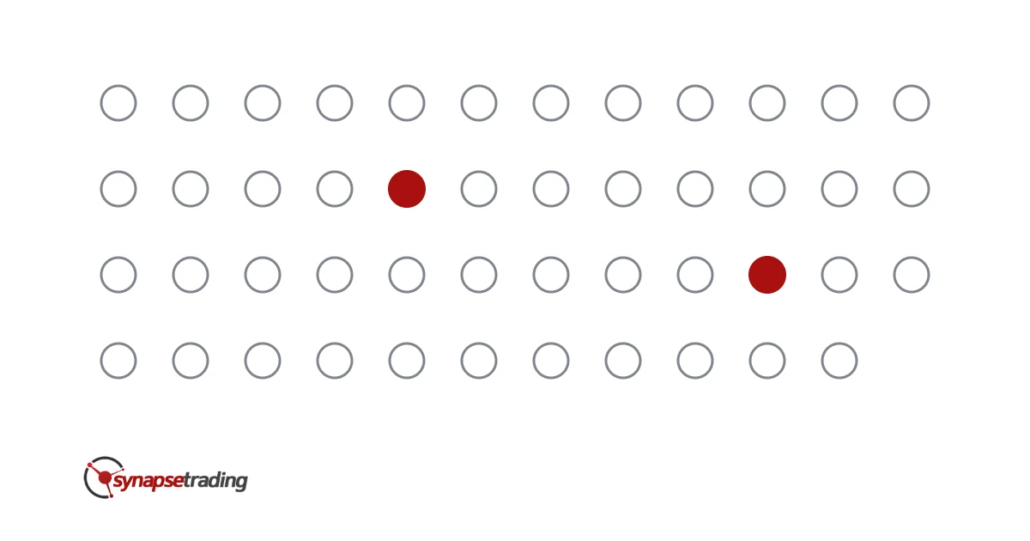
Today the same scan takes seconds. Ask an AI tool for swing setups in US stocks and it will hand you 47 of them, each with a tidy paragraph on why it looks good. So the scarce skill has flipped. It used to be finding a trade, and now it is turning down the 45 that look almost as good as the 2 worth taking.
I call this the 47/2 problem. The edge sits in the 45 noes.
Why does more choice make it harder?
So you might be thinking, surely more options is better? More fish in the net means more chances of a good one.
Well, a trading account works differently from a fishing net. Every setup on the screen asks you for a decision, and every one of them now arrives with a reason attached. That second part is new. A scanner from 10 years ago gave you a list of tickers, while an AI tool gives you the list plus 47 well-written arguments for buying, and it writes a weak argument just as fluently as a strong one.
Try it once. Look at 30 setups in a row and notice what happens to your standards by number 25. The reasons start to sound alike, the bar drops a little with each chart, and somewhere near the end of the list a trade you would have skipped on Monday morning starts to look fine.
There is a second problem, and it is quieter. If the tool is cheap and everyone has it, the same 47 setups are sitting on thousands of screens at once. A breakout that every scanner flagged the night before can be a crowded trade a minute after the open. Hence, the 2 you take need a reason the crowd doesn’t have, and the crowd has the same scan you do.
What does a good “no” look like?
A no needs a name. An unnamed no is a mood, and moods change by lunchtime.
Here is a simple lens. It follows the order I check a trade in, and almost every rejection lands in one of 4 buckets:
- Regime. The overall market is moving against the trade. A perfect long setup in a falling market is still swimming against the tide.
- Trend. The stock is on the wrong side of its 200-day EMA (a moving average of the last 200 daily closes that gives more weight to recent days, and a rough line between an uptrend and a downtrend).
- Shape. It is not one of the few setups you actually trade. It looks interesting, which is a long way from being yours.
- Stop. There is no clean place to put the stop-loss, or the stop sits so far away that the position becomes too small to matter.
Most of the 45 fail one of these in under a minute. The real payoff comes later, once you have counted them. Keep a tally for a month and you will learn which bucket does most of your filtering, and which one you keep overriding when you are bored and the market is quiet.
What should the AI do, then?
To be fair to the diary, the scan really is better now, as at October 2026. A machine reads more charts in a minute than I can in a month, it doesn’t get tired, and it doesn’t fall in love with a ticker because it made money on it last year.
So it makes sense to use it for what it is good at, which is widening the net. Then it can work the other side as well. One prompt worth trying is the case against: give it the setup and ask for the strongest reason to skip it. A tool that writes a convincing yes will write an equally convincing no, and seeing the two side by side is a quick lesson in how much of that fluency is decoration.
The judgment still has to come from you. The tool can recite the 4 buckets, but it has no money in the trade, and it won’t be the one watching the screen when the stop gets hit.
For what it’s worth, my own published log holds 484 closed trades, losses included. 51% of them won, and the average win was about 3.1 times the average loss. That is close to a coin-flip hit rate. The edge sits in which trades get through.
The skill that is left
The skill is rejection, done on purpose and with names. A trader who looks at 47 setups and takes 2 has done far more work than one who looks at 5 and takes all 5, even though the second one looks busier, and probably feels busier too.
How many setups did you look at last week? How many did you take? And could you name the reason you said no to each of the rest?
About the author. Spencer Li is The 15-Minute Trader and the founder of Synapse Trading. He is a Certified Financial Technician (CFTe) with 15+ years of trading, run from 70+ countries. He holds a B.Acc and B.BM from SMU. Every trade he takes is public, dated, losses left in. He teaches rules-based swing trading in 15 minutes a day, one system for any market.
Educational content only, not personalised financial advice. Trading carries risk, including loss of capital. Past performance is not indicative of future results. Synapse Trading is not licensed or regulated by MAS.
Want the daily routine? Enter your email for the free 15-Minute Swing Trader's Checklist.
Free 5-page PDF, then occasional trading emails. Education only, not financial advice. Unsubscribe anytime. Kit stores your email in the US: see our privacy policy.
Want to learn the full method? The Trading Mastery Program teaches the 4 strategies I have traded since 2011. It suits beginners and experienced traders.
Rather follow the trades as they happen? Daily Trading Signals is our Telegram channel: my trade ideas with entry, stop and exit, and every trade is public.
Questions about this post? Ask in the free Telegram channel →
Educational content only, not personalised financial advice. Trading carries risk, including loss of capital. Past performance is not indicative of future results. Synapse Trading is not licensed or regulated by MAS.
