

One Up on Wall Street Summary: Peter Lynch’s Six Categories and Stock Checklist
Want the daily routine? Get the free 15-Minute Swing Trader’s Checklist. Get it free →
How Lynch found stocks in everyday life, sorted them into six types, and checked the story before he bought, plus where his method and a trader’s part ways
Published: 17 October 2026 · Last updated: 17 October 2026 · By Spencer Li, CFTe
What is One Up on Wall Street about? Peter Lynch’s book argues that an ordinary investor can beat professionals by buying companies they already understand from daily life, often before Wall Street notices them. His first rule is blunt: “Stop listening to professionals!”
The method has three parts. Notice a company doing well in your own world. Put it into one of six categories, from slow growers to fast growers to turnarounds, so you know what kind of story you are buying. Then check the story against the numbers before you invest. Lynch also lists the 13 traits of a “perfect stock”, the stocks he avoids, and how he decides when to sell. This summary walks through each one.
Who is Peter Lynch?
Peter Lynch ran Fidelity’s Magellan fund. In the book, he writes that during the twelve years he managed it, the fund “has risen over twentyfold per share.” One Up on Wall Street was first published in 1989.
His voice is the reason the book still sells. He writes like a neighbour explaining stocks over the fence, with doughnuts and motels instead of formulas.
A note on sources: this summary is drawn from an authorised summary of the book, published by permission of Simon & Schuster. Quotes are as printed there.
What is the overview of the book?
The book has three parts. Part I is about getting ready to invest: why amateurs have an edge, and whether you should be in stocks at all. Part II is about picking winners: the six categories, the perfect stock and the ones to avoid. Part III is the long view: how many stocks to own, and when to buy and sell.
Lynch’s edge for the amateur is simple. He found Taco Bell through a burrito on a trip, La Quinta Motor Inns through a tip at a rival motel, and Dunkin’ Donuts because he loved the coffee. You see these things long before an analyst writes about them.
A reader on Reddit put the same idea this year, about chains like Chipotle and Starbucks: “These companies didn’t just suddenly appear everywhere overnight, right?”
Is the stock market gambling?
Lynch faces this head on. “To me, an investment is simply a gamble in which you’ve managed to tilt the odds in your favor.”
And he does not need to be right all the time. “If six out of ten perform as expected, then I’m thankful. Six out of ten is all it takes to produce an enviable record on Wall Street.”
Before you buy a single share, he asks three personal questions. Do you own a house? Do you need the money? And do you have the qualities it takes, such as patience, humility and the willingness to admit mistakes? On the money question his rule is clear: “Only invest what you could afford to lose without that loss having any effect on your daily life in the foreseeable future.”
What are Peter Lynch’s six categories of stocks?
This is the core of the book. Once Lynch finds a company, he places it in one of six categories, because each one behaves differently and needs a different plan.
| Category | What it is | What to check |
| Slow growers | Large, ageing companies growing a little faster than the economy | The dividend, and whether it has always been paid |
| Stalwarts | Big, solid companies that protect you in hard times | The P/E ratio, so you do not overpay |
| Fast growers | Small, aggressive firms growing “at 20 to 25 percent a year” | Whether growth is speeding up or slowing, and room to expand |
| Cyclicals | Companies whose profits rise and fall with the business cycle | Inventories and the early signs of a turn |
| Turnarounds | Battered companies that could recover | Cash, debt, and whether they can survive their creditors |
| Asset plays | Companies sitting on something valuable the market has missed | The real value of the assets, and the debt against them |
Fast growers are where Lynch finds his “10- to 40-baggers”. A tenbagger, in his words, is “a stock in which you’ve made ten times your money.” He is just as clear about the other end: “big companies don’t have big stock moves.”
How does Lynch’s method work?
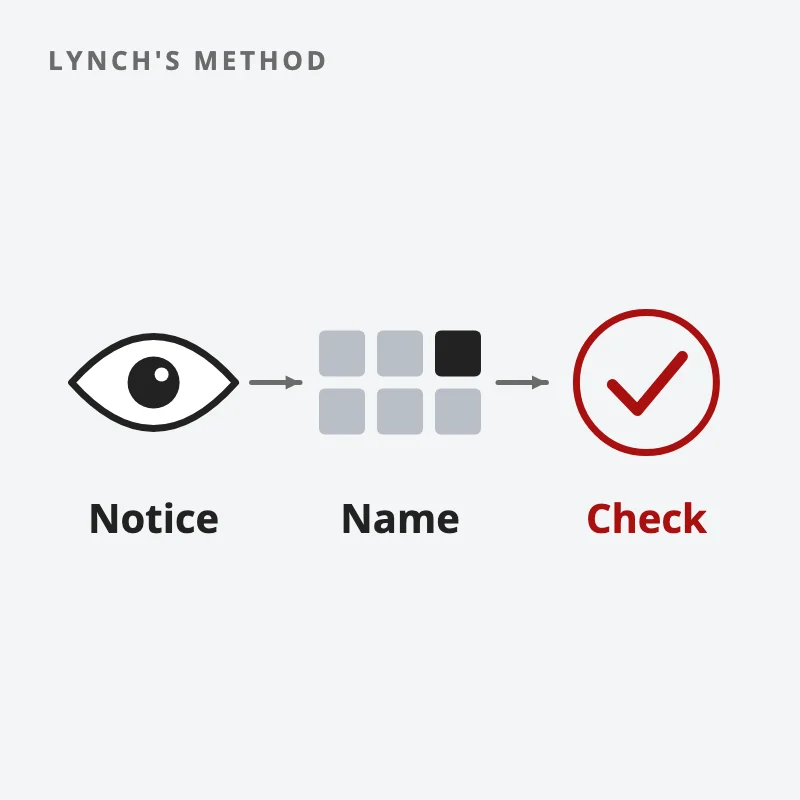
Here is the method as three steps.
- Notice. Start with what you already see at work, in shops and at home. Lynch says the average person comes across “a likely prospect two or three times a year.”
- Name. Put the company into one of the six categories. “If you can’t figure out what category your stocks are in, then ask your broker.” Each category sets what you expect and when you would sell.
- Check. Treat the tip like “an anonymous and intriguing tip, mysteriously shoved into your mailbox.” Read the numbers before you buy. “Investing without research is like playing stud poker and never looking at the cards.”
The checking does not take long. Lynch says that developing the story “at most it will take a couple of hours.”
What makes a perfect stock, and which stocks should you avoid?
Lynch lists 13 traits of his ideal company. A few of them stand out. It sounds dull, “or, Even Better, Ridiculous.” It does something dull or disagreeable. It is a spinoff. Institutions do not own it and analysts do not follow it. It has a niche. People have to keep buying what it makes. Insiders are buying, and the company is buying back its own shares.
Then the stocks he avoids. The hottest stock in the hottest industry. Any company touted as “the next” famous success. Companies that waste profits on bad acquisitions, which he calls “diworseifications”. The whisper stock with a whiz-bang story and no earnings. A supplier that sells 25 to 50 percent of its goods to a single customer. And a stock with an exciting name.
The whisper stock sounds a lot like penny-stock hype today. Lynch’s answer is to wait. If the prospects are that good, it will still be a fine investment next year, once the company has proven itself.
How many stocks should you own, and when do you sell?
Lynch says that in small portfolios he would “be comfortable owning between three and ten stocks.” More stocks raise the chance that one becomes a tenbagger. If you want to see how that compares with a sizing rule for each position, our guide on how much of your portfolio to put in one stock works through it.
On selling, he goes category by category. Sell a slow grower after a 30 to 50 percent gain, or when the fundamentals slip. Sell a cyclical near the end of the cycle, when inventories build. With a fast grower, “the trick is not to lose the potential tenbagger,” so you watch for the end of the second phase of rapid growth.
Where does Lynch’s method differ from swing trading?
Here is the honest contrast. Lynch writes: “If you can’t convince yourself ‘When I’m down 25 percent, I’m a buyer’ and banish forever the fatal thought ‘When I’m down 25 percent, I’m a seller,’ then you’ll never make a decent profit in stocks.”
That is an investor’s rule. He buys a business after research, expects to hold it for years, and treats a falling price as a discount on a company he understands. A swing trader works on a different clock. We set the exit before the trade, and a stop-loss closes the position when the chart says we are wrong. Our post on averaging down explains why adding to a loser is a different decision for a trader than for a long-term owner.
Both approaches share one idea that Lynch puts best: “A stock does not know that you own it.” Your purchase price means nothing to the market. And his warning on cheap shares fits any style: “If a stock goes to zero, you lose just as much money whether you bought it at $50, $25, $5, or $2.”
If you want the trader’s version of a buying checklist, with the exit set before you enter, our free 15-Minute Swing Trader’s Checklist lays it out. Get the free checklist →
Concluding thoughts
One Up on Wall Street is the friendliest entry to stock picking I know, which is why it sits at number nine in the ten books on my reading list for beginners. It teaches you to look at a company as a business with a story, and to check that story before you pay for it.
If you want the deeper theory of value behind it, read our summary of The Intelligent Investor. For how stock picks fit into a whole portfolio, see the DIY guide to building your investment portfolio, and for the full shelf, the best investing and trading books of all time.
So look around you this week. Which company have you noticed doing well, long before you heard anyone talk about its stock?
FAQ
What is the main idea of One Up on Wall Street?
That ordinary investors can beat professionals by buying companies they understand from everyday life, then checking the numbers before Wall Street notices them.
What are Peter Lynch’s six categories of stocks?
Slow growers, stalwarts, fast growers, cyclicals, turnarounds and asset plays. Each behaves differently, so each needs its own plan for buying and selling.
What is a tenbagger?
Lynch’s term for a stock in which you have made ten times your money. He says fast growers are where most tenbaggers come from.
Does Peter Lynch say to buy what you know?
He says to start there, then do the research. A company you notice in daily life is a lead, not a buy signal, until you have checked its numbers.
How many stocks did Peter Lynch recommend owning?
For a small portfolio, he says he would be comfortable with between three and ten stocks.
Go deeper
Lynch checks the story before he buys. The free 15-Minute Swing Trader’s Checklist does the same for traders: the daily scan, the questions to ask before you enter, and the five rules that keep you in the game. Enter your email and we’ll send it over:
We use your email address to send you the checklist, then emails about trading and our courses. Unsubscribe in one click, any time. Privacy policy.
About the author. Spencer Li is The 15-Minute Trader and the founder of Synapse Trading. He is a Certified Financial Technician (CFTe) with 15+ years of trading, run from 70+ countries. He holds a B.Acc and B.BM from SMU. Every trade he takes is public, dated, losses left in. He teaches low-risk swing trading in 15 minutes a day, one system for any market.
Educational content only, not personalised financial advice. Trading carries risk, including loss of capital. Past performance is not indicative of future results. Synapse Trading is not licensed or regulated by MAS.
Want the daily routine? Enter your email for the free 15-Minute Swing Trader's Checklist.
Free 5-page PDF, then occasional trading emails. Education only, not financial advice. Unsubscribe anytime. Kit stores your email in the US: see our privacy policy.
Want to learn the full method? The Trading Mastery Program teaches the 4 strategies I have traded since 2011. It suits beginners and experienced traders.
Rather follow the trades as they happen? Daily Trading Signals is our Telegram channel: my trade ideas with entry, stop and exit, and every trade is public.
Questions about this post? Ask in the free Telegram channel →
Educational content only, not personalised financial advice. Trading carries risk, including loss of capital. Past performance is not indicative of future results. Synapse Trading is not licensed or regulated by MAS.

