

Checklist Before Buying a Stock: 7 Questions to Ask in 60 Seconds
Want the daily routine? Get the free 15-Minute Swing Trader’s Checklist. Get it free →
Pilots and surgeons pause before the risky part. Here is the same pause for the moment you click buy
Published: 17 October 2026 · Last updated: 17 October 2026 · By Spencer Li, CFTe
Before a plane takes off, the pilots stop and run a short list, even after thousands of flights. They are not forgetful. They simply know that skilled people still miss simple steps when they are busy, confident or in a hurry. Buying a stock is the same.
So here is a short checklist to run before you buy any stock, framed as seven things to answer. It takes about a minute.
- Trade or investment
- The point that proves me wrong
- What a loss costs my whole account
- What is scheduled before I sell
- How easily I can get out
- How much I already hold in this area
- Why today
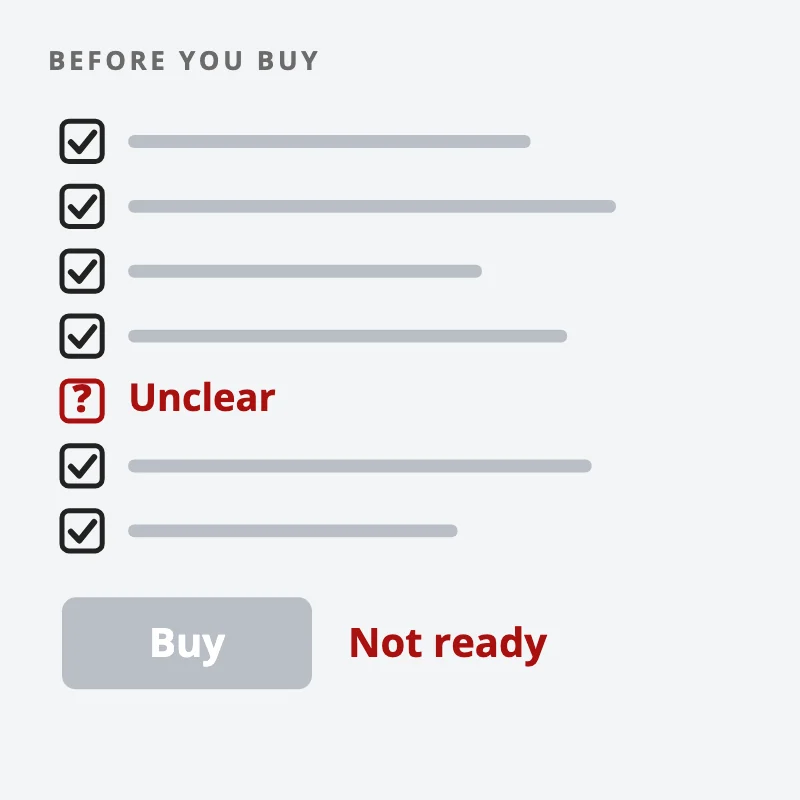
If any answer is unclear, you are not ready to buy. The stock will still be there tomorrow. Below, I go through why each question is on the list, and what a good answer looks like.
Why use a checklist before buying a stock?
Because the mistakes that hurt most are rarely about knowledge. They are about skipping something you already knew.
Atul Gawande wrote a whole book on this, The Checklist Manifesto. At one US hospital, doctors were given a simple five-step list for putting in a central line, the kind of thing every one of them already knew how to do. The ten-day infection rate “went from 11 percent to zero.”
Nobody learned anything new. They just stopped skipping steps.
Gawande also explains what makes a checklist work. It needs a clear pause point, a moment when you stop and run it. It should be short, ideally “between five and nine items.” And it should take about a minute, because “after about sixty to ninety seconds at a given pause point, the checklist often becomes a distraction.”
So the pause point for an investor or a trader is obvious. It is the moment before you click buy.
Plenty of people ask about this. A trader asked on Reddit: “is there a checklist you follow before choosing to swing trade/invest in a stock?” Most answers listed research steps, like checking earnings and debt. Those matter, but they belong earlier in the process. The list below is what you check at the door.
What are the 7 questions to ask before buying a stock?
Here they are again, with the reason each one is on the list.
1. Is this a trade or an investment?
This one comes first because it changes every other answer. A trade is held for days or weeks and exits on a chart level. An investment is held for years and exits when the business story changes. Many painful losses start life as a short trade that slowly turned into a long-term investment, because the person holding it could not bear to take a loss and kept finding reasons to wait.
Decide which it is now, and write it down.
2. What would prove me wrong, and will I act on it?
For a trade, it is a price, usually a chart level, that says the idea failed. For an investment, it is a business result, like two quarters of falling sales when you bought for growth. If you cannot name it, you do not know when to sell. Where to put your stop loss and take profit shows how to find that level on a chart.
The second half of the question matters just as much. A stop you will not honour is not doing anything for you.
3. If I am wrong, how much of my whole account do I lose?
Measure the loss against your whole account, because that is the money you actually live on. A 10% fall on a small position is a scratch. The same fall on a position worth half your account is a disaster. Most traders keep the loss on any single trade to a small, fixed slice of the account, and the position sizing post explains one common way to do it.
4. What is scheduled before I plan to sell?
Check the calendar for earnings, an ex-dividend date, or a big central bank decision. An earnings report can gap a stock 10% or more overnight, straight through any stop you placed. If you are swing trading, the simple rule is to be out before the report unless the trade is about the report. Holding stocks through earnings covers the trade-offs.
5. Can I get out easily?
Look at the average daily volume and the bid-ask spread. A common floor for trading is at least 1 million shares or USD 50 million traded a day, with a spread of 0.1% or less. A thin stock is easy to buy and hard to sell, and it is hardest to sell exactly when you most want to.
Want a full routine built around questions like these? Our free 15-Minute Swing Trader’s Checklist has the daily routine and the questions to ask before every single trade. Get the free checklist →
6. How much of my money already sits in this stock or its sector?
Concentration creeps up on you. You own two banks, then a bank ETF, then a REIT that is mostly bank debt. Each buy looked small, and together they are one big bet on one thing. Count it before you add. How much of your portfolio to put in one stock gives some sensible limits.
7. Why today?
This is the feelings question, and it catches the most. Maybe the stock just jumped and you feel left behind, or a friend mentioned it over dinner, or it dropped and now it feels cheap. As one Reddit post put it, “just because a stock dips doesn’t mean it’s on sale.”
A good answer sounds like a rule: the stock reached the level your plan named. A bad answer sounds like a story. If everyone around you is buying, read why the herd is usually late before you join it.
Which questions matter most for traders and for investors?
All seven apply to both. But the weight shifts depending on how long you plan to hold.
| Question | Weight for a swing trader | Weight for a long-term investor |
| 1. Trade or investment | High | High |
| 2. What proves me wrong | A chart level, decided now | A business result, decided now |
| 3. What a loss costs | High, every trade | High, at the position level |
| 4. What is scheduled | High, earnings especially | Low, unless the event changes the thesis |
| 5. Getting out | High | Medium |
| 6. Concentration | Medium | High |
| 7. Why today | High | High |
If you are still deciding between reading the chart and reading the accounts, technical analysis vs fundamental analysis lays out what each one is good at.
Won’t a checklist make me miss good trades?
Sometimes it will, and that is fine. Gawande made a similar point about pilots. They are trained to accept that “their memory and judgment are unreliable”, so they run the list even when they feel sure. Missing a good trade costs you nothing. Taking a bad one costs you money, and often confidence too.
Do note this is a DO-CONFIRM list, to use Gawande’s term. You do your research and planning the way you always do. Then, at the door, you stop and confirm. It should never take more than a minute or two.
How do you make the checklist stick?
Put it where you click buy. A sticky note on your screen works. So does a note pinned in your broker app. The point is to see it at the pause point, every time, without having to remember it.
The most useful habit is to write the answers down, even in one line each. A written “why today” is hard to fake. Then, when you review your trades at the end of the month, you can see which question you skipped on the ones that went wrong.
So which of the seven did you skip on your last buy, and would that trade have survived the question? For more on building your first habits, see the beginner’s guide to trading.
FAQ
What should you check before buying a stock?
Run seven quick questions: trade or investment, what proves you wrong, how much you lose if wrong, what is scheduled, whether you can get out easily, how concentrated you are, and why today. Research comes before this, and the checklist confirms it at the moment you buy.
How long should a stock checklist be?
Between five and nine items, and it should take about a minute. Atul Gawande found that longer lists tend to get skipped.
Should you buy a stock before earnings?
For a swing trade, usually not. An earnings report can gap the price straight through your stop. For a long-term investment, earnings matter less unless they change your reason for owning it.
Is a stock that dropped a good buy?
A drop alone does not make it one. A falling price says nothing by itself about value, and question 7 is there to catch exactly this.
Go deeper
This list is the pause before you buy. The free 15-Minute Swing Trader’s Checklist adds the daily routine, the pre-trade questions to ask before every trade, and the five rules that protect your account. Enter your email and we’ll send it over:
We use your email address to send you the checklist, then emails about trading and our courses. Unsubscribe in one click, any time. Privacy policy.
About the author. Spencer Li is The 15-Minute Trader and the founder of Synapse Trading. He is a Certified Financial Technician (CFTe) with 15+ years of trading, run from 70+ countries. He holds a B.Acc and B.BM from SMU. Every trade he takes is public, dated, losses left in. He teaches low-risk swing trading in 15 minutes a day, one system for any market.
Educational content only, not personalised financial advice. Trading carries risk, including loss of capital. Past performance is not indicative of future results. Synapse Trading is not licensed or regulated by MAS.
Want the daily routine? Enter your email for the free 15-Minute Swing Trader's Checklist.
Free 5-page PDF, then occasional trading emails. Education only, not financial advice. Unsubscribe anytime. Kit stores your email in the US: see our privacy policy.
Want to learn the full method? The Trading Mastery Program teaches the 4 strategies I have traded since 2011. It suits beginners and experienced traders.
Rather follow the trades as they happen? Daily Trading Signals is our Telegram channel: my trade ideas with entry, stop and exit, and every trade is public.
Questions about this post? Ask in the free Telegram channel →
Educational content only, not personalised financial advice. Trading carries risk, including loss of capital. Past performance is not indicative of future results. Synapse Trading is not licensed or regulated by MAS.

