

How to Spot a Pump-and-Dump Before You Buy
Want the daily routine? Get the free 15-Minute Swing Trader’s Checklist. Get it free →
The four checks to run on any stock tip from a chat group, and two real Singapore cases that show how the trap is built
Published: 17 October 2026 · Last updated: 17 October 2026 · By Spencer Li, CFTe
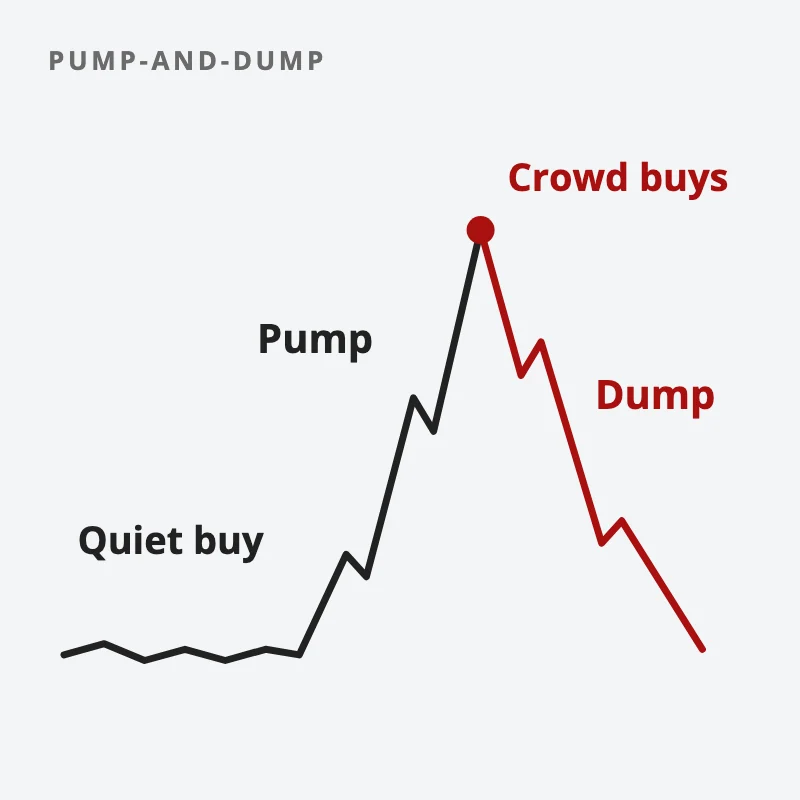
A pump-and-dump is a scheme where someone buys a cheap, thinly traded stock, talks it up to a crowd, and sells into the buying they created. The price jumps, the promoters cash out, and the crowd is left holding shares that fall back to where they started.
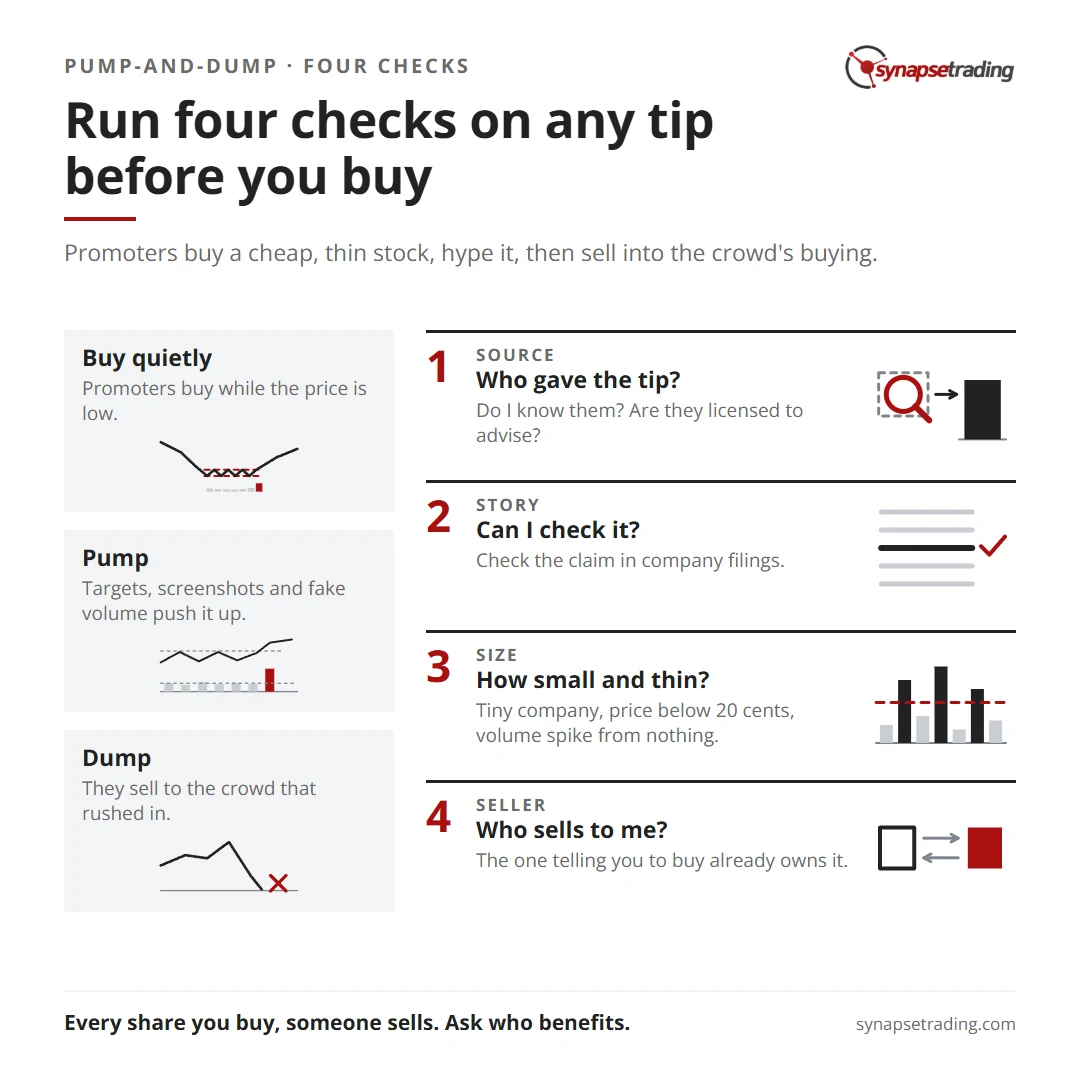
So how do you spot one? You check four things before you buy: who is giving you the tip, what the story rests on, how small and thin the stock is, and who would be selling to you. If the tip comes from a stranger online, rests on a story you cannot check, sits on a tiny stock, and comes from someone who already owns it, walk away. That is the whole method. The rest of this post shows why each check matters, using two cases Singapore’s regulator has published.
How does a pump-and-dump actually work?
It runs in three moves. First, the promoters buy quietly while the price is low. Then they pump: they post targets, screenshots and “I just bought more” messages to a group. Finally, they dump, selling their shares to the people who rushed in.
The Singapore Police Force describes the pump as “spreading false positive news about the company, or creating an appearance of trading activity”. Both halves matter. One is a story, and the other is fake volume that makes the story look real.
And the scheme works because the crowd does the heavy lifting. The promoters only need enough buyers to push a thin stock up for a few days. After that, every new buyer is their exit.
What did the Singapore cases look like?
The Monetary Authority of Singapore (MAS) featured two in its enforcement report for July 2023 to December 2024.
In the first, a member of two Telegram stock groups with about 2,955 members made false statements on 10 occasions between April and November 2020. MAS says his statements “included overstating his target sell price for the securities and claiming that he had purchased shares in the securities when he had not.” He and a friend in the same groups promoted stocks they held, then sold as the price rose. He was convicted in October 2024 of making false statements to induce others to trade, and sentenced to 16 months in prison. His friend got 19 months.
Notice what the group saw. They saw a respected regular with a good record of “spotting” moves, a target price, and a claim that he was buying too. Every one of those signals looked like conviction. None of it was true.
The second case shows the other half, fake volume. A former chief executive of an SGX-listed company and an associate used 14 trading accounts in other people’s names to trade the company’s shares back and forth. According to MAS, the price rose “from a low of $0.115 on 4 November 2014 to a high of $0.191 on 25 May 2015, before closing at $0.118 on 8 September 2015.”
So that is a 66% rise built on trades between their own accounts, followed by a 38% fall to almost exactly where it began. Anyone who bought near the top on the strength of “heavy volume” bought from a ghost.
Why are penny stocks the usual target?
Because a small push moves them a long way.
The SEC’s investor bulletin on microcap stocks says these companies are “susceptible to fraud and manipulation”, and that with low trading volumes “any size trade can have a large percentage impact on the price.”
Now look at the tick sizes on SGX. Under SGX Rule 8.3.3, a share priced below 20 cents moves in steps of 0.1 cent. On a 1.2-cent share, one step is 8.3% of the price. On a S$5 share, one step of 1 cent is 0.2%. So a promoter needs a handful of trades to make a penny stock look like it is flying, and the chart will show double-digit percentage jumps that would take serious money on a blue chip.
So treat a sudden spike on a thin penny stock as noise until proven otherwise. A real business rarely reprices by a third in an afternoon. Why the low price is a trap even without a promoter is a topic of its own, covered in our post comparing penny stocks with blue chips.
Source, Story, Size, Seller: the four checks before you buy
Run these four on any tip that reaches you through a chat group, a stranger’s message or a post that “everyone” is sharing.
| Check | Ask yourself | Red flag |
| Source | Do I know this person, and are they licensed to give advice? | A stranger online, a “mentor”, a group admin you have never met |
| Story | Can I check the claim in the company’s own filings? | Targets, “insider” news, screenshots of buys you cannot verify |
| Size | How small is the company, and how much trades each day? | A tiny market value, a price below 20 cents, a volume spike from nothing |
| Seller | If I buy now, who is selling to me? | The person telling you to buy already owns it |
The SPF’s 2021 advisory puts the first check plainly: “Be wary of stock tips provided to you online or by persons you have not personally met before.” You can also look up whether an adviser is on the MAS register, and whether the name appears on MAS’s Investor Alert List.
The fourth check is the one people skip. Every share you buy, someone sells. In a pump, the seller is often the person cheering you on. Ask who benefits if you click buy in the next ten minutes, and the answer is usually not you.
If you want a daily routine that starts from your own chart instead of a group chat, our free 15-Minute Swing Trader’s Checklist has the questions to ask before any trade. Get the free checklist →
But aren’t these real shares on real exchanges?
Yes, and that is exactly the trap. A trader asked about one such scam this year: “These were real companies traded on NASDAQ.” The same writer added that “once I had made some money, naturally he gained my trust.”
The SPF saw this coming in 2021, when it warned: “Do not be lulled into complacency just because you are purchasing actual shares listed on reputable exchanges.” A real ticker on a real exchange tells you the shares exist. It tells you nothing about why the price is moving.
There is a second variant you should know about. In its advisory of 4 June 2026, the SPF said that “Since May 2026, at least 48 cases were reported, with total losses amounting to at least $3.6 million” in scams where “mentors” in WhatsApp groups move victims onto fake trading platforms. There the shares never existed at all. The early “profits” are numbers on a screen, built to make you deposit more.
Why do smart people still fall for it?
Because the group feels like evidence. When hundreds of people post green screenshots, your brain reads the crowd as proof. That is herd behaviour, and a pump is designed to trigger it.
The story does the rest. A tip with a reason attached, a contract coming, a takeover rumour, a “Top Spotter” with a record, feels far safer than a bare ticker. That pull toward a neat story is the narrative fallacy, and it is why the false statements in the MAS case worked.
And then there is the first win. The scam in that post above let the victim make money first. A small early profit feels like proof the source is real, and it is the most expensive proof you can get.
What should you do if you think you are in one?
Stop adding money. Do not chase a loss by buying more on the next “target”.
Then check the four boxes in the table against what you hold. If the stock is tiny and thin, the size of your position matters more than your view on it. Our guide to how much of your portfolio to put in one stock shows why one position should never be able to sink the account. The wider habits are in the risk management guide.
If you were asked to move money to an unfamiliar platform or app, report it. The SPF’s own advice is to check through ScamShield and tell the police.
So how do you spot a pump-and-dump?
You look past the excitement and check the plumbing. Who is telling you, can you verify what they say, how easily can the price be pushed, and who is on the other side of your trade.
The groups will keep forming, because the crowd is the fuel and the crowd is free. What changes is whether you are in it. The next time a tip arrives with a target and a rocket emoji, which of the four checks will it pass?
FAQ
What is a pump-and-dump?
It is a scheme where promoters buy a cheap, thinly traded stock, hype it to a crowd, then sell their shares into the buying they caused. The price usually falls back once they stop.
Is a pump-and-dump illegal in Singapore?
Yes. In the MAS case above, the promoter was convicted of making false statements to induce others to trade, under section 200(1)(a) of the Securities and Futures Act, and sent to prison for 16 months.
Why do pump-and-dumps target penny stocks?
Because they are cheap to move. Below 20 cents, SGX shares move in steps of 0.1 cent, so a single step on a 1.2-cent share is 8.3% of the price, and thin daily volume means a few trades can push it a long way.
Can I lose money even if the shares are real?
Yes. Real shares on a real exchange can still be pumped. You lose when you buy near the top from the promoters and the price falls back after they sell.
How do I check if an adviser is licensed?
Look the person or firm up on the MAS Financial Institutions Directory, and check the MAS Investor Alert List for names that have been flagged.
Go deeper
Pump-and-dumps prey on traders who have no routine of their own. The free 15-Minute Swing Trader’s Checklist gives you one: the daily scan, the questions to ask before every trade, and the five rules that keep you in the game.
About the author. Spencer Li is The 15-Minute Trader and the founder of Synapse Trading. He is a Certified Financial Technician (CFTe) with 15+ years of trading, run from 70+ countries. He holds a B.Acc and B.BM from SMU. Every trade he takes is public, dated, losses left in. He teaches low-risk swing trading in 15 minutes a day, one system for any market.
Educational content only, not personalised financial advice. Trading carries risk, including loss of capital. Past performance is not indicative of future results. Synapse Trading is not licensed or regulated by MAS.
Want the daily routine? Enter your email for the free 15-Minute Swing Trader's Checklist.
Free 5-page PDF, then occasional trading emails. Education only, not financial advice. Unsubscribe anytime. Kit stores your email in the US: see our privacy policy.
Want to learn the full method? The Trading Mastery Program teaches the 4 strategies I have traded since 2011. It suits beginners and experienced traders.
Rather follow the trades as they happen? Daily Trading Signals is our Telegram channel: my trade ideas with entry, stop and exit, and every trade is public.
Questions about this post? Ask in the free Telegram channel →
Educational content only, not personalised financial advice. Trading carries risk, including loss of capital. Past performance is not indicative of future results. Synapse Trading is not licensed or regulated by MAS.

