

Antifragile Summary: Nassim Taleb on Gaining From Disorder, and the Barbell
Want the daily routine? Get the free 15-Minute Swing Trader’s Checklist. Get it free →
Some things break under stress, some survive it, and some get better. What that means for how you size risk
Published: 17 October 2026 · Last updated: 17 October 2026 · By Spencer Li, CFTe
What is Antifragile about? Nassim Nicholas Taleb’s 2012 book argues that there are 3 kinds of things in the world, where most of us only see 2. Fragile things are harmed by shocks. Robust things shrug them off. And antifragile things actually gain from shocks, the way muscles grow back stronger after training.
His point is that you can tell which is which without predicting anything. You only need to look at the shape of the payoff. If a surprise can hurt you more than it can help you, you are fragile. If it can help you more than it can hurt you, you are antifragile.
His most famous practical idea is the barbell: keep most of your money extremely safe, put a small slice into bets with large upside, and avoid the middle. This summary covers the triad, the barbell, and what each idea means for a trader.
Who is Nassim Nicholas Taleb?
Taleb is a former options trader and risk manager who turned to writing about uncertainty. Antifragile is the third book in his Incerto series, after Fooled by Randomness and The Black Swan. Our summary of The Black Swan covers the problem: rare events dominate, and nobody can forecast them. Antifragile is his answer to what to do about it.
Do note the style. Taleb calls the book an essay, and it moves by stories, polemics and examples more than by data. There is no backtest in it. It is best read for the way of thinking, with each idea tested against your own experience before you rely on it, since the book itself offers stories and arguments where a trader might expect evidence.
What is the difference between fragile, robust and antifragile?
The whole book hangs on this triad. Taleb defines the fragile as “what does not like volatility.” The robust is unharmed by it. And the antifragile goes one step further: in his framing, the resilient resists shocks and stays the same, while the antifragile gets better.
His mythological picture makes it easy to remember. Damocles, with a sword hanging over him by a single hair, is fragile. The Phoenix, which always rises back to where it was, is robust. The Hydra, which grows 2 heads for every 1 cut off, is antifragile.
| Category | How it reacts to shocks | Taleb’s image | A trading example |
| Fragile | Loses more than it gains | Damocles | A leveraged account with no stop |
| Robust | Roughly unchanged | Phoenix | A small, diversified position held with a planned stop |
| Antifragile | Gains more than it loses | Hydra | A position with a capped loss and open upside |
His test fits in one line. Fragility and antifragility can almost always be spotted “using a simple test of asymmetry.” More downside than upside from a random event means fragile. More upside than downside means antifragile.
And his favourite image sums up the whole book in 8 words: “The glass on the table is short volatility.” Left alone, it is fine. Any shock can only hurt it.
Why does fragility hurt more than you expect?
Because harm to a fragile thing grows faster than the shock. Taleb’s example is a car. Driving into a wall once at 50 mph does far more than 10 times the damage of driving into it 10 times at 5 mph.
That is why averages mislead. A portfolio that handles a lot of small moves well can still be wiped out by 1 large one. Taleb’s folk version: “Do not cross a river if it is on average four feet deep.”
He is also blunt about borrowing: “Debt always puts you on the left.” The left, in his language, is the side of the distribution where the losses live. Debt removes your ability to wait out a shock, because the lender can demand repayment or more margin at exactly the moment prices are lowest, which turns a bad day into a forced sale. Our post on how much leverage a beginner should use looks at the same problem from a trader’s side.
If you want a short daily routine that keeps your downside planned before every trade, our free 15-Minute Swing Trader’s Checklist covers it. Get the free checklist →
What is Taleb’s barbell strategy?
A trader asked on an investing forum: ‘Can someone please ELI5 the concept of “barbell investing”?’ Here it is in plain words.
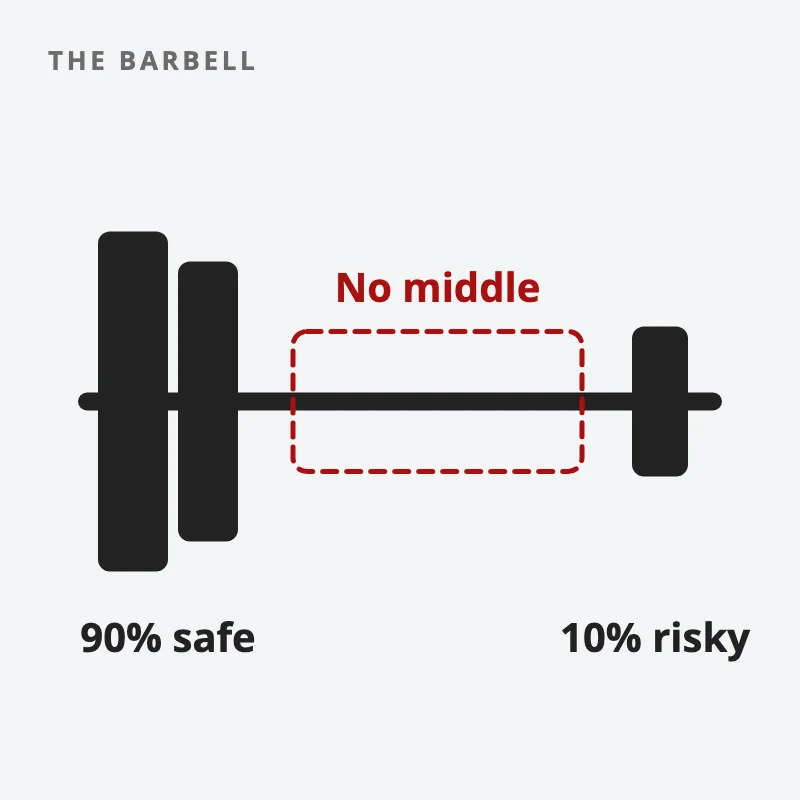
Taleb’s example is to put 90 percent of your money in something boring and safe, such as cash protected from inflation, and 10 percent in maximally risky bets. Your worst case is then a loss of about 10%. Your best case is open. He compares it with putting everything in “medium” risk assets, which he calls a “sucker game,” because medium risks are exactly the ones people measure badly.
Two things about the barbell often get lost.
The 90/10 is one example, nothing more. Taleb introduces it as “an example from vulgar finance,” and gives no derivation of those numbers anywhere in the book. The idea is the shape: extreme safety on one side, small bets with large upside on the other, and nothing in the fragile middle.
The safe side comes first. Taleb says the first step toward antifragility is cutting the downside, and that this is a requirement, before any thought about increasing the upside. Survival comes before success. If the safe side is not truly safe, there is no barbell.
That gives a simple check to run before any trade or investment, in 3 questions. What is my worst case, and is it capped? Would a shock twice as big hurt me more than twice as much? And does surprise help me, or only calm?
How do options and optionality fit in?
Taleb tells the story of Thales, the Greek philosopher, who paid small deposits in winter for the right to use every olive press in the area. When the harvest came in large, he rented them out on his own terms. Taleb calls this “the very first option on record”: “the right but not the obligation.”
His point is that you do not need to predict well if your payoff is lopsided. The size of the win when you are right “makes it unnecessary to be right too often.” And many of the best options in life, he says, cost nothing: “most interesting options are free, or at the worst, cheap.”
For a trader, the parallel is direct. A trade with a planned stop and no fixed target has a capped loss and an open upside. That is the payoff shape Taleb prefers. It is also why trend following can make money with a win rate below 50%.
The reverse shape is selling options for steady income. Taleb calls payoffs like that “bounded right”: limited gains, with the losses open on the left. Our post on the real risk of selling covered calls shows how that plays out.
What does Antifragile mean for traders?
Three ideas carry over directly.
Track records lie in both directions. Taleb argues that for fragile strategies, like selling insurance, a short track record looks better than the truth, because the rare disaster has not happened yet. For antifragile strategies, a short record looks worse than the truth, because the rare big win has not happened yet. So a smooth equity curve can be the most dangerous one to trust.
Robust across conditions beats tuned for one. In our Black Swan summary, I wrote that “a method built to perform only in calm conditions is fragile by definition.” A system tuned to last month’s market is short volatility, like the glass on the table.
Small, repeated losses are the price of the upside. A stop that costs a little, often, is what keeps the left side capped. That is the trader’s version of the barbell.
Antifragile reads best as a risk book more than an investing book. It does not tell you what to buy. It tells you what to check before you buy anything. For more on that, see our guide to money and risk management.
Concluding thoughts
Antifragile is long, opinionated and sometimes repetitive. But its core test fits in a sentence: does a shock help you or hurt you more? And its core rule is short: cut the downside first.
Do note one tension the book leaves open. In one chapter Taleb argues for spreading bets thinly across many small positions. In another he argues for the barbell’s heavy concentration in safety. Both can be useful, as long as you know which one you are using and why.
More books worth reading alongside it are in our list of the best investing and trading books.
So, on your current positions, which side of the triad are you on? If the market gapped hard against you tomorrow, would you lose more than you planned?
FAQ
What is the main idea of Antifragile?
Some things gain from shocks and disorder, beyond simply surviving them. Taleb calls them antifragile, and says you can spot them by checking whether a surprise would help or hurt you more.
What is the barbell strategy?
Taleb’s example is about 90% in very safe assets and 10% in high-risk, high-upside bets, with nothing in the middle. He presents the 90/10 as an illustration, without a formula behind it.
What is the difference between robust and antifragile?
A robust thing resists shocks and stays the same. An antifragile thing gets better from them. Taleb says the resilient resists while the antifragile improves.
Should I read The Black Swan or Antifragile first?
The Black Swan first. It explains the problem of rare, unpredictable events. Antifragile then explains how to position yourself so those events help you or at least cannot ruin you.
How does Antifragile apply to trading?
It points to a capped downside on every position, care with debt and leverage, and trades where the possible gain is much larger than the planned loss. Strategies with smooth returns and hidden tail risk deserve extra suspicion.
Go deeper
A capped downside starts with a plan you write before you trade. The free 15-Minute Swing Trader’s Checklist has the daily routine, the questions to ask before every trade, and the five rules that protect your account. Enter your email and we’ll send it over:
We use your email address to send you the checklist, then emails about trading and our courses. Unsubscribe in one click, any time. Privacy policy.
About the author. Spencer Li is The 15-Minute Trader and the founder of Synapse Trading. He is a Certified Financial Technician (CFTe) with 15+ years of trading, run from 70+ countries. He holds a B.Acc and B.BM from SMU. Every trade he takes is public, dated, losses left in. He teaches low-risk swing trading in 15 minutes a day, one system for any market.
Educational content only, not personalised financial advice. Trading carries risk, including loss of capital. Past performance is not indicative of future results. Synapse Trading is not licensed or regulated by MAS.
Want the daily routine? Enter your email for the free 15-Minute Swing Trader's Checklist.
Free 5-page PDF, then occasional trading emails. Education only, not financial advice. Unsubscribe anytime. Kit stores your email in the US: see our privacy policy.
Want to learn the full method? The Trading Mastery Program teaches the 4 strategies I have traded since 2011. It suits beginners and experienced traders.
Rather follow the trades as they happen? Daily Trading Signals is our Telegram channel: my trade ideas with entry, stop and exit, and every trade is public.
Questions about this post? Ask in the free Telegram channel →
Educational content only, not personalised financial advice. Trading carries risk, including loss of capital. Past performance is not indicative of future results. Synapse Trading is not licensed or regulated by MAS.

