

What is a Forex Lot Size?
Want the daily routine? Get the free 15-Minute Swing Trader’s Checklist. Get it free →
A lot in forex trading is a standardized unit of measurement that represents the size of a trade. Since the changes in currency values are measured in pips, which are very small increments (usually the fourth decimal place), trading a single unit of currency would not be practical. To make trading these small movements feasible, lots are used, allowing traders to buy and sell currencies in large batches.
The size of a lot is set by an exchange or market regulator, ensuring that all traders understand the amount of currency they are trading when they open a position. Lots come in four different sizes—standard, mini, micro, and nano—giving traders more flexibility and control over their level of exposure in the market.
Understanding Lots in Forex with a Chocolate Box Analogy
Imagine a company selling chocolates in two box sizes: one with 12 chocolates and another with 24 chocolates. Consumers expect these standard sizes rather than buying a single chocolate.
Similarly, in forex trading, you don’t buy just one unit of currency; you buy a lot. Lots have standardized sizes that are universally recognized. For instance, you might purchase 100,000 units of the base currency in the GBP/USD pair, known as a standard lot. Alternatively, you could buy a micro lot, which equals 1,000 units.
Forex Lot Sizes Explained
The size of a lot in forex varies depending on whether you’re trading a standard, mini, micro, or nano lot. These standardized units of measurement allow traders to manage small changes in currency value effectively.
Let’s use the currency pair EUR/USD as an example, which compares the euro (base currency) against the U.S. dollar (quote currency). If you buy EUR/USD, you’re speculating that the euro will strengthen against the dollar. If the exchange rate is $1.3000, it means you can exchange €1 for $1.3000.
Standard Lot
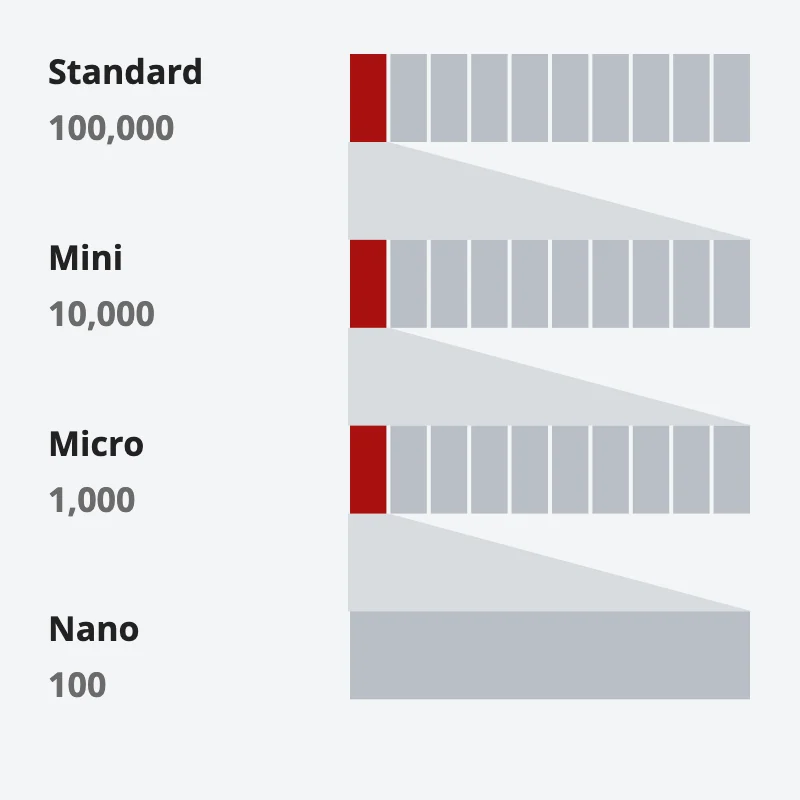
A standard lot in forex is equal to 100,000 currency units. It’s the most common unit size for both independent and institutional traders.
**Example:**
If the EUR/USD exchange rate is $1.3000, one standard lot (100,000 EUR) would require 130,000 USD to buy 100,000 EUR.
Mini Lot
A mini lot is one-tenth the size of a standard lot, meaning it equals 10,000 currency units. Trading a mini lot results in smaller profit and loss impacts compared to a standard lot.
**Example:**
If the EUR/USD exchange rate is $1.3000, one mini lot (10,000 EUR) would require 13,000 USD to buy 10,000 EUR.
Micro Lot
A micro lot is one-tenth the size of a mini lot, equating to 1,000 currency units. With a micro lot on EUR/USD, each one-pip move is worth $0.10 (1,000 × 0.0001). The value is in the quote currency, US dollars here, not euros.
**Example:**
If the EUR/USD exchange rate is $1.3000, one micro lot (1,000 EUR) would require 1,300 USD to buy 1,000 EUR.
Nano Lot
A nano lot is one-tenth the size of a micro lot, meaning it’s worth 100 currency units. A one-pip move with a nano lot on EUR/USD is worth $0.01 (100 × 0.0001), again in the quote currency.
**Example:**
If the EUR/USD exchange rate is $1.3000, one nano lot (100 EUR) would require 130 USD to buy 100 EUR.
How to Calculate Lot Size in Forex
Typically, you won’t need to calculate lot sizes manually, as your trading platform will display all necessary information. You can easily see the available lot sizes—standard, mini, micro, and nano—when placing a trade and choose the one that fits your trading strategy. You can also calculate the overall size of your position based on the lot size and the number of lots you purchase.
How to Choose Lot Size in Forex
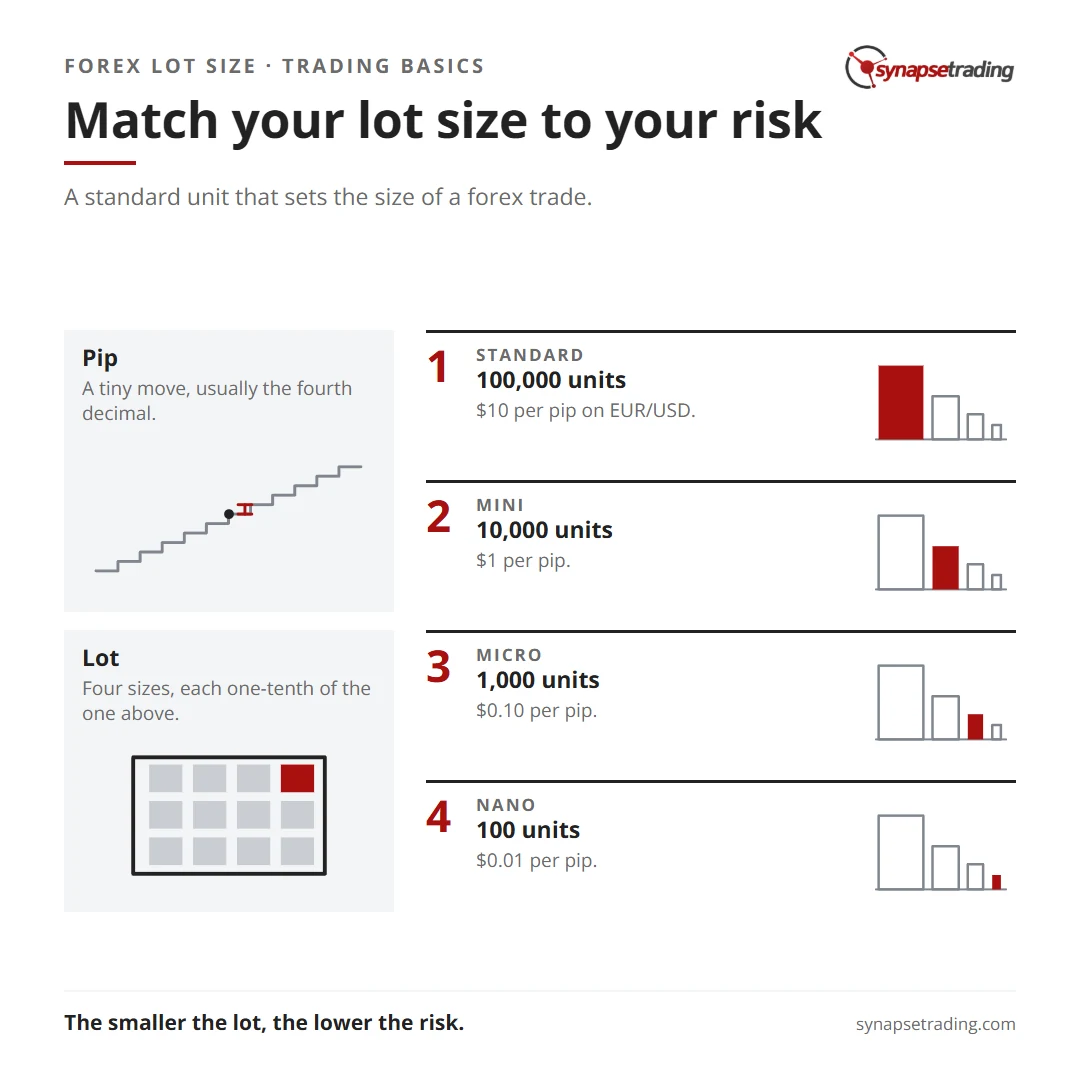
Choosing your lot size depends on the level of risk you’re willing to take. The larger the lot size, the more money you’ll need to put down or leverage, and the more significant each pip movement will be in terms of profit or loss.
For example, with the EUR/USD pair:
– A standard lot (100,000 units) equals $10 per pip movement.
– A mini lot (10,000 units) equals $1 per pip movement.
– A micro lot (1,000 units) equals $0.10 per pip movement.
– A nano lot (100 units) equals $0.01 per pip movement.
The smaller the lot, the less financial impact a pip movement will have, allowing for a smaller initial investment and lower risk.
Getting Started with Forex Trading
To start trading forex, you need to understand how lots work. Once you’re comfortable, you can begin live trading or use a demo account to practice.
Here’s how to trade forex:
1. Create or log in to your trading account.
2. Choose the currency pair you want to trade.
3. Decide whether to go long (buy) or short (sell).
4. Set your lot size.
5. Open and monitor your position.
Using CFDs or spread bets, you can trade forex with leverage, meaning you can control a larger position with a smaller initial investment. Remember, leverage magnifies both potential profits and potential losses.
Concluding Thoughts
Understanding lots is essential for effective forex trading:
– Lots determine the number of currency units you’re buying or selling.
– You can trade in standard, mini, micro, or nano lots.
– Your position size depends on the lot size and the number of lots traded.
By understanding and choosing the appropriate lot size, you can manage your risk and tailor your forex trading strategy to your financial goals.
Want the daily routine? Enter your email for the free 15-Minute Swing Trader's Checklist.
Free 5-page PDF, then occasional trading emails. Education only, not financial advice. Unsubscribe anytime. Kit stores your email in the US: see our privacy policy.
Want to learn the full method? The Trading Mastery Program teaches the 4 strategies I have traded since 2011. It suits beginners and experienced traders.
Rather follow the trades as they happen? Daily Trading Signals is our Telegram channel: my trade ideas with entry, stop and exit, and every trade is public.
Questions about this post? Ask in the free Telegram channel →
Educational content only, not personalised financial advice. Trading carries risk, including loss of capital. Past performance is not indicative of future results. Synapse Trading is not licensed or regulated by MAS.

