

How to Read Candlestick Patterns Like a Pro
Want the daily routine? Get the free 15-Minute Swing Trader’s Checklist. Get it free →
Price action trading and candlestick patterns are some of the most commonly used concepts in technical analysis.
However, misconceptions and half-truths can cause confusion and lead to poor trading decisions.
In this blog post, we’ll explore the five best candlestick patterns and provide insights on how to trade them effectively.
We’ll also address common issues traders face when working with price action trading.
4 Tips for Candlestick Patterns Trading
1. Context and Location
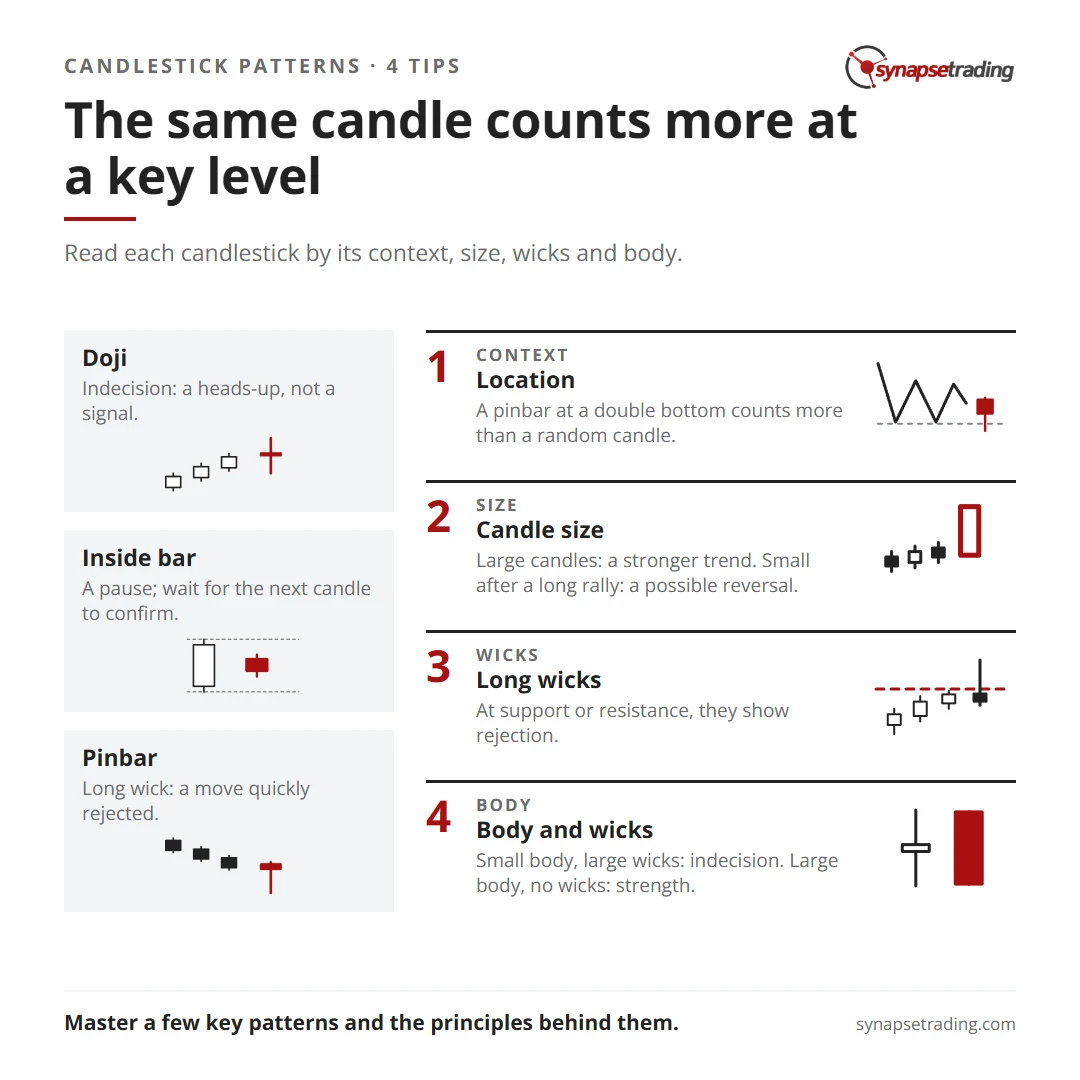
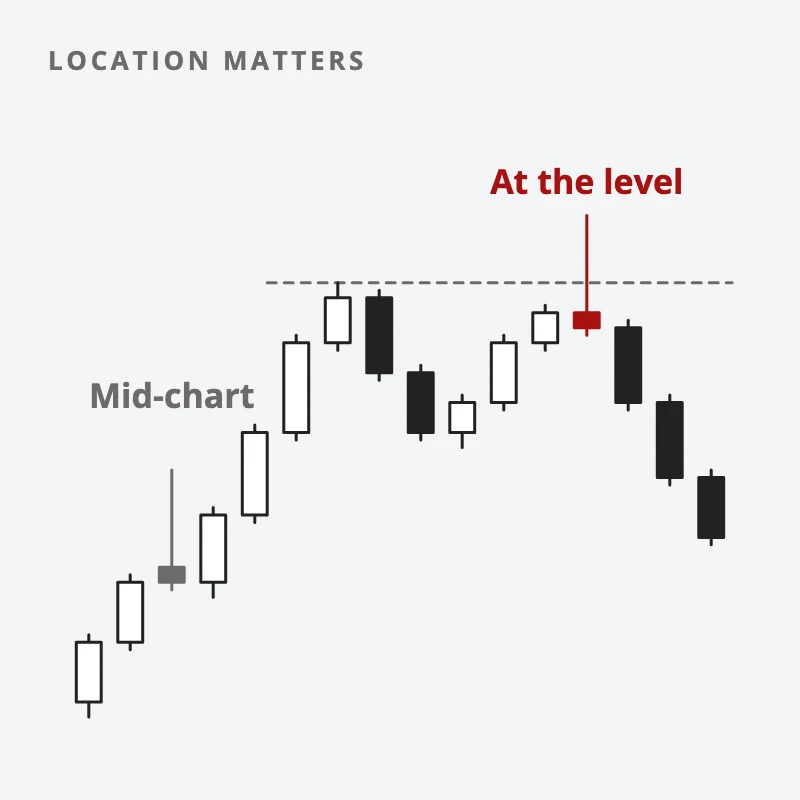
The foundation of price action and candlestick trading lies in understanding context and location. Always compare the current candlestick to recent price action to get the full picture. Focusing too much on individual candlesticks without considering the broader context can lead to mistakes. Location is equally important; candlesticks at significant price levels, such as a pinbar at a double top or bottom, carry more weight than random candlesticks in the middle of a chart.
2. Size
The size of a candlestick can reveal a lot about the market’s strength, momentum, and trends. Larger candles often indicate a stronger trend, while small candles after a prolonged rally can signal a potential reversal or the end of a trend.
3. Wicks
Long wicks at key support or resistance levels often suggest potential reversals. Wicks indicate rejections and failed attempts to push the price higher or lower. While long wicks around double tops or bottoms can be strong signals, not all wicks indicate reversals. It’s crucial to assess the context in which they appear.
4. Body
The body of a candlestick represents the range between the opening and closing prices. The body’s size and the presence of wicks offer insights into market sentiment. For instance, a small body with large wicks shows indecision, while a large body without wicks suggests strength. Understanding the relationship between the body and wicks is key to interpreting candlestick patterns.
The 5 Best Candlestick Patterns
While there are many candlestick patterns to learn, mastering a few key ones can greatly enhance your trading strategy.
Below are five of the best candlestick patterns, explained in the context of the four principles discussed above.
#1 Abandoned Baby – Evening Star
The abandoned baby and evening star patterns are most effective on daily charts but can also appear on lower timeframes. These patterns involve a sequence of candles:
Uptrend: A long green candle followed by a small candle with a gap up, then a large red candle with a gap down.
Downtrend: A long red candle followed by a small candle with a gap down, then a large green candle with a gap up.
Key Concepts: The gap between candles is not mandatory, but the sequence is crucial. The small candle often has wicks on both sides, indicating a struggle between bulls and bears.
Meaning: This is a classic reversal pattern. After a strong trend, the price gaps but fails to maintain momentum, and the third candle confirms the reversal. Waiting for the third candle to close is essential to validate the pattern.
#2 Doji – Spinning Top
Dojis are common candlestick patterns that often signal indecision in the market. A Doji candle typically has a small body with wicks on both sides.
Key Concepts: A Doji alone is not a trading signal but a heads-up to potential market changes. They often appear after strong trends or at key support/resistance levels. The size of the wicks can indicate the intensity of the battle between bulls and bears.
Meaning: Dojis indicate a pause in the market, where buyers and sellers are reevaluating their positions. They’re an opportunity to adjust your stop-loss or take partial profits in anticipation of a possible reversal.
#3 Engulfing or Outside Bar
The engulfing bar, also known as an outside bar, is a strong signal when it appears in the right context. This pattern involves a smaller candle followed by a larger one that completely engulfs the previous candle.
Key Concepts: The pattern is more powerful when the second candle has small or no wicks and is significantly larger than the first. A rejection wick on the larger candle can further strengthen the signal.
Meaning: Engulfing bars can signal either a trend reversal or continuation, depending on the direction of the second candle. During a trend, they often mark the end of a retracement and a continuation of the trend.
#4 Inside Bar and Fakey
The inside bar pattern is a smaller candle that falls entirely within the range of the previous, larger candle. The Fakey pattern occurs when the price breaks out of the inside bar’s range, only to reverse direction immediately.
Key Concepts: Patience is crucial when trading inside bars. Wait for the candle after the inside bar to confirm the breakout before entering a trade. The Fakey pattern often exploits the impatience of amateur traders who place pending orders.
Meaning: Inside bars represent a pause in the market, often before a significant move. The Fakey pattern can indicate a false breakout, trapping traders who entered too early.
#5 Pinbar, Hammer, Kangaroo Tail
The pinbar is one of the most popular and powerful candlestick patterns, characterized by a long wick and a small body. It often indicates a potential reversal in the market.
Key Concepts: A pinbar can signal a trend reversal when it appears after a prolonged trend or during a trend when it acts as a continuation signal. The long wick usually represents the failed attempts of amateur traders to predict market movements.
Meaning: The pinbar’s wick shows where the market attempted to move but was quickly rejected, leading to a reversal. This pattern is particularly useful for identifying potential turning points in the market.
Concluding Thoughts
Understanding and applying candlestick patterns can significantly enhance your trading strategy. By focusing on the context, size, wicks, and body of candlesticks, traders can gain valuable insights into market sentiment and potential price movements. While it’s tempting to memorize numerous candlestick patterns, mastering a few key ones and understanding the underlying principles is more effective. Always remember to use these patterns in conjunction with other technical analysis tools and sound money management practices to maximize your trading success.
Want the daily routine? Enter your email for the free 15-Minute Swing Trader's Checklist.
Free 5-page PDF, then occasional trading emails. Education only, not financial advice. Unsubscribe anytime. Kit stores your email in the US: see our privacy policy.
Want to learn the full method? The Trading Mastery Program teaches the 4 strategies I have traded since 2011. It suits beginners and experienced traders.
Rather follow the trades as they happen? Daily Trading Signals is our Telegram channel: my trade ideas with entry, stop and exit, and every trade is public.
Questions about this post? Ask in the free Telegram channel →
Educational content only, not personalised financial advice. Trading carries risk, including loss of capital. Past performance is not indicative of future results. Synapse Trading is not licensed or regulated by MAS.

