

Four setups, fifteen minutes: the whole shape of the method
Want the daily routine? Get the free 15-Minute Swing Trader’s Checklist. Get it free →
Most people who are struggling with this do not have a knowledge problem. They have a too-much problem.
Twelve indicators on the chart. Six strategies half-learned. Three courses bought, one finished. Every one of those was a reasonable decision at the time, and together they add up to a desk you cannot possibly be consistent at.
The fix is not more discipline. It is fewer things.
I know because I ran the maximal version of the problem. I read over fifteen hundred books and backtested nearly every strategy and indicator I could get my hands on, hunting for the secret. And the punchline, after all of that, is that almost everything I collected described the same handful of patterns with different names. It all collapsed into four core situations. Fifteen hundred books to learn I needed four setups.
Here they are, by name.
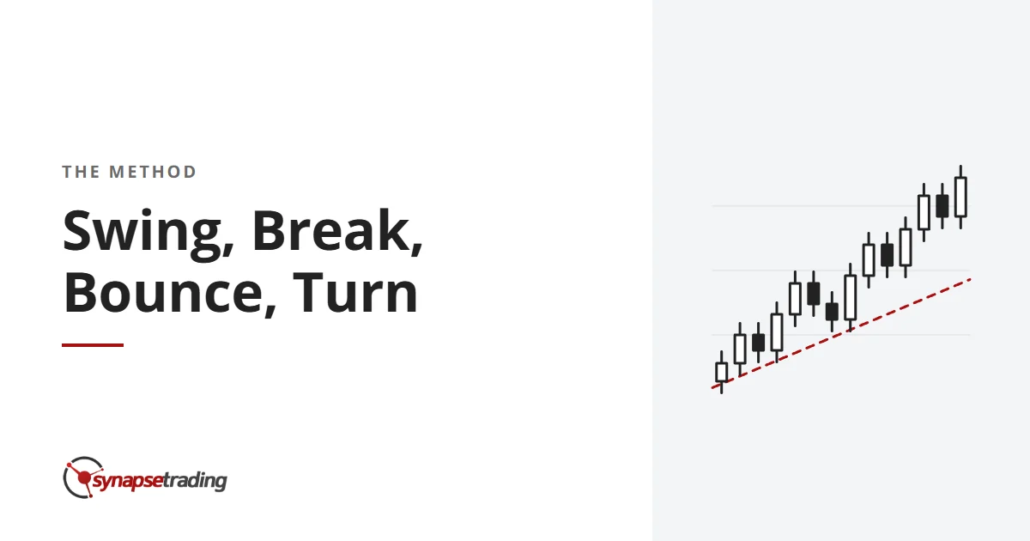
The Swing. The market is in a strong trend, pulls back gently, and you join the trend on the dip. It’s the easiest of the four, and it’s where most of the work gets done.
The Break. The market has been coiling into a tighter and tighter range, pressure building, until it breaks out.
The Bounce. Price runs hard into a level, exhausts itself, and snaps back.
The Turn. The trend cracks, tries to recover, fails, and reverses.
Every chart you’ll ever look at is some version of one of those four. They’re read from price itself, from what buyers and sellers are actually doing, rather than from lagging indicators describing what already happened. Once you know the four names, open any chart you like and try to find a move that isn’t one of them. That exercise does more for most people than another course would.
The other half of the method is the shape of the day. The whole routine runs after the market closes, in about fifteen minutes. You scan for the four situations, mark the handful of charts that qualify, place your orders with their stops, and walk away. No watching the open. No lunchtime phone checks. The point isn’t convenience, although it’s convenient. Past a certain point, screen time adds mistakes instead of edge, and trading end-of-day keeps you on the right side of that line by construction.
You don’t have to take the fifteen minutes on trust. I was writing about trading in 15 minutes a day back in October 2016, and every trade I’ve taken since April 2024 sits in a dated public log, losses left in.
Now the honest limit, because you’d discover it anyway. Naming the four setups isn’t the same as trading them. Each one has entry conditions, a stop placement and a management rule, and none of that is in this article. This is the map, not the driving lesson. But the map matters more than it looks. In my experience the biggest single upgrade for a struggling trader isn’t a new technique, it’s deleting everything that isn’t one of these four situations and discovering how much calmer the chart gets.
If you want the fifteen-minute routine in a form you can run tonight, it’s in my free checklist: every step, in order, on five pages.
About the author. Spencer Li is The 15-Minute Trader and the founder of Synapse Trading. He is a Certified Financial Technician (CFTe) with 15+ years of trading, run from 70+ countries. He holds a B.Acc and B.BM from SMU. Every trade he takes is public, dated, losses left in. He teaches rules-based swing trading in 15 minutes a day, one system for any market.
Want the daily routine? Enter your email for the free 15-Minute Swing Trader's Checklist.
Free 5-page PDF, then occasional trading emails. Education only, not financial advice. Unsubscribe anytime. Kit stores your email in the US: see our privacy policy.
Want to learn the full method? The Trading Mastery Program teaches the 4 strategies I have traded since 2011. It suits beginners and experienced traders.
Rather follow the trades as they happen? Daily Trading Signals is our Telegram channel: my trade ideas with entry, stop and exit, and every trade is public.
Questions about this post? Ask in the free Telegram channel →
Educational content only, not personalised financial advice. Trading carries risk, including loss of capital. Past performance is not indicative of future results. Synapse Trading is not licensed or regulated by MAS.

Leave a Reply
Want to join the discussion?Feel free to contribute!