

Dark Cloud Cover Pattern: How to Spot a Real One and What to Do When It Appears
Want the daily routine? Get the free 15-Minute Swing Trader’s Checklist. Get it free →
By Spencer Li, CFTe · Last updated: 25 June 2026
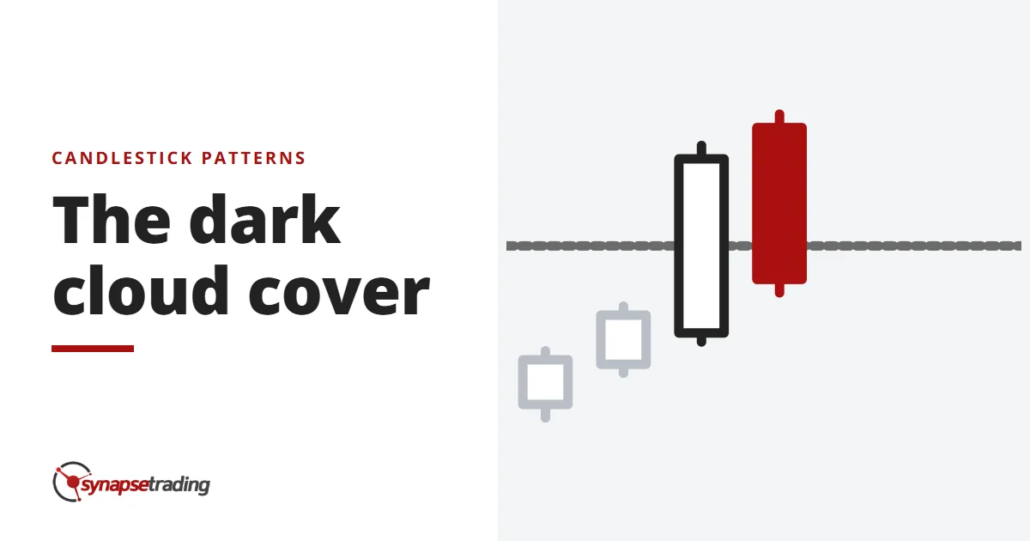
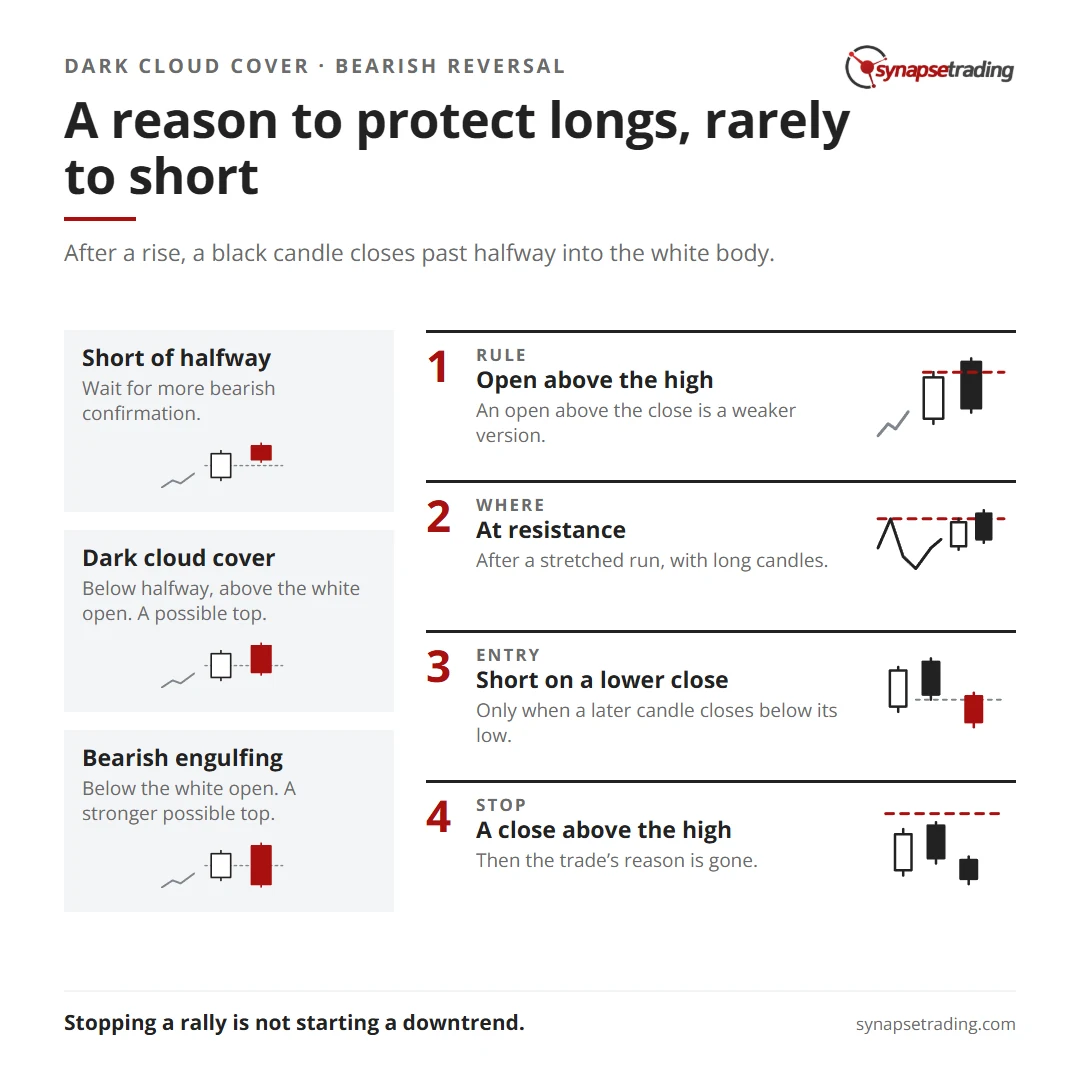
The dark cloud cover is a two-candle bearish reversal pattern that forms after a rise in price. The first candle is a long white (up) candle. The second is a black (down) candle that opens above the high of the white candle, then sells off to close more than halfway down into the white candle’s body, while staying above the white candle’s open.
So the session starts with the buyers at a fresh high and ends with the sellers holding back more than half of the previous day’s gain. That is the whole signal.
On its own, a dark cloud cover is a warning that the rally may be running out of buyers. Personally, I read it first as a reason to protect a long position I already hold, and only rarely as a reason to go short.
Where does the second candle have to open?
This pattern is often defined loosely. Plenty of explanations online say the black candle only needs to open above the white candle’s close, and the books that define it ask for more.
Steve Nison, whose book introduced Japanese candlesticks to most Western traders, has the second candle opening above the prior session’s high, which on a daily chart usually means a gap up. Gregory Morris, author of the other standard candlestick reference, treats it as the mirror image of the piercing pattern, whose open he insists must clear the prior extreme rather than the prior close. When I took the ChartNexus candlestick course in Singapore in 2009, the slides said the same thing.
So why do a few cents of opening price matter? Because the open above the high is what makes the failure mean something. Everyone who held overnight wakes up to a new high, the chart looks better than it has all month, and that is exactly when the sellers take over.
Do note that Nison allows some room. In his second book he wrote that if the black candle opens above the prior close but below the prior high, and also fails to close under the midpoint, you may want to wait. He also points out that stocks often open near the previous close, so gap-based patterns need adjusting outside futures. Hence, I treat an open above the close as a weaker version. An open above the high is the real thing.
Why does the halfway line matter?
Imagine a white candle that opens at 40 and closes at 44, so the middle of its body is 42. The next candle opens above the white candle’s high. Where it closes decides what you are looking at.
| The black candle opens above the high and closes at… | What it is called | How it is usually read |
|---|---|---|
| About 44, the white candle’s close | Bearish counterattack line | A weaker warning |
| Between 42 and 44 | Short of a dark cloud cover | Wait for more bearish confirmation |
| Below 42 but above 40 | Dark cloud cover | A possible top |
| Below 40 | Bearish engulfing | A stronger possible top |
Nison notes that some Japanese technicians insist on a close more than 50% into the white body. He also observes that traders are a little more forgiving about that line here than on the bullish mirror, the piercing pattern. So you will see dark clouds labelled where the close stops just short of 42. Both he and Morris agree that a deeper close carries more weight, right up until it closes below 40 and becomes a bearish engulfing pattern.
Checking where a candle opened and closed takes a minute once it is a habit. The habit I use lives in my free 15-minute swing trader checklist.
What does it feel like to be the buyer?
In my weekly outlook on 8 November 2025, I looked at Datadog after a strong gap up and said it was “a bit dangerous to buy”, because it was hard to find a good place for the stop loss. A dark cloud cover is roughly what happens to the people who buy that kind of gap anyway.
Suppose you have watched a stock climb for three weeks without you. Every day you promise yourself you will buy the next pullback, and every day there is no pullback. Then one morning it opens above yesterday’s high, the fear of missing out finally wins, and you buy at the open.
By lunchtime it is back at yesterday’s close. By the end of the day it sits below the middle of yesterday’s candle, and you are holding a loss on your first day in the trade, along with everyone else who bought that open.
Relief has turned into regret. Some of those buyers will sell tomorrow just to make the feeling stop.
Is it a dark cloud cover or a shooting star?
On 23 August 2024, a trader on Reddit’s r/technicalanalysis who was just starting out asked “whether this is a dark cloud cover or a shooting star”. Their red candle had covered half of the green one and carried a long upper shadow. Both names seemed to fit.
The difference is what each one measures. A shooting star is a single candle, judged on its own shape, with a small body near the bottom of its range and a long upper shadow. A dark cloud cover is a pair, judged on where the second body closes against the first. When one candle meets both descriptions, I stop worrying about the label. Both tell the same story.
Should you short it or just sell your long?
Nison has a rule that most pattern guides leave out. You place a new position off a reversal signal only in the direction of the major trend. A top reversal in a bull market is a reason to get out of your longs.
I only buy stocks above their 200-day exponential moving average, the EMA, an average of closing prices that weighs recent days more. Shorts are a tactical sideline for me. So when a dark cloud cover appears on a stock I own, my first question is how much of the gain I am willing to give back.
My own exits already lean towards taking some profit into strength when a stock gets overbought or runs into major resistance, and towards not letting a good gain shrink into a small one. A dark cloud cover at that spot makes the decision easier.
Here is the arithmetic, with made-up numbers. Say you bought at 50 and the stock is now at 60.
That is a gain of 20%.
Say you decide never to give back more than half of it. That puts your stop no lower than 55. Then a dark cloud cover prints, with a white candle from 56 to 60 and a black candle that opens at 61 and closes at 57. You sell half at 57, which locks in 14% on that half, and the other half keeps its stop at 55, so the worst it can do is 10%.
Put together, the worst case for the whole position is about 12%. You still own half the stock in case the dark cloud turns out to be a false alarm.
Where does a dark cloud cover actually mean something?
Nison noticed that dark cloud covers seemed to work particularly well on daily crude oil charts. Every market has its own personality.
Wherever you trade, three things make the pattern worth more attention.
- A level. Nison gives the pattern more weight when the black candle opens above major resistance and then fails, and more still when that high is the highest in months.
- A stretched run. Alan Farley, in The Master Swing Trader, writes that dark cloud covers print often during blow-offs, the climax at the end of a run when volume spikes well above normal. My own habits agree from the other side, since I avoid buying a stock that runs into resistance when its RSI, a 0 to 100 gauge of how stretched a move is, is already very high.
- Long candles. A small white candle followed by a small black one tells you very little about who is in charge.
A dark cloud cover in the middle of a sideways range is mostly noise. The same two candles at a high that capped the stock months ago, after a fast run on heavy volume, deserve a response.
How do you trade a dark cloud cover as a short?
If you do short it, the order of the steps matters more than the pattern.
- Entry. Let the black candle finish, then go short only when a later candle closes below its low. Price poking through the low during the session and recovering by the close does not count.
- Stop loss. Nison observes that a dark cloud cover often becomes resistance, and suggests a stop on a close above the pattern’s high. If the market closes up there, the trade’s reason is gone.
- Target. The next support level below, such as the last swing low or a moving average the stock has been respecting.
Work out the stop first, and the position size falls out of it. Suppose, with round made-up numbers, your stop sits 5% above your entry, and you are willing to lose 0.5% of your account. The position is 0.5% divided by 5%.
That comes to 10% of your account.
The free 15-minute swing trader checklist is how I keep the stop-first habit every day.
Does a dark cloud cover mean a new downtrend has begun?
On 31 January 2025, a trader on Reddit’s r/technicalanalysis posted 3M’s daily chart and wrote that its dark cloud cover meant “a new downtrend has begun”. It is a common reading. It is also stronger than the pattern can support.
Sometimes it is right. Farley writes that a long dark cloud cover on a daily chart, well into new highs, can stop a rally for months or even years.
But stopping a rally is a different thing from starting a downtrend. Farley himself calls the blow-off the start of a new range period, and he notes that if price does not reverse quickly, it can drift sideways through the pattern and go on to new highs. The dark cloud cover tells you to stop counting on the uptrend. The chart after it tells you whether to expect a fall.
My own trade log cannot settle this either. As at June 2026, 63 of the 450 closed trades in my log were shorts, about 14%, and the log does not record which candle triggered each entry. So I cannot tell you how many began with a dark cloud cover.
What I can say is that the decision this pattern forces on me is usually about the longs I already hold.
FAQ
Is the dark cloud cover bullish or bearish?
It is bearish. A black candle opens above the prior high and closes more than halfway down the prior white body, warning that buyers may be losing control.
Does the second candle have to open above the prior high?
In the classic definition, yes. Nison and Morris both describe it that way. An open above the prior close but below the prior high is a weaker version that needs more confirmation.
What is the difference between a dark cloud cover and a bearish engulfing pattern?
The depth of the close. A dark cloud cover closes below the middle of the white body but above its open. A bearish engulfing closes below the white candle’s open, so it is the stronger signal.
What if the black candle closes above the midpoint?
Then most traders would not call it a dark cloud cover, and Nison suggests waiting for more bearish confirmation. A close right at the white candle’s close is a bearish counterattack line.
Where do you put the stop on a dark cloud cover?
On a short, a stop on a close above the high of the pattern. A close above it means the sellers have lost the argument.
Is a dark cloud cover a signal to short?
It can be. Nison’s rule is to trade reversal signals in the direction of the major trend, so in a stock still in an uptrend it is better read as a signal to protect or trim your longs.
Have you ever bought a gap up and watched it turn into a dark cloud cover by the close? And when you see one on a stock you own, do you sell, trim or hold? Let me know in the comments.
For the whole family of reversal candles in one place, read my guide to candlestick patterns, and compare this one with the evening star and the hanging man. The rest of my material is in my free trading guides.

If you would like to learn more about all the different candlestick patterns, also check out: “The Definitive Guide to Candlestick Patterns”
And if you would rather check all of this once a day after work than watch every open, grab the free 15-minute swing trader checklist.
About the author. Spencer Li is The 15-Minute Trader and the founder of Synapse Trading. He is a Certified Financial Technician (CFTe) with 15+ years of trading, run from 70+ countries. He holds a B.Acc and B.BM from SMU. Every trade he takes is public, dated, losses left in. He teaches rules-based swing trading in 15 minutes a day, one system for any market.
Education, not financial advice. Synapse Trading is not licensed by MAS to advise on investment products. Trading carries risk of loss, and past performance is not indicative of future results.
Want the daily routine? Enter your email for the free 15-Minute Swing Trader's Checklist.
Free 5-page PDF, then occasional trading emails. Education only, not financial advice. Unsubscribe anytime. Kit stores your email in the US: see our privacy policy.
Want to learn the full method? The Trading Mastery Program teaches the 4 strategies I have traded since 2011. It suits beginners and experienced traders.
Rather follow the trades as they happen? Daily Trading Signals is our Telegram channel: my trade ideas with entry, stop and exit, and every trade is public.
Questions about this post? Ask in the free Telegram channel →
Educational content only, not personalised financial advice. Trading carries risk, including loss of capital. Past performance is not indicative of future results. Synapse Trading is not licensed or regulated by MAS.

