

Dividend Stocks in Singapore: Yield, Tax and the Income Trap
Want the daily routine? Get the free 15-Minute Swing Trader’s Checklist. Get it free →
How dividend yield really works, what IRAS taxes and what it leaves alone, and the one sum that shows whether dividends can pay your bills
Published: 17 October 2026 · Last updated: 17 October 2026 · By Spencer Li, CFTe
Dividend stocks in Singapore are shares, REITs and funds that pay part of their profits to you in cash, usually once or twice a year, sometimes quarterly. They are popular here for a simple reason. For individuals, IRAS does not tax dividends from Singapore companies under the one-tier system, and it does not tax REIT distributions either, with a few exceptions.
So are they a good way to build income? They can be, if you know what the yield is telling you. A dividend is paid out of the company’s value, so the share price drops by about the same amount when it goes ex-dividend. A high yield often comes from a falling price. And the portfolio you need to live on dividends is much bigger than most people expect. This post walks through all four, with the sums.
What is dividend yield, and how do you work it out?
Dividend yield is the yearly dividend divided by the price you pay for the share.
A S$1 dividend on a S$40 share is a 2.5% yield. Put S$10,000 into that share and, if the dividend holds, you collect about S$250 a year before any tax.
Both numbers in that formula move, and that is where people get caught. The dividend can be cut. The price changes every day. And the yield you see quoted is usually based on last year’s dividend, which tells you what the company paid. Next year’s payout is still a forecast.
The four-line dividend sum
Here is a simple way to check any dividend idea. Four lines, in order.
| Line | The question | What it catches |
| Yield | What is the dividend as a % of today’s price, and is it rising or falling? | A yield that is high only because the price fell |
| Drop | How much does the price fall when the share goes ex-dividend? | The idea that dividends are free money |
| Leak | How much tax is taken before the cash reaches you? | The 30% US withholding on Singapore investors |
| Gap | How big must the portfolio be to cover your spending? | The “live on dividends” dream with no maths |
Here they are one at a time.
Why can a high yield be a warning sign?
Because the yield goes up when the price goes down.
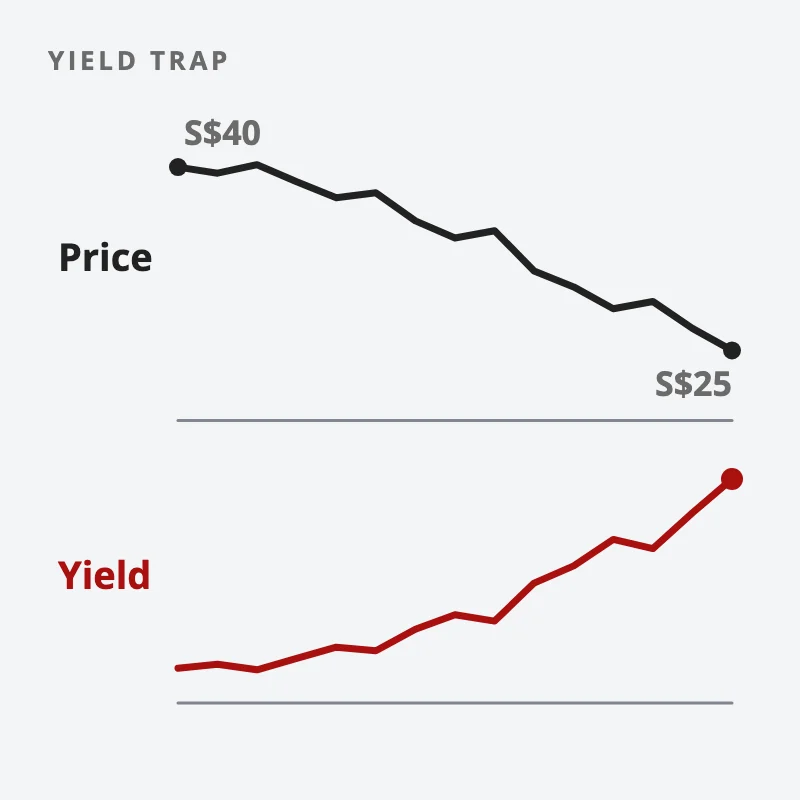
Take a hypothetical company paying S$2 a year on a S$40 share. That is a 5% yield. Now say the business runs into trouble and the share falls to S$25. On last year’s S$2, the yield now shows 8%, and it starts appearing on “top dividend stocks” lists.
But the market is often pricing in a cut. If the dividend is halved to S$1, the yield on S$25 is 4%. Anyone who bought at S$40 for the income has lost 37.5% of their capital to collect a smaller cheque.
This is what people call a yield trap. The fix is to read the yield next to the price chart and the payout history. A yield that rose because the dividend grew is a very different thing from a yield that rose because the price fell.
Buffett’s rules make the same point from the business side. Quality comes before the size of the yield, which is the thread of Warren Buffett’s 7 secrets to dividend investing.
Do you lose the dividend in the share price?
A trader on Reddit asked it bluntly this year: “Why are dividends considered meaningless? If they are a share of real profits?”
A dividend is real cash, and it is also cash leaving the company. In theory, on the ex-dividend date the share price drops by about the size of the dividend. A S$5 share paying 10 cents might open near S$4.90 on its ex-date. You now hold S$4.90 of share and 10 cents of cash coming. Your wealth has not changed on that day.
So a dividend is a way of being paid out of value you already own. Over years, what matters is whether the business keeps growing the profits that pay it. How the ex-date and record date fit the settlement cycle is explained in how SGX trading works.
None of this makes dividends meaningless. For someone who needs cash, a steady payout means they do not have to sell shares at a bad time. That is a real benefit. It is just not free money.
Are dividends taxable in Singapore?
For most individuals, Singapore dividends are not. IRAS lists these among income that is not taxable:
- “Dividends paid to shareholders by a Singapore resident company under the one-tier corporate tax system”, except dividends from co-operatives.
- “Foreign dividends received in Singapore by resident individuals”, except those received through a Singapore partnership.
- “Income distribution from Real Estate Investment Trusts (REITs)”, except distributions received through a partnership or from carrying on a trade.
That last exception matters. If IRAS sees your share dealing as a trade or business, the treatment can change. Our post on whether trading income is taxable in Singapore covers that line.
Now the leak. “Foreign dividends are not taxed in Singapore” does not mean nothing is taken. The tax can be taken before the money ever arrives. For US shares, the US Internal Revenue Service says to “Withhold at 30% or lesser tax treaty rate” on dividends paid to non-residents, and Singapore does not appear on the IRS list of treaty countries. So on a US share yielding 3%, a Singapore investor keeps about 2.1%.
That is one reason many long-term investors here hold US exposure through funds domiciled elsewhere. The guide to choosing an index ETF explains why the fund’s home country matters.
How big a portfolio do you need to live on dividends?
This is the Gap line, and it is where most plans fall apart.
A Singapore investor shared their real numbers on Reddit in May 2026. A portfolio of about S$1.5 million, paying around S$2,600 a month in dividends, against monthly spending of S$7,000 to S$8,000. Their conclusion: “Still cannot leave my job.”
Do the sum. S$2,600 a month is S$31,200 a year. On S$1.5 million, that is a yield of about 2.08%. To cover S$7,500 a month, or S$90,000 a year, at that same yield, you need about S$4.3 million. Even at a 5% yield, you need S$1.8 million.
So before you choose a dividend stock, work out how many years of saving and compounding it takes to close the Gap. That is why many investors reinvest dividends while they are still building, and only switch them to income when the portfolio is big enough to carry their spending.
If you are building that portfolio alongside an active trading account, our free 15-Minute Swing Trader’s Checklist shows the daily routine we use on the trading side. Get the free checklist →
Where do REITs and dividend ETFs fit?
REITs own property and pass most of their rental income to holders, which is why they are a big part of the Singapore dividend market. They have their own risks, from interest rates to the type of property they own. The 5 major types of REITs post walks through each one.
A dividend ETF spreads your money across many payers at once. You give up the chance of picking a star, and you also avoid one company’s cut sinking your income.
For where dividends sit in a whole plan, alongside growth, bonds and cash, the DIY guide to building your investment portfolio is the place to start.
So are dividend stocks in Singapore worth it?
For long-term income, they can be, and the tax treatment here is generous to individuals. But run the four lines before you buy. Check whether the yield is high because the price fell. Remember that the price drops by the dividend. Count what leaks out in foreign tax. And measure how far your portfolio is from closing the Gap.
Try the Gap line on your own numbers tonight. Take your monthly spending, multiply by 12, and divide by a yield you believe. How many years away is that number?
FAQ
Are dividends taxable in Singapore?
For most individuals, no. IRAS lists one-tier dividends from Singapore companies, foreign dividends received by resident individuals, and REIT distributions as not taxable, with exceptions such as income received through a partnership or from carrying on a trade.
What is the US dividend withholding tax for Singapore investors?
The IRS withholds at 30% on US dividends paid to non-residents unless a lower treaty rate applies, and Singapore is not on the IRS list of treaty countries.
What is a good dividend yield?
There is no single number. A yield is only as good as the dividend behind it, so check whether it is high because the payout grew or because the price fell.
Does the share price drop after a dividend?
In theory, yes, by about the size of the dividend on the ex-dividend date, because that cash has left the company.
How much do I need to live off dividends in Singapore?
Divide your yearly spending by the yield you expect. At a 2% yield, S$90,000 a year needs about S$4.5 million. At 5%, it needs S$1.8 million.
Go deeper
Dividends are one side of a portfolio. If you also want to trade actively in 15 minutes a day, the free 15-Minute Swing Trader’s Checklist gives you the daily scan, the questions to ask before every trade, and the five rules that keep you in the game. Enter your email and we’ll send it over:
We use your email address to send you the checklist, then emails about trading and our courses. Unsubscribe in one click, any time. Privacy policy.
About the author. Spencer Li is The 15-Minute Trader and the founder of Synapse Trading. He is a Certified Financial Technician (CFTe) with 15+ years of trading, run from 70+ countries. He holds a B.Acc and B.BM from SMU. Every trade he takes is public, dated, losses left in. He teaches low-risk swing trading in 15 minutes a day, one system for any market.
Educational content only, not personalised financial advice. Trading carries risk, including loss of capital. Past performance is not indicative of future results. Synapse Trading is not licensed or regulated by MAS.
Want the daily routine? Enter your email for the free 15-Minute Swing Trader's Checklist.
Free 5-page PDF, then occasional trading emails. Education only, not financial advice. Unsubscribe anytime. Kit stores your email in the US: see our privacy policy.
Want to learn the full method? The Trading Mastery Program teaches the 4 strategies I have traded since 2011. It suits beginners and experienced traders.
Rather follow the trades as they happen? Daily Trading Signals is our Telegram channel: my trade ideas with entry, stop and exit, and every trade is public.
Questions about this post? Ask in the free Telegram channel →
Educational content only, not personalised financial advice. Trading carries risk, including loss of capital. Past performance is not indicative of future results. Synapse Trading is not licensed or regulated by MAS.

