

When to Sell a Stock: Three Reasons to Sell, and the Rules That Catch Each One
Want the daily routine? Get the free 15-Minute Swing Trader’s Checklist. Get it free →
Selling is the harder half of every trade. Here is a simple way to decide, for traders and long-term investors
Published: 17 October 2026 · Last updated: 17 October 2026 · By Spencer Li, CFTe
“Should I sell my 1,154% NVIDIA gains” is how one reader’s question started this year. Another asked the opposite problem: when do you sell a stock that is going against you?
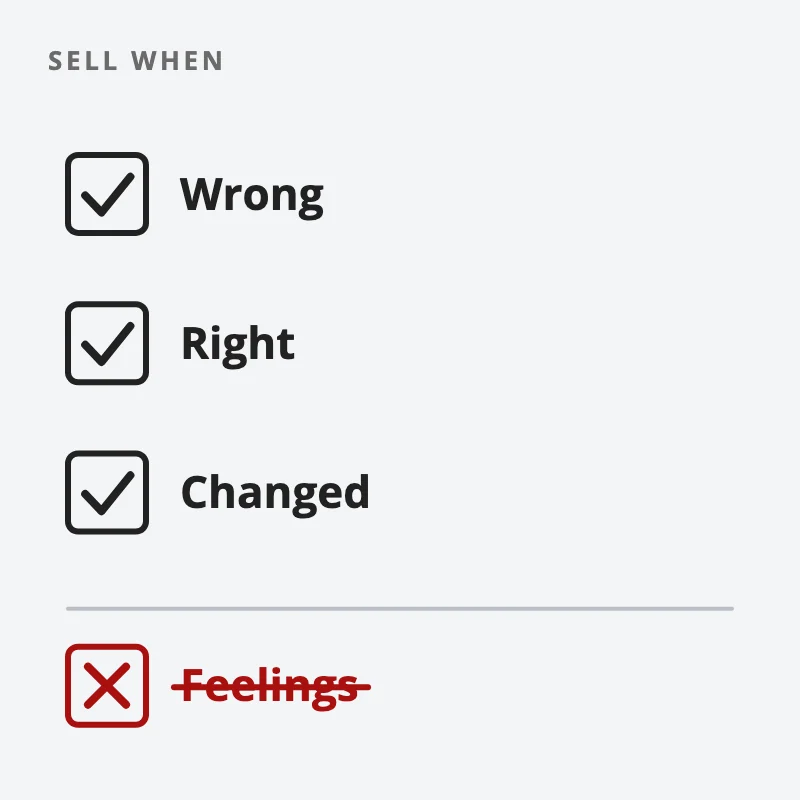
Here is the short answer. You sell a stock for one of three reasons. You were wrong, so the price hit the level that proves it. You were right, so the move has paid you and your rule says take some off. Or something changed, so the reason you bought it is no longer true. Every good sell rule catches one of those three.
What you should almost never do is sell because you feel nervous, or hold because you hope. Both are feelings, and the market does not read them.
Why is selling so much harder than buying?
Think about a casino. The house never wonders when to leave the table, because every game has its rules set before the first card is dealt. You and I decide when to leave while we are still sitting there with chips in front of us, heart rate up, telling ourselves one more hand will turn it around.
That is why most people sell backwards. They take a small profit quickly to feel safe, and they hold a loss to avoid admitting it. William O’Neil put the fix in eight words: “take your losses quickly and your profits slowly.” He also noted that most investors do the reverse.
So the answer is to decide your sell rules before you buy. Then selling stops being a decision you make under stress. It becomes a rule you follow.
When should you sell a stock at a loss?
When the price reaches the level that says your idea was wrong. Decide that level before you enter, and place the order the day you buy.
For a swing trader, that level is a chart level, like the low of the pullback you bought. If price closes below it, the setup has failed. A fixed percentage fits badly here, because every stock moves a different amount. Where to put your stop loss and take profit goes through how to pick the level.
O’Neil, who wrote for investors buying growth stocks, used a simpler rule: cut every loss at 7% or 8% below what you paid. His reasoning is worth knowing. If you take gains of 20% to 25% and cut losses at 7% or 8%, then, as he put it, “You could be wrong twice and right once” and still come out ahead.
Do note what that rule is measured from. It runs from your purchase price, and O’Neil was clear on this: “Do not sell a stock just because it’s off 7% to 8% from its peak price.” A stock that is well up from where you bought it gets more room.
And never, ever average down to avoid taking the loss. That turns a small mistake into a big one. If you are tempted, read why averaging down hurts traders first.
When should you sell a stock for profit?
When it has paid you a set multiple of what you risked, take some off, and let the rest run on a trailing stop.
Most of us measure profit in percent. It is more useful to measure it in R, where 1R is what you stood to lose if the stop was hit. A trade risking 4% that gains 8% has made 2R.
A common shape for a swing-trade exit has three parts:
- At a set multiple of your risk, sell part of the position.
- Move the stop on the rest to your entry price, so the trade can no longer lose.
- Trail the rest with a short moving average or the last swing low, and sell on a daily close below it.
Why bother with the trail at all? Because most of a swing trader’s profit comes from a few big winners, and a fixed target cuts those off. The trail keeps a big winner running, while a fixed target sells it early and watches the rest of the move from the sidelines.
If you want to go further into trailing methods, trailing stop loss strategies compares the main ones.
Want those rules on one page before your next trade? Our free 15-Minute Swing Trader’s Checklist has the daily routine and the questions to ask before you enter. Get the free checklist →
What about winners you keep selling too early?
This one comes up a lot. A trader asked on a day-trading forum this year: “I can follow my stop-loss, but I keep exiting my winners too early.”
That is a fair complaint, and a very common one. The fix that works best is to write the exit down as a rule, so there is nothing left to decide mid-trade. Selling part at a set multiple of your risk takes care of the itch to bank something. The trail takes care of the rest. You only sell on a daily close, so the noise during the day stops mattering.
O’Neil had a similar rule for his biggest winners. If a stock gained 20% within 1 to 3 weeks of breaking out on heavy volume, he held it for at least 8 weeks. He read a move that fast as the sign of a possible big winner, and he did not want a normal wobble to shake him out of the one stock that could make his year.
When should you sell because something changed?
When the reason you bought is no longer true, or when a coming event could break the trade before your stop gets a say.
These are the “changed” sells, and they look different for traders and investors.
| Swing trader | Long-term investor | |
| Wrong | Price closes below the chart level that proves the setup failed | The business result you bought for does not arrive |
| Right | Part off at a set multiple of your risk, trail the rest | The position has grown past your size limit, so trim it back |
| Changed: an event | Earnings or a big news print is due, so close it before | Rarely a reason on its own |
| Changed: time | No progress in the few days you allowed, so the trade is dead money | A thesis that has not played out in the time you gave it |
| Changed: the reason | The chart no longer shows the setup you bought, such as a broken uptrend | The story changed: management, debt, a lost market |
Earnings are the event that catches most swing traders. A good setup can gap straight through your stop on a bad report, and your stop fills wherever the price opens. Holding stocks through earnings goes into when, if ever, it makes sense.
For a long-term investor, the “right” sell usually looks like a rebalance. A common approach is to rebalance once a year, plus any time a holding drifts a set amount, such as 5 percentage points, from its target weight. Selling a winner to get back to target feels wrong. But it is the rule doing its job, which is stopping one stock from becoming your whole result. Portfolio rebalancing shows how to set the bands, and how much of your portfolio to put in one stock covers the size limit.
So should you sell that big winner?
Back to the reader with the huge NVIDIA gain. The three reasons give a clear way to think about it.
Was the stock wrong? Clearly not. Did something change in the business? Only the owner can answer that. Has the position grown far past any size you would choose today? Very likely, after a gain that size. So the answer is probably to trim it back to a size you can live with, and let the rest ride on a rule.
Selling all of it and holding all of it are both bets on a single outcome. Trimming to a set size gets you out of that guessing game, because whatever the stock does next, you will have kept some and banked some, and neither outcome will feel like a disaster.
Which of the three reasons are you using today: wrong, right or changed? And is it written down anywhere, or does it live in your head? For more on the risk side, see the guide to money and risk management.
FAQ
When should you sell a stock?
Sell when you are wrong, when you are right, or when something changed. Wrong means the price hit the level that proves the idea failed. Right means the move has paid you and your profit rule says take some off. Changed means the reason you bought is gone.
What is the 7% sell rule?
It is William O’Neil’s rule to cut any loss at 7% or 8% below your purchase price. It applies to the price you paid, and O’Neil said a stock that is well up should be given more room from its peak.
When should you sell a stock for profit?
Take part of it off at a set multiple of your risk, and trail the rest. O’Neil’s investor version was to take most gains at 20% to 25%.
Should you sell a stock before earnings?
For a swing trader, usually yes. A bad report can gap the price through your stop, and the fill lands wherever the market opens.
Should I sell a stock that has gone up a lot?
Check whether it has grown past the size you would choose today. If it has, trimming back to that size is a rule-based answer that keeps you in the stock.
Go deeper
A sell rule only works if you decide it before you buy. The free 15-Minute Swing Trader’s Checklist has the daily routine, the questions to ask before every trade, and the five rules that protect your account.
About the author. Spencer Li is The 15-Minute Trader and the founder of Synapse Trading. He is a Certified Financial Technician (CFTe) with 15+ years of trading, run from 70+ countries. He holds a B.Acc and B.BM from SMU. Every trade he takes is public, dated, losses left in. He teaches low-risk swing trading in 15 minutes a day, one system for any market.
Educational content only, not personalised financial advice. Trading carries risk, including loss of capital. Past performance is not indicative of future results. Synapse Trading is not licensed or regulated by MAS.
Want the daily routine? Enter your email for the free 15-Minute Swing Trader's Checklist.
Free 5-page PDF, then occasional trading emails. Education only, not financial advice. Unsubscribe anytime. Kit stores your email in the US: see our privacy policy.
Want to learn the full method? The Trading Mastery Program teaches the 4 strategies I have traded since 2011. It suits beginners and experienced traders.
Rather follow the trades as they happen? Daily Trading Signals is our Telegram channel: my trade ideas with entry, stop and exit, and every trade is public.
Questions about this post? Ask in the free Telegram channel →
Educational content only, not personalised financial advice. Trading carries risk, including loss of capital. Past performance is not indicative of future results. Synapse Trading is not licensed or regulated by MAS.

