

Stop Hunting in Trading: Is It Real, and How Do You Protect Your Stop Loss?
Want the daily routine? Get the free 15-Minute Swing Trader’s Checklist. Get it free →
A regulator has caught bank traders trying it. But the stop hunt most traders feel has a far more ordinary cause
Published: 17 October 2026 · Last updated: 17 October 2026 · By Spencer Li, CFTe
You place a stop just under the obvious low. Two days later, price dips a few cents below it, fills your stop, and then rips higher without you. It feels personal. It feels like someone saw your order and went after it.
So is stop hunting real? Yes, in two very different forms. The first is misconduct that regulators punish. Banks have been fined after a regulator found their traders tried to trigger clients’ stop orders. The second is everyday market mechanics: stops pile up at the same obvious levels, and that pile of orders attracts price like a magnet, without anyone knowing or caring where your stop is.
The difference is between being hunted and being herded. Being hunted needs someone who can see your order. Being herded only needs you to put your stop where everyone else put theirs. For most traders in liquid stocks, the second is what is happening.
Has stop hunting ever been proven?
Yes. And it is worth being clear about this, because people who say “it is all in your head” are wrong about the history.
In November 2014, the UK’s Financial Conduct Authority imposed “fines totalling £1,114,918,000 ($1.7 billion) on five banks” over their foreign exchange trading. Among its findings, traders “attempted to manipulate fix rates and trigger client “stop loss” orders.” In plain words, a bank that held a client’s stop order could push the price to that level, fill the stop, and profit from the difference.
A different case shows how big players can fake the order book. In September 2020, the US Commodity Futures Trading Commission ordered JPMorgan to pay USD 920.2 million, which it called “the largest amount of monetary relief ever imposed by the CFTC.” Its traders had “placed hundreds of thousands of orders” with “the intent to cancel those orders prior to execution,” which created false signals of supply and demand.
Do note what both cases have in common. In each one, the firm could see the orders, or was placing them itself. That is what makes the hunted version possible.
Why does it feel like your stop always gets hit?
Because stops cluster, and a cluster of stops is a pool of guaranteed orders.
Think about where most traders put their stop. Just below the obvious swing low. Under a round number. Below yesterday’s low. Every textbook teaches the same levels, so a lot of stops end up in the same small area.
Now think about what a sell stop actually is. It is an order to sell at whatever price is available once a level is touched. A hundred of them under one low is a hundred sellers who will sell at almost any price. For a large buyer who needs to fill a big order without pushing the price up, that is the best place on the chart to buy.
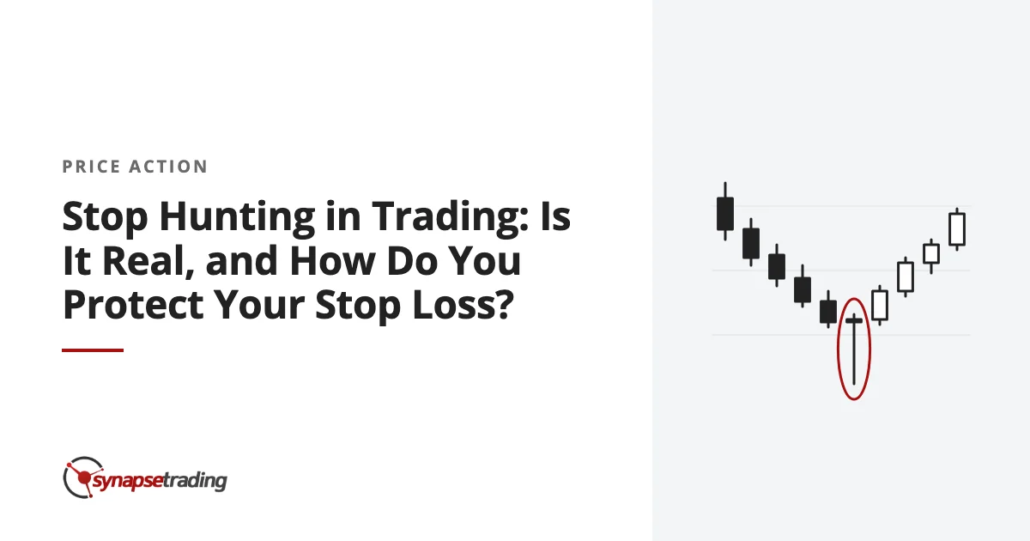
So price reaches the level, sometimes on its own and sometimes with a nudge. The stops fire. That burst of selling pushes the price lower for a moment, which triggers the next layer of stops. Then the forced selling runs out, the buyers have their shares, and price snaps back.
Nobody in that story knows your stop. The same thing would have happened if you had no position at all. You joined the crowd by putting your stop where the crowd put theirs. That is the herded version, and it is by far the more common one. Our post on false breakouts shows the same mechanics from the other side.
A trader asked on a day-trading forum: “Is stop hunting/stop run real or just paranoia?” The honest answer is that it is real mechanics, and paranoia about the motive.
Where is stop hunting most likely to happen?
It depends a lot on what you trade and who holds your stop.
| What you trade | Who can see your stop | How exposed you are |
| Forex or CFDs with a dealing-desk broker | The broker, who may also be on the other side of your trade | Highest |
| Leveraged crypto futures | Liquidation levels are widely estimated and published | Very high |
| Futures and very short intraday charts | Nobody sees your order, but stops are easy to guess from the chart | High |
| Thin, small-cap stocks | Nobody sees it, but price is cheap to push | Medium to high |
| Liquid large-cap stocks, held for days | Nobody, if the broker keeps the stop on its own server | Lowest |
That last row is worth explaining. A standard stop order held by many brokers is not shown on the exchange’s order book. It waits at the broker and only becomes a real order when its price is hit. So in a liquid stock, nobody scanning the book can see it. The level may be obvious, but your order is not.
The first row is where you need the most care. With a dealing-desk broker, the firm sees your stop and may be your counterparty as well. That is the same structure the 2014 case was about, on a smaller scale. Our guide on how to choose a forex broker explains what to check, and if you trade with leverage, what happens in a CFD margin call is worth reading first.
If you want a routine that keeps your stops planned instead of rushed, our free 15-Minute Swing Trader’s Checklist covers the questions to ask before every trade. Get the free checklist →
How do you protect your stop loss from being hunted?
You cannot stop the market from visiting obvious levels. But you can stop being part of the crowd that gets flushed out there.
- Exit on the close, rather than intraday. For swing trades, decide your exit on the daily close. A wick that pokes through your level during the day and closes back above it never triggers you. This one rule removes most of the “hunted to the tick” pain.
- Put a buffer beyond the obvious level. Go a little further than everyone else, sized to how much the stock normally moves. The ATR, the average daily range, is a common way to size that buffer.
- Use odd numbers. Stops pile up at round numbers. Placing yours a little away from them costs nothing.
- Trade smaller with a wider stop. A wider stop with a smaller position risks the same amount as a tight stop with a big one. But it gives the trade room to survive a normal shake-out. Where to put your stop loss goes through how to pick the level.
- Know your order type. A stop-market order fills at the next available price. A stop-limit order may not fill at all in a fast drop, which can leave you holding the whole move down. Order types in trading explains the difference.
- Trade the failed move. When price flushes through a level and closes back above it, the trapped sellers have just left. That reversal is a well-known entry in its own right.
What is the real risk with stop hunting?
The real risk is the belief.
A post on a day-trading forum this year was titled “The Market Knows My Stop Losses.” The feeling is easy to understand. But once you believe the market is out to get you, every loss has someone else to blame. That makes it very hard to fix the things you control, like where you placed the stop, how big the position was, and whether the setup was any good.
The belief also tempts traders into the worst possible fix, which is trading with no stop at all. That turns a small, planned loss into an open-ended one. And when everyone around you is blaming the same villain, it is worth asking whether you have just joined another crowd. Our post on herd mentality in trading looks at how that happens.
There is a deeper point too. Research by Kaminski and Lo, published in 2014, found that whether a stop helps depends on how the market you trade behaves. In markets that tend to keep trending, stops can add value. In markets that tend to snap back, they can cost you, with or without anyone hunting them.
So, on your last stop-out that felt hunted, was your stop where everyone else’s was? And did the price close through your level, or just poke through it during the day? For more on managing risk, see the guide to money and risk management.
FAQ
Is stop hunting real?
Yes, in two forms. A regulator fined banks after finding their traders tried to trigger client stop orders. The everyday version is stops clustering at obvious levels, which attracts price without anyone targeting your order.
What does stop hunting mean in trading?
It means price moving to a level where many stop orders sit, triggering them, and then reversing. Sometimes it is deliberate. More often it is the natural pull of a large pool of orders.
Can brokers see your stop loss?
Your own broker can. With a dealing-desk forex or CFD broker, the firm may also be on the other side of your trade, which is where the risk is highest. On a stock exchange, a standard stop order held at the broker is not shown on the public order book.
How do you avoid stop hunting?
Exit on the daily close, put your stop a buffer beyond the obvious level, avoid round numbers, and use a smaller position with a wider stop. Trading liquid markets through a broker that is not your counterparty also helps.
Should you trade without a stop loss to avoid stop hunting?
No. Removing the stop swaps a small, planned loss for an open-ended one. A better stop placement is the fix.
Go deeper
Most stop-loss pain comes from decisions made in a hurry. The free 15-Minute Swing Trader’s Checklist has the daily routine, the questions to ask before every trade, and the five rules that protect your account. Enter your email and we’ll send it over:
We use your email address to send you the checklist, then emails about trading and our courses. Unsubscribe in one click, any time. Privacy policy.
About the author. Spencer Li is The 15-Minute Trader and the founder of Synapse Trading. He is a Certified Financial Technician (CFTe) with 15+ years of trading, run from 70+ countries. He holds a B.Acc and B.BM from SMU. Every trade he takes is public, dated, losses left in. He teaches low-risk swing trading in 15 minutes a day, one system for any market.
Educational content only, not personalised financial advice. Trading carries risk, including loss of capital. Past performance is not indicative of future results. Synapse Trading is not licensed or regulated by MAS.
Want the daily routine? Enter your email for the free 15-Minute Swing Trader's Checklist.
Free 5-page PDF, then occasional trading emails. Education only, not financial advice. Unsubscribe anytime. Kit stores your email in the US: see our privacy policy.
Want to learn the full method? The Trading Mastery Program teaches the 4 strategies I have traded since 2011. It suits beginners and experienced traders.
Rather follow the trades as they happen? Daily Trading Signals is our Telegram channel: my trade ideas with entry, stop and exit, and every trade is public.
Questions about this post? Ask in the free Telegram channel →
Educational content only, not personalised financial advice. Trading carries risk, including loss of capital. Past performance is not indicative of future results. Synapse Trading is not licensed or regulated by MAS.

