

What are Cross Currency Pairs?
Want the daily routine? Get the free 15-Minute Swing Trader’s Checklist. Get it free →
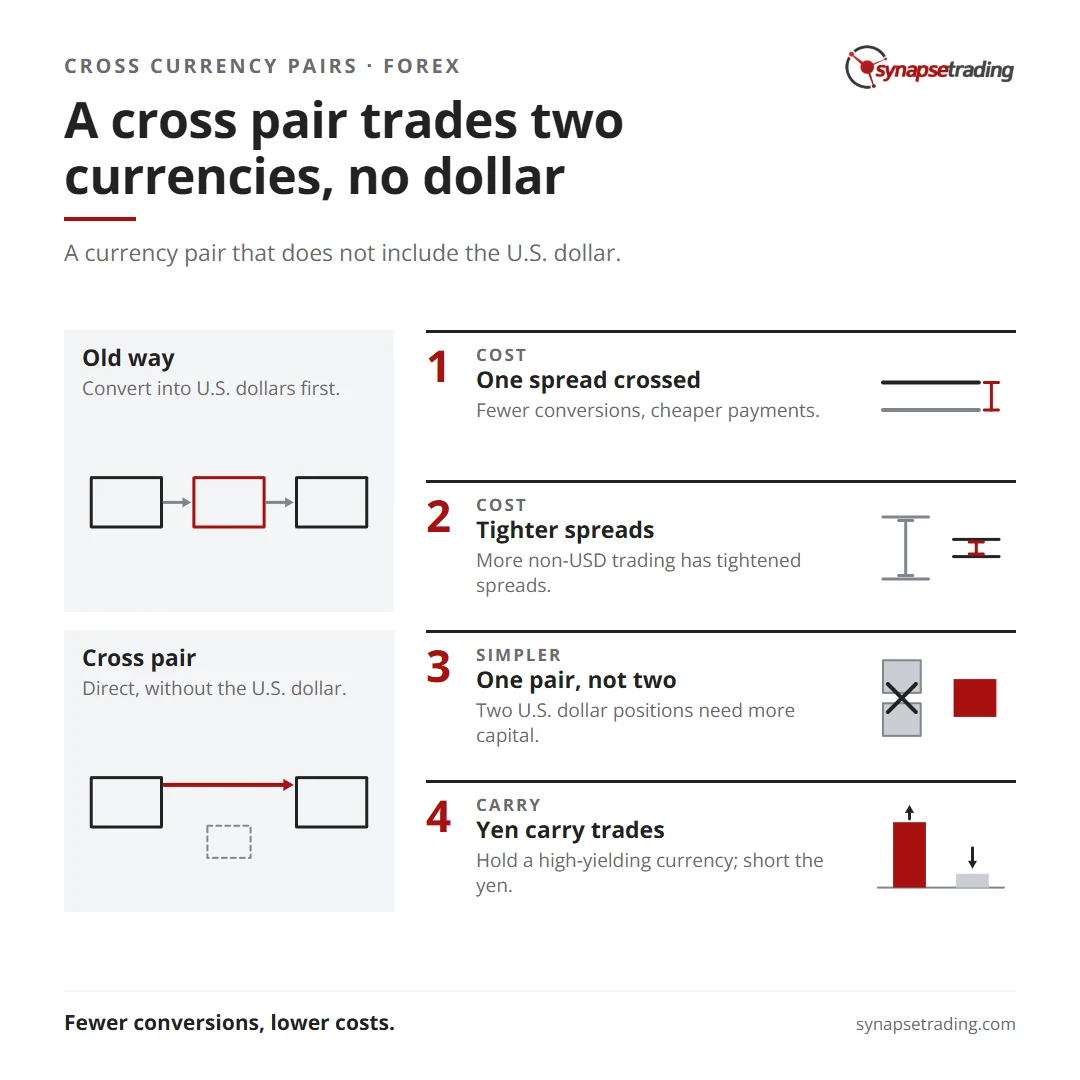
A cross currency refers to a currency pair or transaction that does not involve the U.S. dollar. In a cross currency transaction, the U.S. dollar is not used as a contract settlement currency. A cross currency pair consists of two currencies traded in the forex market that do not include the U.S. dollar. Common examples of cross currency pairs involve the euro and the Japanese yen.
Understanding Cross Currency
After the Second World War, most currencies were pegged and quoted against the U.S. dollar due to the strength of the U.S. economy and the dollar’s fixed relationship with gold. This practice set a precedent for converting two currencies that weren’t U.S. dollars.
Historically, if an individual wanted to exchange money into a different currency, they would first need to convert it into U.S. dollars before converting it into the desired currency. Even though cross currency transactions were possible under this system, they often still involved a U.S. dollar calculation to ensure fair settlement. While the U.S. dollar continues to function as the world reserve currency, the rise of the forex market has made cross currency transactions and pairs much more common. For instance, the GBP/JPY cross was created to allow direct currency conversion between the British pound and the Japanese yen without involving the U.S. dollar.
Advantages of Cross Currency Pairs and Transactions
Since the end of the gold standard and the increase in global trade, cross currency transactions have become a routine part of financial life. These transactions not only simplify international payments but also make them significantly cheaper. By eliminating the need to convert currency into U.S. dollars first, cross currency transactions reduce the number of conversions, meaning only one spread is crossed. Additionally, as non-USD pairs have become more commonly traded, the spreads have tightened, further reducing the cost of moving from one currency to another.
Cross Currency Pairs in Forex Trading
Cross currency pairs can be valuable tools for forex traders. For example, traders might use the EUR/GBP pair to position themselves based on developments in the ongoing Brexit situation. Setting up this trade using separate positions with USD/GBP and USD/EUR would be more complex and require more capital. However, this method is still used to create exotic cross currency pairs that are not widely traded.
Common cross currency trades often involve the Japanese yen. Many traders engage in carry trades where they hold a high-yielding currency, like the Australian dollar or the New Zealand dollar, and short the Japanese yen, which is a low-yielding currency.
Concluding Thoughts
Cross currency pairs and transactions have become essential in the global financial landscape, offering efficiency and cost savings in currency exchange. For forex traders, these pairs provide opportunities to capitalize on specific economic events and trends without involving the U.S. dollar. Understanding and utilizing cross currency pairs can enhance trading strategies and reduce costs in the increasingly interconnected global market.
Want the daily routine? Enter your email for the free 15-Minute Swing Trader's Checklist.
Free 5-page PDF, then occasional trading emails. Education only, not financial advice. Unsubscribe anytime. Kit stores your email in the US: see our privacy policy.
Want to learn the full method? The Trading Mastery Program teaches the 4 strategies I have traded since 2011. It suits beginners and experienced traders.
Rather follow the trades as they happen? Daily Trading Signals is our Telegram channel: my trade ideas with entry, stop and exit, and every trade is public.
Questions about this post? Ask in the free Telegram channel →
Educational content only, not personalised financial advice. Trading carries risk, including loss of capital. Past performance is not indicative of future results. Synapse Trading is not licensed or regulated by MAS.

