

What is an Exotic Currency?
Want the daily routine? Get the free 15-Minute Swing Trader’s Checklist. Get it free →
Exotic currencies are those that are thinly traded in foreign exchange markets and are not commonly used in global financial transactions. These currencies typically come from developing or emerging market countries and are characterized by low trading volumes, high volatility, and a lack of liquidity.
Understanding Exotic Currencies
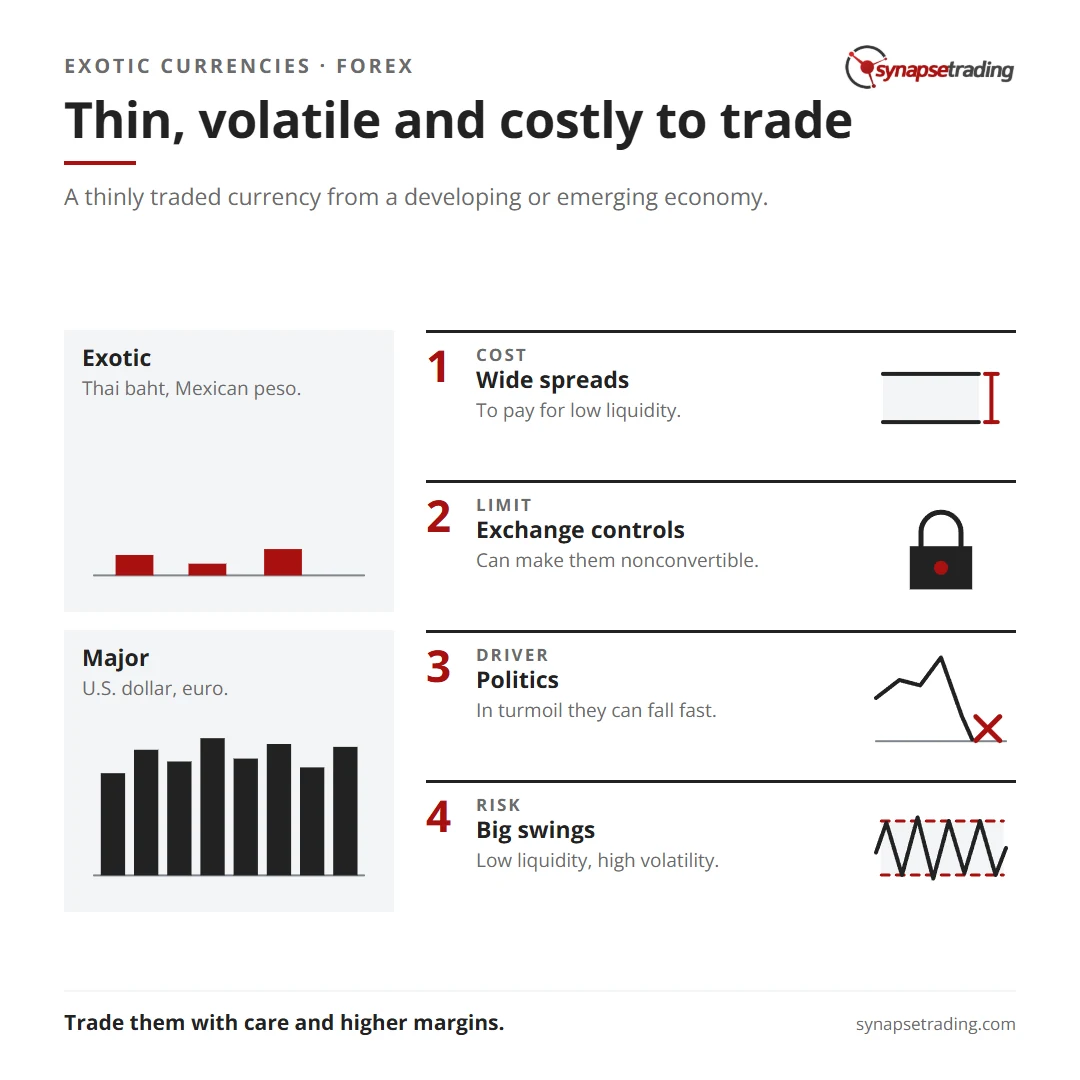
An exotic currency refers to a currency that is not widely traded in the foreign exchange market. These currencies are often illiquid, meaning they are not easily bought or sold without causing significant price changes. As a result, exotic currencies tend to lack market depth and can be extremely volatile. Trading these currencies can be costly due to the wide bid-ask spreads, which compensate for the lack of liquidity.
Exotic currencies are not considered major currencies because they are less accessible in the forex market and are often linked to developing or emerging economies. These currencies are sometimes subject to exchange rate controls, which can render them nonconvertible, further complicating their trade.
Examples of exotic currencies include the Thai baht, the Mexican peso, and the Saudi Arabian riyal. In contrast, major currencies, such as the U.S. dollar, euro, Canadian dollar, and Swiss franc, originate from developed countries with large economies and significant trading relationships.
Factors Influencing Exotic Currencies
The factors that affect exotic currencies differ from those that influence major currencies. While the value of a major currency typically depends on the health of its economy and interest rate differentials, exotic currencies are more often influenced by political changes and instability. During periods of political turmoil, exotic currencies can depreciate rapidly.
Additionally, due to their lower liquidity, exotic currencies generally exhibit higher volatility, which can result in significant price swings. Investors who wish to trade exotic currencies must often maintain higher margins in their brokerage accounts to accommodate the potential for substantial adverse changes in the currency’s value.
Concluding Thoughts
Exotic currencies represent a unique segment of the forex market, characterized by high volatility, low liquidity, and the potential for rapid depreciation in times of political instability. While they offer opportunities for traders willing to navigate their risks, trading exotic currencies requires careful consideration and higher margins to manage the increased volatility. Understanding the distinct factors that influence these currencies is crucial for anyone looking to engage in trading them.
About the author. Spencer Li is The 15-Minute Trader and the founder of Synapse Trading. He is a Certified Financial Technician (CFTe) with 15+ years of trading, run from 70+ countries. He holds a B.Acc and B.BM from SMU. Every trade he takes is public, dated, losses left in. He teaches low-risk swing trading in 15 minutes a day, one system for any market.
Education, not financial advice. Synapse Trading is not licensed by MAS to advise on investment products. Trading carries risk of loss; past performance is not indicative of future results.
Want the daily routine? Enter your email for the free 15-Minute Swing Trader's Checklist.
Free 5-page PDF, then occasional trading emails. Education only, not financial advice. Unsubscribe anytime. Kit stores your email in the US: see our privacy policy.
Want to learn the full method? The Trading Mastery Program teaches the 4 strategies I have traded since 2011. It suits beginners and experienced traders.
Rather follow the trades as they happen? Daily Trading Signals is our Telegram channel: my trade ideas with entry, stop and exit, and every trade is public.
Questions about this post? Ask in the free Telegram channel →
Educational content only, not personalised financial advice. Trading carries risk, including loss of capital. Past performance is not indicative of future results. Synapse Trading is not licensed or regulated by MAS.

