

Are Deep ITM LEAPS Just Leveraged Stock?
Want the daily routine? Get the free 15-Minute Swing Trader’s Checklist. Get it free →
Deep in-the-money LEAPS vs stock, worked through on one position: what you save, what you pay, and the date that changes everything
Published: 16 October 2026 · Last updated: 16 October 2026 · By Spencer Li, CFTe
Is a deep in-the-money LEAP just leveraged stock? Mostly, with three catches. A reader on Reddit’s options forum asked it almost word for word this year, “Is deep ITM LEAPS just leveraged stocks?”, and it deserves a straight answer.
A deep in-the-money LEAP is a call option with a strike well below today’s price and an expiry one to three years away. It moves almost dollar for dollar with the shares, for a fraction of the cash, so for most of its life it does behave like leveraged stock. The catches are that you pay for it in time value, you collect no dividends, and it has an end date. If the stock falls far enough, the whole premium can go to zero, which is a 100% loss on the cash you put in, from a fall that would have cost a shareholder 30%.
What is a deep in-the-money LEAP?
LEAPS stands for long-term equity anticipation securities, which is a long way of saying long-dated options. Cboe, the exchange that lists them, describes equity LEAPS as options that “expire in approximately two to three years from the date of initial listing,” with expiry months “up to 39 months from the date of initial listing, January expiration only.”
“Deep in the money” means the strike sits well below the share price. Most of what you pay is the value the option already has today, and only a small part is the bet on time.
Take a hypothetical stock at USD 100, with round numbers. A call with a strike of 70, expiring in two years, costs about USD 38 a share. Of that 38, 30 is the gap between the share price and the strike. The other 8 is time value, which is what you pay for everything else.
At that strike, the option moves roughly 89 cents for every dollar the stock moves. That is why it feels like owning the shares.
How does a LEAP compare with owning the shares?
One contract covers 100 shares. So the choice in the example is between USD 10,000 for 100 shares, or USD 3,800 for one LEAP that tracks most of their move.
Here is how the two compare two years later, at expiry, before any dividends.
| Stock price in two years | 100 shares, USD 10,000 | One LEAP, USD 3,800 |
| USD 130 | +30% | +57.9% |
| USD 110 | +10% | +5.3% |
| USD 100, unchanged | 0% | −21.1% |
| USD 70 or below | −30% or worse | −100% |
Read the rows in pairs.
When the stock rises a lot, the LEAP roughly doubles the shareholder’s percentage gain. When it rises a little, the LEAP barely beats breakeven, because the 8 of time value has to be earned back first. When the stock goes nowhere for two years, the shareholder is flat and the LEAP holder is down a fifth.
And at 70, the shareholder has lost 30% and still owns a company. The LEAP holder has lost everything.
A 30% fall in the stock is a 100% loss on the LEAP.
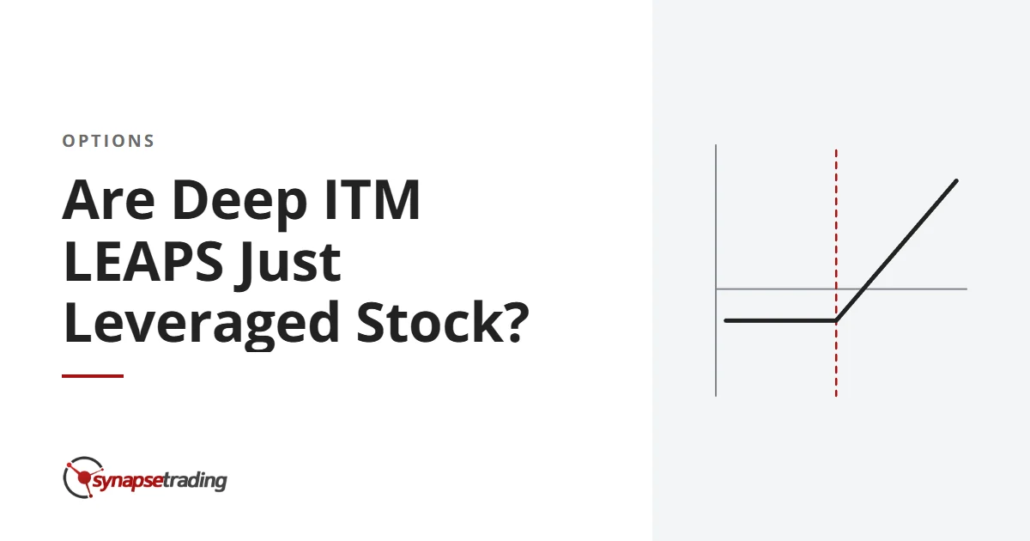
[INFOGRAPHIC: payoff at expiry of 100 shares against one deep ITM LEAP, with the 70 strike, the 108 breakeven and the flat-stock loss marked]
Loan, Floor, Clock: what the time value really buys
So where does that USD 8 of time value go? I find it easiest to think of it as buying two things and costing a third.
- Loan. You get the move on USD 100 of stock while paying 38. In effect, you are deferring payment of the 70 strike for two years. Paying 8 to defer 70 for two years works out to roughly 5.7% a year, simple, on money you never see.
- Floor. Below 70, the shareholder keeps losing, and the LEAP holder has already lost all of the 38. So part of the 8 buys a floor under your losses. On the same exposure, you can never lose more than the premium.
- Clock. You pay for both with a date. If the move you expected arrives a month after expiry, it arrives for someone else.
Seen this way, the question becomes whether you would rather borrow to buy shares, or pay for a loan with a built-in floor and a deadline. That is a different choice from “cheap stock”.
What are the catches people miss?
The first catch is dividends. An option holder collects no dividend. The Options Industry Council says “A call holder is entitled to the dividend if the holder exercises the call prior to the ex-dividend date,” which means you have to give up the option to get the payment. On a stock that pays a few percent a year, that is a cost the table above leaves out.
The second catch is the roll. A LEAP has an end date, so holding the position for longer means selling it and buying a new one further out, and paying a fresh slice of time value each time. How a roll really works is in what happens when an option is assigned, rolled or expires.
The third catch is liquidity. A deep in-the-money strike far out in time can trade thinly, so check the gap between the bid and the ask on the strike you are looking at. The guide to options trading uses a simple screen: skip any strike with fewer than 1,000 contracts of open interest or under 300 traded a day.
The fourth catch is the one that blows up accounts, and it is size. Because one LEAP costs about 38% of the shares, it is tempting to put the full USD 10,000 into LEAPS instead. That buys roughly 2.6 contracts, the exposure of about 260 shares, and the 30% fall in the bottom row of the table wipes out all of it. The leverage was the attraction. It is also how a normal correction becomes a total loss.
Sizing a position as if it could go to zero is the same habit we teach for shares, forex and ETFs. Our free 15-Minute Swing Trader’s Checklist has the daily routine and the questions to ask before any trade. Get the free checklist →
How does a LEAP fit the 2-month rule in the options guide?
It does not, and the rule still stands.
In the options guide, one of the three rules is never to hold a bought option past 2 months, because time value bleeds. A LEAP is a bought option held for years, so the rule applies to it like any other bought option.
What the example does show is where the cost sits. In the deep in-the-money LEAP, 30 of the 38 is value the option already has, and 8 is time value that will be gone by expiry. So you can see the trade-off in plain numbers. You put up less cash than the shares and get a floor under the loss. In exchange you pay time value, give up the dividends, accept a date, and often a wide spread. The bleed on a LEAP is slower than on a short-dated option, and it is still a bleed.
So are deep ITM LEAPS just leveraged stock?
While they stay deep in the money, mostly yes. They track the shares closely, they need less cash, and you pay for the loan in time value instead of interest.
The difference shows up at the edges. A shareholder who is wrong can wait. A LEAP holder who is wrong has a date, and a 30% fall that a shareholder would sit through takes the LEAP to zero.
Whichever way you lean, the sizing habit is the same as for any bought option. Size it as if the whole premium could vanish, because in a bad two years it can. If the position only looks interesting when it is large, it is the leverage you want, rather than the company.
How much of the premium could you watch go to zero without changing your plans? And if the stock drifted sideways for two years, how would you feel about being down a fifth while the shareholder is flat? Those two answers will tell you more than the delta will.
FAQ
Are deep in-the-money LEAPS the same as owning stock?
Mostly, while they stay deep in the money, because they move nearly dollar for dollar with the shares. They differ in three ways: you pay time value, you collect no dividends, and the position ends at expiry.
What is the most you can lose on a LEAP?
You can lose the whole premium you paid. In the example, a fall from 100 to 70 or lower takes a USD 38 LEAP to zero, a 100% loss, while the shares are down 30%.
Do LEAPS holders receive dividends?
No. Only shareholders receive dividends, so a call holder has to exercise the option before the ex-dividend date to collect one, and that means giving up the option’s remaining time value.
How long do LEAPS last?
Equity LEAPS are listed with expiries of up to 39 months, according to Cboe, and expire in approximately two to three years from the date they are first listed.
Does Synapse Trading teach LEAPS?
No, we do not teach options at the moment. We teach end-of-day swing trading in shares, forex and ETFs, and the rule of sizing every position as if it could go to zero carries straight across.
Go deeper
This post covers one corner of options. If you would rather start with what we do teach, the free 15-Minute Swing Trader’s Checklist has the daily routine, the questions to ask before every trade, and the five rules that keep you in the game. Enter your email and we’ll send it over:
We use your email address to send you the checklist, then emails about trading and our courses. Unsubscribe in one click, any time. Privacy policy.
About the author. Spencer Li is the founder of Synapse Trading and a Certified Financial Technician (CFTe) with 15 years of trading across stocks, forex, crypto, commodities, and bonds. His trade log is public: every trade since April 2024, dated, losses left in. He teaches low-risk swing trading in 15 minutes a day, one system for any market.
Educational content only, not personalised financial advice. Trading carries risk, including loss of capital. Past performance is not indicative of future results. Synapse Trading is not licensed or regulated by MAS.
Want the daily routine? Enter your email for the free 15-Minute Swing Trader's Checklist.
Free 5-page PDF, then occasional trading emails. Education only, not financial advice. Unsubscribe anytime. Kit stores your email in the US: see our privacy policy.
Want to learn the full method? The Trading Mastery Program teaches the 4 strategies I have traded since 2011. It suits beginners and experienced traders.
Rather follow the trades as they happen? Daily Trading Signals is our Telegram channel: my trade ideas with entry, stop and exit, and every trade is public.
Educational content only, not personalised financial advice. Trading carries risk, including loss of capital. Past performance is not indicative of future results. Synapse Trading is not licensed or regulated by MAS.


Leave a Reply
Want to join the discussion?Feel free to contribute!