

Call and Put Options Explained: How Each One Makes or Loses Money
Want the daily routine? Get the free 15-Minute Swing Trader’s Checklist. Get it free →
Last updated: 16 October 2026 · By Spencer Li, CFTe
A call option is the right to buy 100 shares of a stock at a fixed price before a fixed date. A put option is the right to sell 100 shares at a fixed price before a fixed date. You pay a premium for that right, and that premium is the most a buyer can ever lose.
So how does each one make money? A call pays when the stock rises far enough above the fixed price, soon enough, to be worth more than the premium you paid. A put pays the same way when the stock falls. If the move is too small, or it arrives after the date, the option expires worth less than you paid, or nothing at all. The person who sold you the option sits on the other side of every one of those outcomes, keeping the premium when little happens and paying out when the big move comes.
Which means an option buyer has to be right about 3 things at the same time. Let’s call them the 3 Ds: Direction, Distance and Deadline. It is easy to think only about the first one, and the other two are where the money goes.
What is a call option, and how does it make money?
Let’s use one hypothetical example with round numbers, so the arithmetic stays visible.
A stock trades at USD 50, and you buy the 50 call that expires in a month for USD 2 a share, so with one contract covering 100 shares, the premium comes to USD 200. Simple enough. That 50 is the strike price, the price at which you have the right to buy.
Now fast forward to expiry. Here is what the call is worth at five different stock prices:
| Stock price at expiry | Stock move | Call worth (per share) | Your result on the premium |
| 45 | −10% | 0 | −100% |
| 50 | 0% | 0 | −100% |
| 52 | +4% | 2 | 0% |
| 55 | +10% | 5 | +150% |
| 60 | +20% | 10 | +400% |
Look at the third row. The stock went up 4%. You made nothing. That is because the call has to cover its own cost first, so the break-even is the strike plus the premium, 50 plus 2, which is 52.
And look at the second row. The stock did not fall at all, it simply sat still for a month while the clock ran, and that was enough to take the whole premium.
What is a put option, and how does it make money?
A put is the mirror image. Same stock at USD 50, and you buy the 50 put for USD 2 a share.
If the stock falls to 40 by expiry, your right to sell at 50 is worth 10 a share, which is 5 times what you paid, and that is the kind of payoff that gets people hooked. If it drifts down to 48, the put is worth 2. Back where you started. And at 50 or above, the put expires worthless.
People buy puts for 2 reasons. Some are betting on a fall. Others already own the shares and want insurance against one, which works much like the travel insurance you buy before a holiday. You pay a small known amount, you hope you never claim it, and most of the time you do not.
Why can you be right about the stock and still lose money?
Well, this is where the 3 Ds come in.
- Direction. Up for a call, down for a put. This is the obvious part, and it is only a third of the job.
- Distance. The stock has to travel past the break-even, the strike plus or minus the premium. A small move in the right direction can still be a loss.
- Deadline. An option has an expiry date, and it loses a little value every day the stock does nothing. That daily cost is called time decay, and it speeds up in the last few weeks before expiry.
So you can be right on direction, wrong on distance or deadline, and still lose every cent of the premium. That is quite a different experience from owning the shares, where being early just means waiting.
A poster on r/Daytrading put numbers on this in September 2026, after he went back through 10 years and 2,044 of his own option trades and found that he had won 55% of them and still lost money overall. Ouch. Trades he held for more than an hour did most of the damage, and so did the cheapest contracts. His own summary: “I didn’t have an edge problem. I had an after-the-entry problem.” (It is self-reported and unchecked, so read it as one person’s record.)
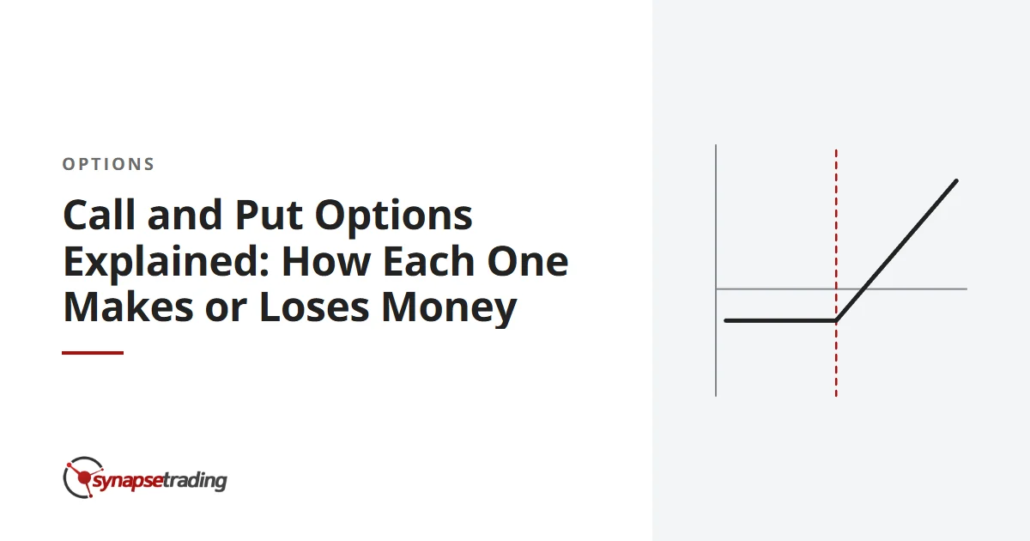
[INFOGRAPHIC: the 3 Ds, a payoff line for a bought call at expiry with the break-even marked, and the time-decay curve steepening into expiry]
What happens on the other side, when you sell an option?
Every option you buy, somebody sold. The seller collects the premium up front and, in exchange, takes on an obligation that only shows up when the stock moves against them. If a call seller is assigned, they have to sell the shares at the strike. If a put seller is assigned, they have to buy them at the strike.
The seller’s position looks a lot like running an insurance company, or the casino. Many small premiums come in, and once in a while a big claim goes out. That is a perfectly good business when the premiums are priced right, and a very painful one when a single claim wipes out a year of them. Who wins? The house, usually. But only because it sets the odds and never lets one table stake the whole building, which is the idea behind running your trading like a casino rather than a gambler.
Here are the 4 basic positions side by side:
| Position | You make money when | Most you can make | Most you can lose |
| Buy a call | the stock rises past strike plus premium before expiry | no fixed ceiling | the premium |
| Buy a put | the stock falls past strike minus premium before expiry | the strike minus the premium, if the stock goes to zero | the premium |
| Sell a call | the stock stays below the strike | the premium | no fixed ceiling if you do not own the shares |
| Sell a put | the stock stays above the strike | the premium | the strike minus the premium, if the stock goes to zero |
Do note the last column. A buyer’s worst case is known the moment the trade is placed. A seller’s worst case can be many times the premium collected. That one fact shapes almost everything else about options.
If you want a daily routine for the trades we do teach, the free 15-Minute Swing Trader’s Checklist is at the end of this post.
What does this mean before your first options trade?
Three practical things follow from the 3 Ds.
First, the premium is the whole risk on a bought option, because there is no price level at which a stop gets you out cheaply. So the premium has to fit inside whatever you already risk per trade, the same way any position does. The 2% money management rule for position sizing works on options too, with the premium as the amount at risk.
Second, the deadline costs money every day, so the further out the expiry, the more you pay for the extra time, and the slower the decay. Neither choice is free. You are only choosing which way to pay.
Third, if you are in Singapore, the broker has to check you first. Options are derivatives. MAS rules require a Customer Account Review before the account is opened, which the notice defines as “a review of a Customer’s knowledge and experience in derivatives”. The broker looks at your education, your investment experience and your work experience. If you trade US-listed options from here, that also means trading in US dollars, in a market that opens at 9.30 pm or 10.30 pm Singapore time.
Personally, I think the 3 Ds are the whole lesson for a beginner. The poster with 2,044 trades won more of them than he lost. By his own count, what cost him was holding too long and buying the cheapest contracts. A contract is cheap because the stock has far to travel or little time left, which is distance and deadline, the 2 Ds that are easy to miss on the way in. For the full map, including the Greeks and the 4 structures most people start with, read the ultimate guide to options trading. And if you are now wondering where a beginner should actually start, that is the next post: the best options strategy for beginners, and how to test the one you found.
FAQ
Do I need to own the shares to buy a call or a put?
No. You can buy a call or a put on a stock you do not own. Owning the shares only matters when you sell a call and want it covered.
What is the most I can lose buying a call option?
The premium you paid, all of it. On one contract that is the price per share times 100.
What is the most I can lose selling a put option?
The strike price minus the premium, times 100 shares, if the stock goes to zero. Selling a call without owning the shares has no fixed ceiling on the loss at all.
Do I have to hold an option until it expires?
No. You can sell the option back before expiry. The Options Industry Council says that historically more than 72% of option contracts are closed out before expiration. On a strike that trades thinly, though, the price you get back can be well below the price on the screen.
Can I trade options from Singapore?
Yes, through a broker that offers them, after the broker reviews your knowledge and experience in derivatives. US-listed options trade during US market hours, which run from late evening to early morning in Singapore.
Does Synapse Trading teach options?
No, not at the moment. We teach end-of-day swing trading in shares, forex and ETFs, and these options posts exist because the questions keep coming and the honest answers are short.
Go deeper
The 3 Ds apply to every trade, options or not, and the swing-trading side is the part we do teach. The free 15-Minute Swing Trader’s Checklist has the daily routine, the questions to ask before every trade, and the five rules that keep you in the game. Enter your email and we’ll send it over:
We use your email address to send you the checklist, then emails about trading and our courses. Unsubscribe in one click, any time. Privacy policy.
About the author. Spencer Li is the founder of Synapse Trading and a Certified Financial Technician (CFTe) with 15 years of trading across stocks, forex, crypto, commodities, and bonds. His trade log is public: every trade since April 2024, dated, losses left in. He teaches low-risk swing trading in 15 minutes a day, one system for any market.
Educational content only, not personalised financial advice. Trading carries risk, including loss of capital, and isn’t suitable for everyone. Past performance is not indicative of future results. Synapse Trading is not licensed or regulated by MAS.
Want the daily routine? Enter your email for the free 15-Minute Swing Trader's Checklist.
Free 5-page PDF, then occasional trading emails. Education only, not financial advice. Unsubscribe anytime. Kit stores your email in the US: see our privacy policy.
Want to learn the full method? The Trading Mastery Program teaches the 4 strategies I have traded since 2011. It suits beginners and experienced traders.
Rather follow the trades as they happen? Daily Trading Signals is our Telegram channel: my trade ideas with entry, stop and exit, and every trade is public.
Educational content only, not personalised financial advice. Trading carries risk, including loss of capital. Past performance is not indicative of future results. Synapse Trading is not licensed or regulated by MAS.


Leave a Reply
Want to join the discussion?Feel free to contribute!