

Negative Volume Index (NVI)
Want the daily routine? Get the free 15-Minute Swing Trader’s Checklist. Get it free →
The negative volume index (NVI) is a technical indicator that integrates volume and price to show how price movements are affected by days when trading volume is lower than the previous day.
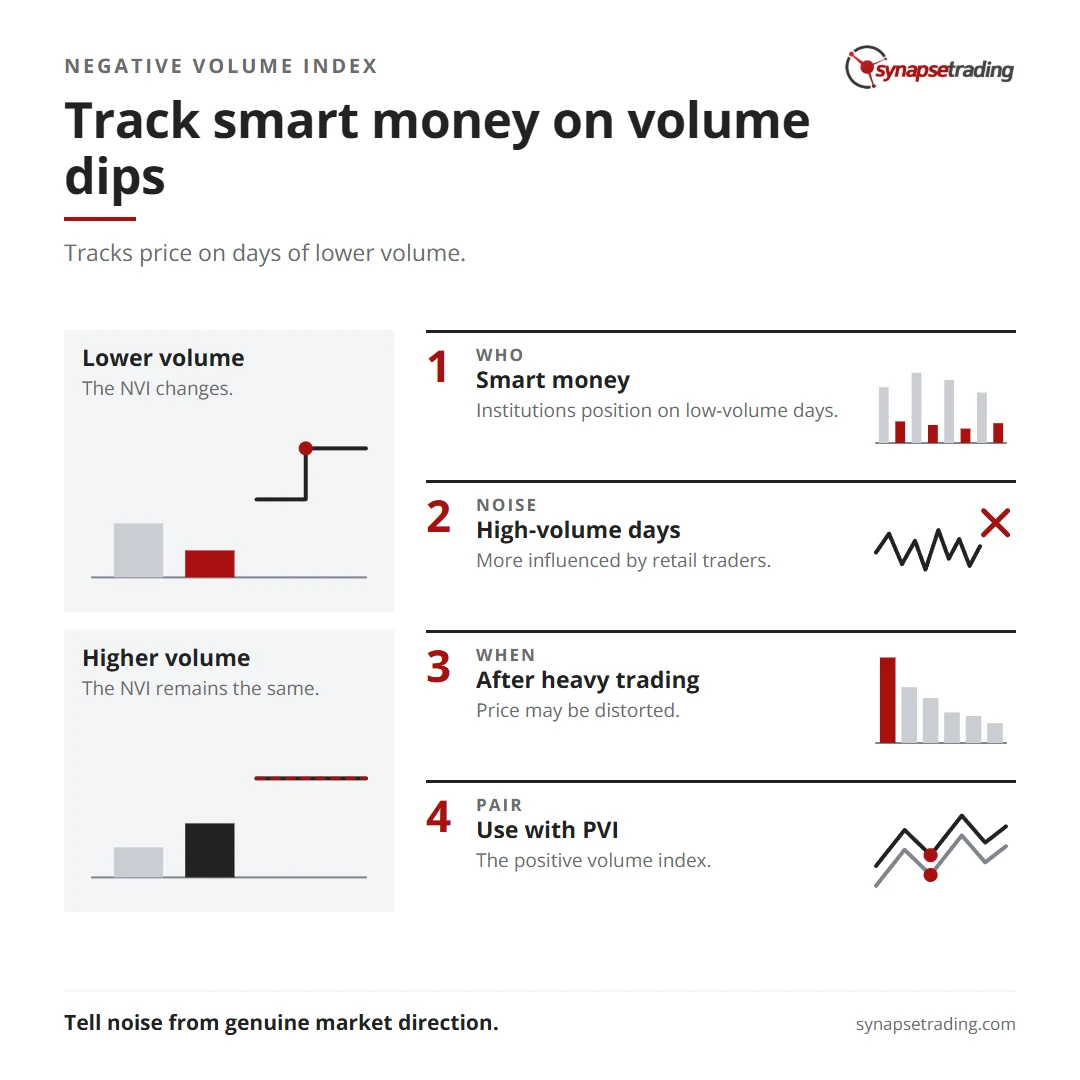
The NVI is particularly useful in tracking “smart money” movements, typically associated with institutional investors, during low-volume trading days.
Understanding Negative Volume Index (NVI)
The NVI is often used alongside the positive volume index (PVI) to gain insights into how price is being influenced by volume trends.
Both the NVI and PVI were first developed by Paul Dysart in the 1930s and gained wider recognition in the 1970s, largely due to Norman Fosback’s book Stock Market Logic.
These indexes track price changes in relation to volume trends and are often used in technical analysis software, such as MetaStock and EquityFeedWorkstation.
The NVI helps investors follow price trends that are influenced primarily by institutional investors and other “smart money” players during low-volume days.
It provides a clearer picture of price action without the noise of high-volume market movements, which tend to be more influenced by retail traders.
NVI is particularly useful after periods of high-volume trading when the price may have been distorted by market noise.
On lower-volume days, the NVI can reveal how institutional investors are positioning themselves, offering more reliable signals for potential price movements.
NVI Calculations
The NVI only changes when the trading volume of the current day is lower than the previous day.
If today’s volume is higher than the previous day, the NVI remains the same.
When volume decreases, the NVI is calculated using the following formula:
NVIₜ = NVIₜ₋₁ + [(Pₜ − Pₜ₋₁) / Pₜ₋₁] × NVIₜ₋₁
Where:
NVIₜ = Negative Volume Index at time t
Pₜ = Price or index level at time t
Concluding Thoughts
The Negative Volume Index is a valuable tool for technical analysts seeking to track institutional trading activity during low-volume periods.
It provides a clearer view of price movements driven by “smart money” and can be a useful complement to the Positive Volume Index for a more comprehensive analysis of market trends.
By focusing on volume dips, the NVI offers insights that help traders distinguish between noise and genuine market direction.
Want the daily routine? Enter your email for the free 15-Minute Swing Trader's Checklist.
Free 5-page PDF, then occasional trading emails. Education only, not financial advice. Unsubscribe anytime. Kit stores your email in the US: see our privacy policy.
Want to learn the full method? The Trading Mastery Program teaches the 4 strategies I have traded since 2011. It suits beginners and experienced traders.
Rather follow the trades as they happen? Daily Trading Signals is our Telegram channel: my trade ideas with entry, stop and exit, and every trade is public.
Questions about this post? Ask in the free Telegram channel →
Educational content only, not personalised financial advice. Trading carries risk, including loss of capital. Past performance is not indicative of future results. Synapse Trading is not licensed or regulated by MAS.

