

Moving Average Convergence Divergence (MACD) Indicator
Join our Telegram channel for more market analysis & trading tips: t.me/synapsetrading
The Moving Average Convergence/Divergence (MACD) is a trend-following momentum indicator developed by Gerald Appel in the 1970s.
It helps traders and investors identify potential buy or sell signals based on the relationship between two exponential moving averages (EMAs) of a security’s price.
The MACD provides insights into price trends, momentum, and market entry points.
Table of Contents
Key Features of MACD:
- MACD Line: Calculated by subtracting the 26-period EMA from the 12-period EMA.
- Signal Line: A 9-period EMA of the MACD line, used to trigger buy and sell signals.
- Histogram: A visual representation of the difference between the MACD and the signal line, providing insights into bullish and bearish momentum.
How MACD Works
The MACD generates trading signals based on the crossover of the MACD line and the signal line. Traders typically interpret these signals using the following methods:
- Crossovers:
- Bullish Crossover: Occurs when the MACD line crosses above the signal line, suggesting a buying opportunity.
- Bearish Crossover: Occurs when the MACD line crosses below the signal line, suggesting a selling opportunity.
- Divergences:
- Bullish Divergence: When the price forms a lower low while the MACD forms a higher low, indicating a potential reversal to the upside.
- Bearish Divergence: When the price forms a higher high while the MACD forms a lower high, signaling a potential reversal to the downside.
- Rapid Rises/Falls: When the MACD moves sharply upward or downward, it signals that the asset may be overbought or oversold, often prompting a return to normal levels.
MACD Formula
The MACD is calculated using the following formula:
MACD=12-Period EMA−26-Period EMAMACD = 12\text{-Period EMA} – 26\text{-Period EMA}
- EMA (Exponential Moving Average): A moving average that places more weight on recent price data compared to a simple moving average (SMA).
- The signal line is a 9-period EMA of the MACD line, which helps smooth out fluctuations and generate trade signals.
MACD vs. Relative Strength Index (RSI)
- RSI: An oscillator that measures price momentum by comparing average gains and losses over a set period, signaling overbought or oversold conditions. It is bound between 0 and 100, with readings above 70 indicating overbought conditions and readings below 30 indicating oversold conditions.
- MACD: Focuses on the relationship between two EMAs and is unbounded, meaning it does not have fixed levels for overbought or oversold conditions.
While both measure momentum, they provide different signals. For instance, the RSI might show a market as overbought while the MACD could indicate continuing bullish momentum.
Limitations of MACD
- Lagging Indicator: MACD is based on historical data, which means it may lag behind actual price movements, leading to delayed signals.
- False Signals: In sideways or consolidating markets, MACD can produce false signals, leading to whipsaws where the price does not follow through after the signal.
- Divergence Risk: Bullish or bearish divergences in MACD may not always lead to reversals, especially if the overall trend remains strong.
To mitigate these limitations, traders often use MACD in combination with other indicators such as the Relative Strength Index (RSI) or Directional Movement Index (DMI) to confirm signals.
Concluding Thoughts
The MACD is a powerful tool for identifying trends, momentum, and potential buy or sell signals.
While it is most effective in trending markets, traders should be cautious in range-bound or consolidating markets to avoid false signals.
Combining MACD with other indicators, such as the RSI or ADX, can improve the reliability of trading decisions.
As with all technical tools, confirmation through price action and other signals is critical to successfully using the MACD in trading strategies.
Want the daily routine? Enter your email for the free 15-Minute Swing Trader's Checklist.
Free, 5 pages, PDF. You get the checklist, then my occasional trading emails. Education only, not financial advice. Unsubscribe anytime.
Where your details go: Kit, our email provider, stores your email address in the United States. Our contract with Kit lets it use your address only to send our emails, and requires Kit to keep it secure. The United States has no national privacy law like Singapore's, so that contract is the main protection. More in our privacy policy.
 Our flagship mentoring program is suitable for both beginners and advanced traders, covering the 4 strategies which I used over the past 15 years to build up my 7-figure personal trading portfolio.
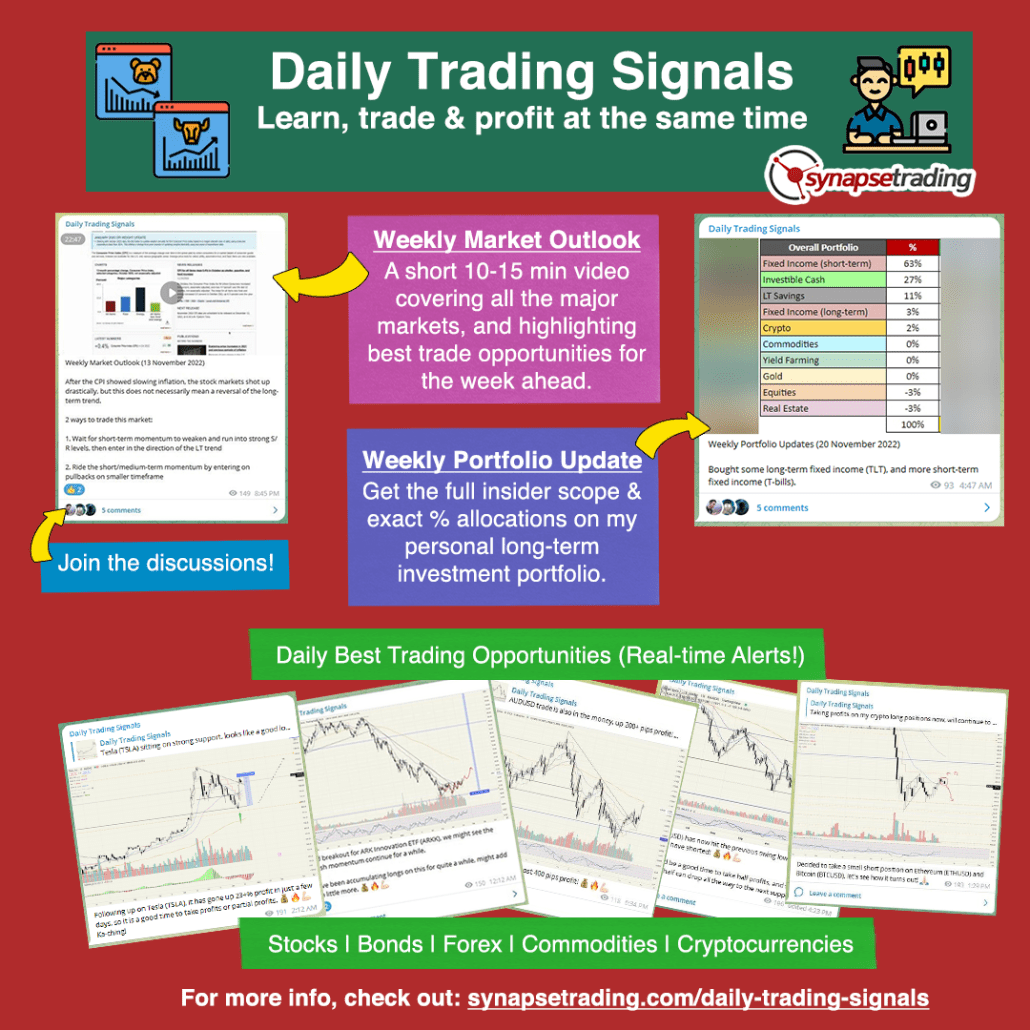 If you're looking for the best trading opportunities every day across various markets, and don't want to spend hours doing the research yourself, check out our private Telegram channel!

Leave a Reply
Want to join the discussion?Feel free to contribute!