
• Link to Facebook
  • Link to X
  • Link to Instagram
  • Link to Youtube
  • Link to LinkedIn
  • Link to Mail
Free PDF: The 15-Minute Swing Trader's Checklist, the daily routine of a trader since 2007
Synapse Trading
  • Mentoring
    • Trading Mastery Program
    • All mentoring options
  • Signals
    • Daily trading signals
    • Signals trade log
  • Results
    • Student results and testimonials
    • Public trade log, losses left in
  • Free guides
    • Start here
    • Trading foundations
    • Technical analysis
    • Strategies and systems
    • Risk and money
    • Trading psychology
    • Markets and products
    • Free trading guides
    • Tools and resources
    • Blog
  • About
    • My background
    • My trading journey
    • Media and interviews
    • Travel log
  • Contact
    • Contact me
    • Partnerships
  • Start free
  • Click to open the search input field Click to open the search input field Search
  • Menu Menu
The Synapse Network

Money Flow Index (MFI) Indicator
Technical Analysis & Price Action
Money Flow Index (MFI) - indicators
Home › Trading guides › Technical indicators guide

Want the daily routine? Get the free 15-Minute Swing Trader’s Checklist. Get it free →

The Money Flow Index (MFI) is a technical oscillator that combines both price and volume data to identify overbought or oversold conditions in an asset.

It can also detect divergences that signal potential trend reversals.

The MFI is unique because it incorporates volume into its calculations, making it different from other oscillators like the Relative Strength Index (RSI), which only considers price.
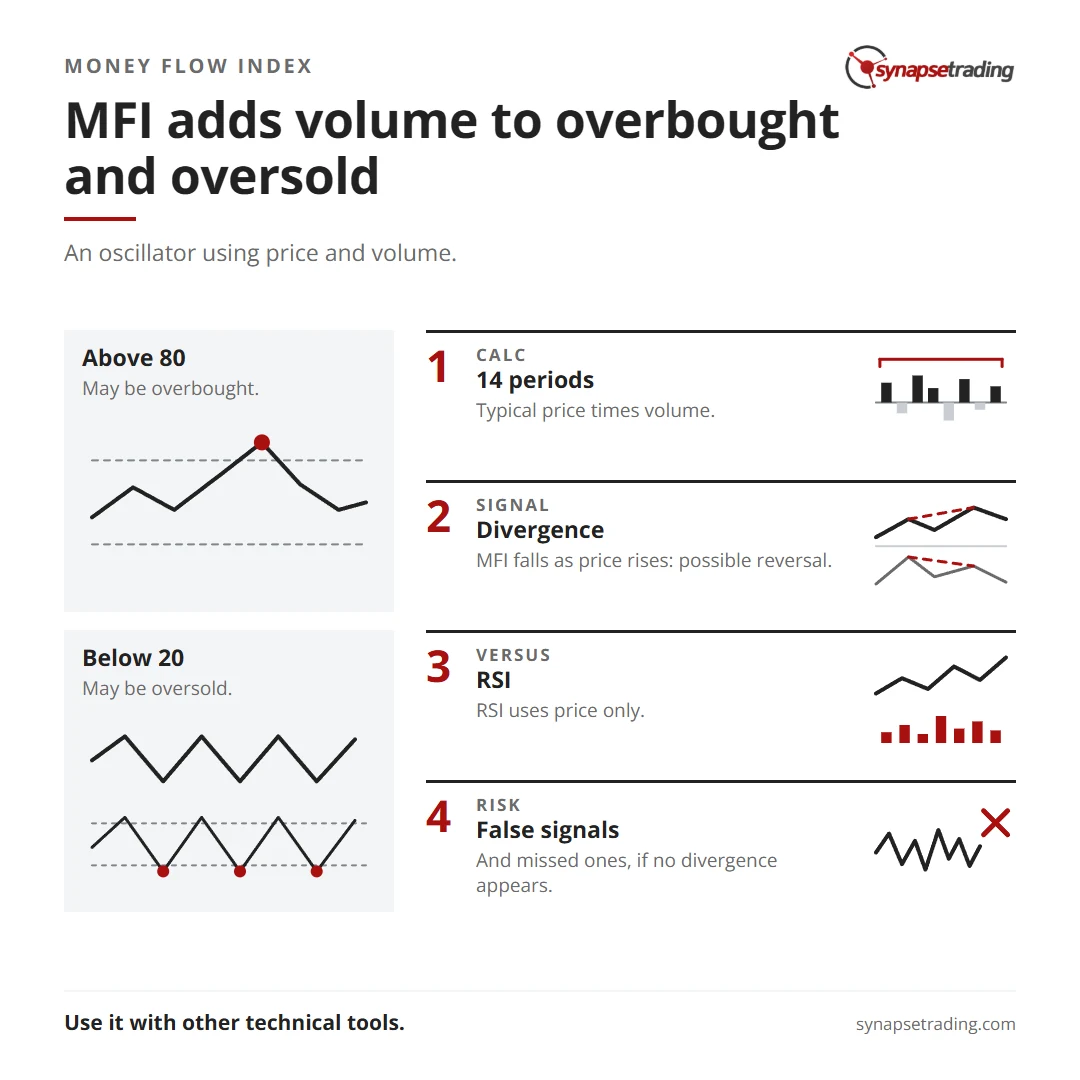
MFI adds volume to overbought and oversold. Summary card for the post: Money Flow Index (MFI) Indicator.

Table of Contents

Toggle
  • How to Calculate the Money Flow Index
  • What the Money Flow Index Tells You
  • Difference Between MFI and RSI
  • Limitations of the MFI
  • Concluding Thoughts

How to Calculate the Money Flow Index

  1. Calculate the typical price for each period.
  2. Determine if raw money flow is positive or negative by comparing the typical price of the current period with the previous period.
  3. Multiply the typical price by volume to calculate raw money flow.
  4. Add up positive and negative money flows over the past 14 periods to find the money flow ratio.
  5. Calculate the MFI using the money flow ratio.

What the Money Flow Index Tells You

  • Overbought and Oversold Signals: An MFI reading above 80 signals that an asset may be overbought, while a reading below 20 suggests it may be oversold. Traders may look for potential reversals after these signals.
  • Divergences: If the MFI moves in the opposite direction to the price, it may indicate a potential reversal. For instance, if the MFI declines while the price continues to rise, it could signal a bearish reversal.

Difference Between MFI and RSI

While the MFI incorporates volume into its calculation, the RSI only uses price data. This means that MFI might provide signals faster or more accurately in certain cases since volume is often viewed as a leading indicator.

Limitations of the MFI

  • False Signals: The MFI can generate false signals, indicating a potential trade that doesn’t result in the expected price movement.
  • Missed Signals: The MFI may not always indicate important market reversals, especially if divergences don’t appear.

Concluding Thoughts

The Money Flow Index (MFI) is a useful tool for traders looking to incorporate volume into their technical analysis.

By offering insights into overbought and oversold conditions, as well as potential divergences, the MFI can help traders spot trends and reversals.

However, like any indicator, it should be used in conjunction with other technical tools to reduce the risk of false signals and improve overall trading strategies.


Want the daily routine? Enter your email for the free 15-Minute Swing Trader's Checklist.

Free 5-page PDF, then occasional trading emails. Education only, not financial advice. Unsubscribe anytime. Kit stores your email in the US: see our privacy policy.

Want to learn the full method? The Trading Mastery Program teaches the 4 strategies I have traded since 2011. It suits beginners and experienced traders.

Rather follow the trades as they happen? Daily Trading Signals is our Telegram channel: my trade ideas with entry, stop and exit, and every trade is public.

Questions about this post? Ask in the free Telegram channel →

Educational content only, not personalised financial advice. Trading carries risk, including loss of capital. Past performance is not indicative of future results. Synapse Trading is not licensed or regulated by MAS.

Part of the Technical indicators guide · all posts on Technical Analysis & Price Action

← Previous: Chaikin Oscillator vs Chaikin Money Flow (CMF): How to Read Buying Pressure From VolumeNext: Volume Price Trend (VPT) Indicator →

More from this guide

  • Accumulation/Distribution (A/D) Indicator
  • Volume Rate of Change (V-ROC) Indicator
  • Ease of Movement Indicator
by The Synapse Network
Share this entry
  • Share on Facebook
  • Share on X
  • Share on WhatsApp
  • Share on Pinterest
  • Share on LinkedIn
  • Share on Tumblr
  • Share on Vk
  • Share on Reddit
  • Share by Mail
  • Visit us on Yelp
  • Link to Instagram
  • Link to Youtube
https://synapsetrading.com/wp-content/uploads/2026/10/money-flow-index-mfi-indicator-card.webp 630 1200 The Synapse Network https://synapsetrading.com/wp-content/uploads/2026/10/synapse-logo-horizontal-light.png The Synapse Network2023-09-16 01:16:072026-10-15 22:30:40Money Flow Index (MFI) Indicator

Free checklist

The 15-Minute Swing Trader’s Checklist

The daily and weekly routine I use to find, manage and review trades in about 15 minutes a day, trading since 2007.

Get the free checklist

Topics

  • Trading foundations
  • Technical analysis
  • Strategies and systems
  • Risk and money
  • Trading psychology
  • Markets and products

Synapse Trading

Swing trading for busy professionals, in 15 minutes a day.

Start free

Learn

  • Start here
  • Free trading guides
  • Blog
  • Tools and resources

Programs

  • Trading Mastery Program
  • Daily trading signals
  • Student results
  • Public trade log

Company

  • About
  • Contact me
  • Partnerships
  • Disclaimer
  • Privacy policy
  • Terms & Conditions

Synapse Trading Pte Ltd
Registration No. 201316168H
WhatsApp +65-8897-1204
info@synapsetrading.com

Contact Us

Synapse Trading Pte Ltd
Registration No. 201316168H

Whatsapp: +65-8897-1204
Telegram: @iamrecneps
Email: info@synapsetrading.com

Links

Disclaimer
Privacy policy
Terms & Conditions
Contact us
Partnerships

© 2012-2026 Synapse Trading | All rights reserved. Educational content only, not personalised financial advice. Trading carries risk, including loss of capital. Past performance is not indicative of future results. Synapse Trading is not licensed or regulated by MAS.
  • Link to Facebook
  • Link to X
  • Link to Instagram
  • Link to Youtube
  • Link to LinkedIn
  • Link to Mail
Link to: Chaikin Oscillator vs Chaikin Money Flow (CMF): How to Read Buying Pressure From Volume Link to: Chaikin Oscillator vs Chaikin Money Flow (CMF): How to Read Buying Pressure From Volume Chaikin Oscillator vs Chaikin Money Flow (CMF): How to Read Buying Pressure...
Reading Chaikin money flow - indicators
Link to: Volume Price Trend (VPT) Indicator Link to: Volume Price Trend (VPT) Indicator
Volume Price Trend explained - indicators
Volume Price Trend (VPT) Indicator
Scroll to top Scroll to top Scroll to top