

The Holy Grail of Trading: Why the Perfect System Doesn’t Exist, and What to Build Instead
Want the daily routine? Get the free 15-Minute Swing Trader’s Checklist. Get it free →
By Spencer Li, CFTe · Last updated: 26 October 2026
The holy grail of trading is the idea that somewhere out there sits one indicator, system, guru or piece of software that predicts the market and wins on every trade. It does not exist. Every method loses some of the time. The traders who do well pick one sound approach and stay with it long enough to get good at it, while everyone else keeps shopping for the next one.
I first wrote about this on the blog in May 2012, and the warning has aged better than most things I wrote that year. The tools have changed a lot since then. The hunt has not.
What do traders mean by the holy grail?
Ask a new trader what they are looking for, and the answer usually comes in one of a few familiar costumes. A “sure-win” indicator. A “100% win rate” system. A “legendary” guru. A “unique proprietary” piece of software that will make you rich while you sleep.
They look different, but they all make the same promise, which is that you can skip the slow part. You can have the results of a skilled trader without becoming one.
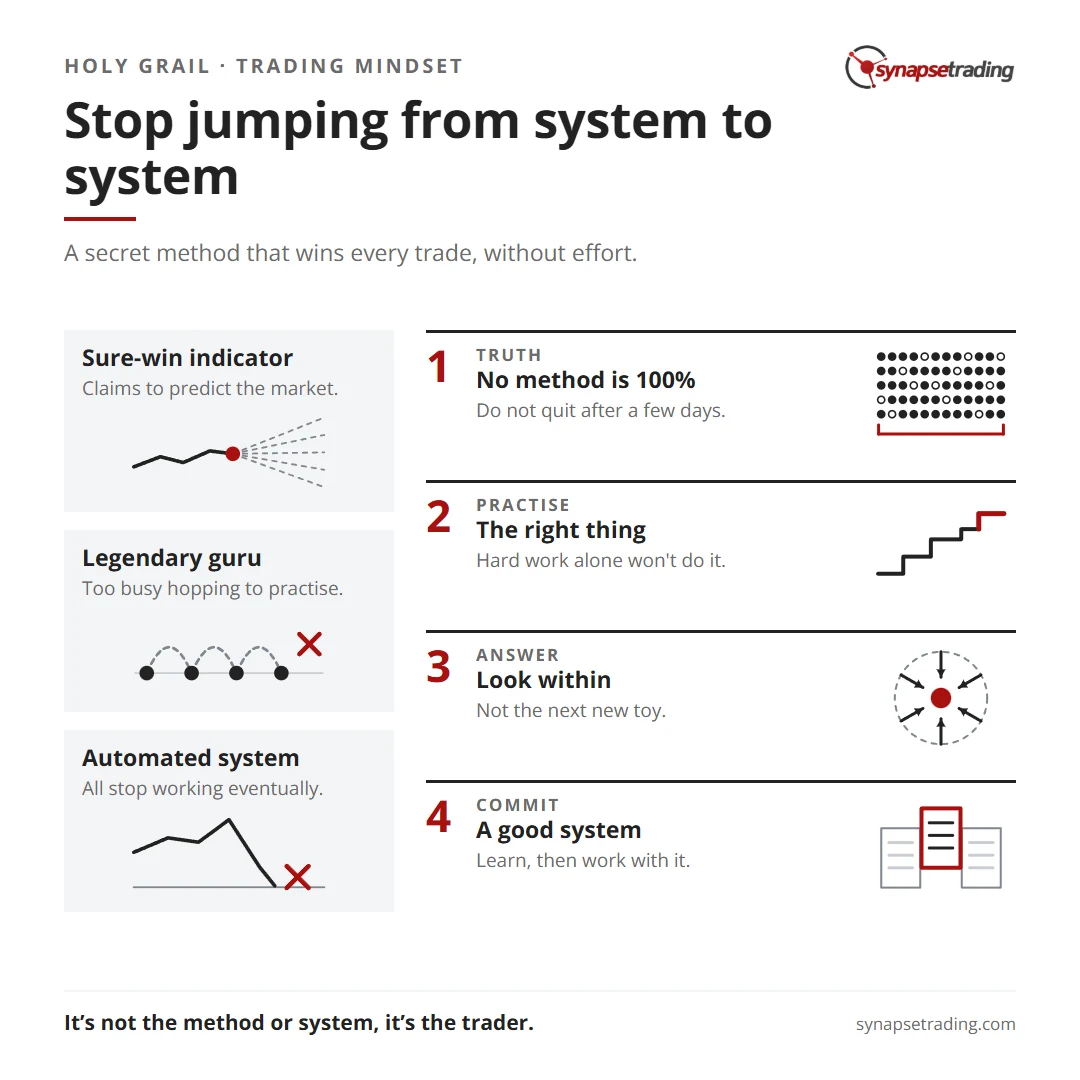
In 2012 I described what this does to people. They test a new method for a few days, find that it is not perfect, and skip off to find the next new toy, because they never realise that no method is 100%. The answer always feels so near, yet always slightly out of reach.
Alexander Elder saw the same thing from the other side of the desk. In his 2002 book Come Into My Trading Room, he describes a friend who tests trading systems for a living. This friend gets “at least one phone call a week” from an amateur who is sure they have found the Holy Grail, and whose main worry is that the programmer will steal it. In several years of testing, the number of profitable automatic systems his friend found was, in Elder’s words, “Not one.”
What can a 500-year-old legend teach us about the search?
The phrase comes from the Arthurian legend, and the original story is a lot darker than the way traders use it.
In Thomas Malory’s Le Morte d’Arthur, printed by Caxton in 1485, the Grail passes through Camelot’s hall at Pentecost, covered in white silk, and then vanishes. Sir Gawaine stands up and swears he will ride out the next morning and not come home until he has seen it properly. Most of the Round Table jump up and swear the same thing. When the king counts them the next day, they come to “an hundred and fifty”. Arthur does not cheer. He tells Gawaine he has “nigh slain” him, because he is sure many of them will die on the road.
He was right. When Lancelot finally rides home to Camelot, more than half of the knights of the Round Table have been “slain and destroyed”.
Only three of the hundred and fifty reach the Grail, and the one who comes closest without reaching it is the most interesting of the lot. Lancelot is the man the book calls “the best knight of the world”, and when he finally stands at the door of the Grail’s chamber, a voice tells him not to enter. He goes in anyway, gets struck down, and lies like a dead man for 24 days. Lancelot himself takes it as punishment for 24 years of sin, one day for each year. So whatever stopped him lived inside him rather than in his sword arm, and the quest exposed it.
The same thing happens in trading. The search rewards a quality in the person that no amount of riding around can buy, and plenty of very capable people spend years on the road without ever looking at what they carry with them.
Why does chasing the holy grail keep traders stuck?
John Carter, in his 2006 book Mastering the Trade, maps out how a new trader’s thinking slides into the hunt. When the entries are bad, the trader decides the indicators must be bad, so they go looking for better ones. “And thus begins the search for the Holy Grail.” In that phase, he writes, development as a trader is “dead in the water”. Nothing gets practised long enough to be learned.
The chaser is rarely lazy. In 2012 I wrote that plenty of them think hard work can solve everything, and that with enough time the skill will simply arrive. They read, they attend every seminar, they rebuild their charts every weekend, and they still end the year with no skill they could name. Hard work aimed at the wrong thing does not compound. It just piles up as hope, then regret, then a new subscription.
Elder has an image for this that is hard to beat. A trader who is afraid to trade, he says, can always hide behind learning new software. He is “like a swimmer who is afraid of water and keeps himself busy ironing his swimsuit.”
That fear is worth naming, because the hunt feels like progress. A new system arrives with all the relief of a fresh start, and none of the risk of finding out whether you can follow the last one.
If you trade around a full-time job, the cure is less screen time on the hunt and more on one routine, and my free 15-minute swing trader checklist is the one I use myself.
Is it the trader or the method?
My 2012 post ended on a single quoted line that put the whole weight on the trader rather than on the method or the system. That line still sits on this page today, and it has its critics.
In April 2026, a trader on Reddit’s r/Daytrading put it bluntly: “Trading psychology is the ‘Have you tried rice?’ of trading”. Their point was that blaming psychology has become the lazy answer to every problem, and that reading a live chart, where nothing is labelled for you, is genuinely hard.
They have a fair point, and my own advice in 2012 quietly agreed with them. It told readers to find “a good system” and work with it, and the word “good” was carrying a lot of weight in that sentence. Discipline applied to a broken method only lets you lose money more consistently.
Elder’s account makes the same split. The people who kept his friend’s testing business alive were successful professionals who brought in “snippets” of method, such as stop settings or indicator lengths, and then used their own judgment to bind those snippets together. So the method matters, but it is the raw material. The trader is the one who has to decide what to do with it on a Tuesday afternoon when the chart looks nothing like the textbook.
Jack Schwager reached a similar place after interviewing fifteen hedge fund managers for his 2012 book Hedge Fund Market Wizards. The first of his 40 lessons is that there is no holy grail, because the methods that worked were in places exact opposites of each other. Colm O’Shea, one of the traders in the book, put the reason plainly: “If I try to teach you what I do, you will fail because you are not me.”
What should you do instead of searching?
In 2012 I had read at least 200 books and tried almost every method and tool I could find before the penny dropped. The book count is past 1,500 now, and the conclusion has not moved. To find the holy grail, you have to look within, and the first step is to throw out the idea that it is waiting in the next course.
After that, the job is fairly unglamorous.
- Learn how price actually moves. Trends, ranges, support and resistance, and why a market behaves differently in each, are worth more than any single indicator.
- Pick one sound system that fits how you think. It has to be complete, with rules for getting in, getting out and how much to risk, and it has to suit your temperament and your hours. If you need a map of the main families first, my post on the 4 types of trading strategies lays them out.
- Give it enough trades to judge. A handful of losses tells you almost nothing about a method. I ask for 100 to 200 trades before judging a system.
- Refine the system instead of replacing it. Review your trades, fix what breaks, and keep the core intact.
Suppose you did only this for a year. You would end it with a written record of how one method behaves in your hands, which is more than most system hoppers have after five. If the inner side of that work interests you, my guide to trading psychology goes deeper, and the long game behind it is in my post on long-term consistency in trading.
Staying with one system is mostly a habit, and habits are easier to keep with a routine. The free 15-minute swing trader checklist is the one I run every day.

If you would like to learn how to get started in trading, also check out: “The Beginner’s Guide to Trading & Technical Analysis”
FAQ
Does the holy grail of trading exist?
No. No indicator, system, guru or software wins on every trade. What comes closest is a trader’s own skill with one sound method, and that is built through practice rather than bought.
Why do so many new traders keep switching strategies?
Because every method has losing streaks, and a new method always looks better than the one that just lost. Switching feels like progress while it quietly resets the learning to zero.
Can an automated system be a holy grail?
In Elder’s account, a friend who tested systems professionally for several years found no profitable fully automatic system. Automation can run rules faster than a person, but someone still has to choose the rules and decide when they no longer fit the market.
Is it the method or the trader that makes money?
Both matter. You need a sound method first, and from there the results depend on how consistently the trader applies it.
How many trades should I take before judging a system?
I ask for 100 to 200 trades. Fewer than that, and a run of bad luck can look exactly like a broken system.
Have you ever caught yourself ironing your swimsuit, and which new toy was it? Let me know in the comments.
If you want a place to start that is not another shiny tool, my free trading guides collect the basics in one place.
And if you would rather spend 15 minutes a day on one routine than hours on the hunt, grab the free 15-minute swing trader checklist.
About the author. Spencer Li is The 15-Minute Trader and the founder of Synapse Trading. He is a Certified Financial Technician (CFTe) with 15+ years of trading, run from 70+ countries. He holds a B.Acc and B.BM from SMU. Every trade he takes is public, dated, losses left in. He teaches rules-based swing trading in 15 minutes a day, one system for any market.
Education, not financial advice. Synapse Trading is not licensed by MAS to advise on investment products. Trading carries risk of loss, and past performance is not indicative of future results.
Want the daily routine? Enter your email for the free 15-Minute Swing Trader's Checklist.
Free 5-page PDF, then occasional trading emails. Education only, not financial advice. Unsubscribe anytime. Kit stores your email in the US: see our privacy policy.
Want to learn the full method? The Trading Mastery Program teaches the 4 strategies I have traded since 2011. It suits beginners and experienced traders.
Rather follow the trades as they happen? Daily Trading Signals is our Telegram channel: my trade ideas with entry, stop and exit, and every trade is public.
Questions about this post? Ask in the free Telegram channel →
Educational content only, not personalised financial advice. Trading carries risk, including loss of capital. Past performance is not indicative of future results. Synapse Trading is not licensed or regulated by MAS.


Comments are closed.